

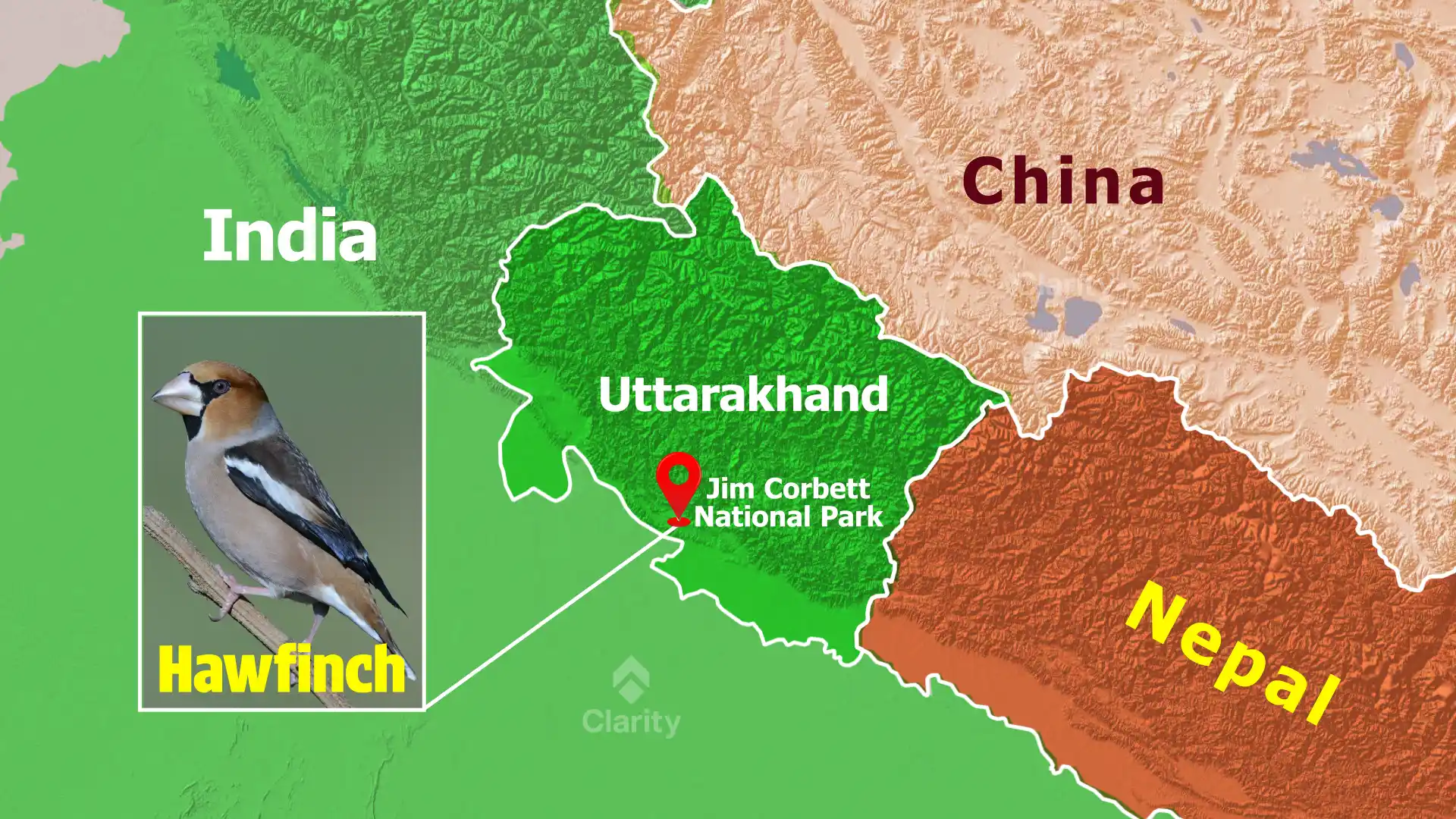
Why in news?
A rare sighting of a hawfinch was reported in Jim Corbett National Park, Uttarakhand. Birdwatchers spotted the heavy‑billed finch, typically native to Europe, north Africa and parts of Asia, feeding on berries in the park’s forest. Such sightings in India are unusual and have excited ornithologists.
Background
The hawfinch (Coccothraustes coccothraustes) is the largest member of the finch family. This stocky bird is about 18 cm long with a 29–33 cm wingspan. It has a thick neck, large round head and exceptionally powerful conical beak, which allows it to crack hard seeds and cherry stones that other birds cannot manage. Both sexes look similar, with warm brown plumage, an orange wash on the head and dark cheeks. The species breeds across Europe and extends east through the Palearctic to Japan; small populations winter in north Africa.
Distribution and habitat
- Range: Hawfinches breed in deciduous and mixed forests across Europe, western and central Asia, and north Africa. Many birds in Asia migrate south in winter, occasionally wandering into the Indian subcontinent.
- Habitats: They favour broad‑leaved woodlands, orchards, parks and streamside vegetation. They often forage high in the canopy and may visit gardens in winter when food is scarce.
Why is the Jim Corbett sighting notable?
- Vagrant appearance: Hawfinches rarely stray so far south. Only a handful of records exist for India, making this observation noteworthy for birdwatchers.
- Rich biodiversity of Jim Corbett: The national park, India’s oldest (established in 1936), covers over 520 square kilometres of moist deciduous forest, grassland and riverine habitat. It supports more than 600 bird species as well as Bengal tigers, Asian elephants and leopards. The Ramganga, Sonanadi, Palain and Mandal rivers nourish the park, while the Kosi River forms its eastern boundary.
Ecological significance
- Seed disperser: By cracking and consuming hard seeds and kernels, hawfinches help disperse tree species such as hornbeam, cherry and yew.
- Indicator species: Their presence signals healthy mature woodland because hawfinches depend on large trees and low disturbance to breed.
Source: Hindustan Times