
Why in news?
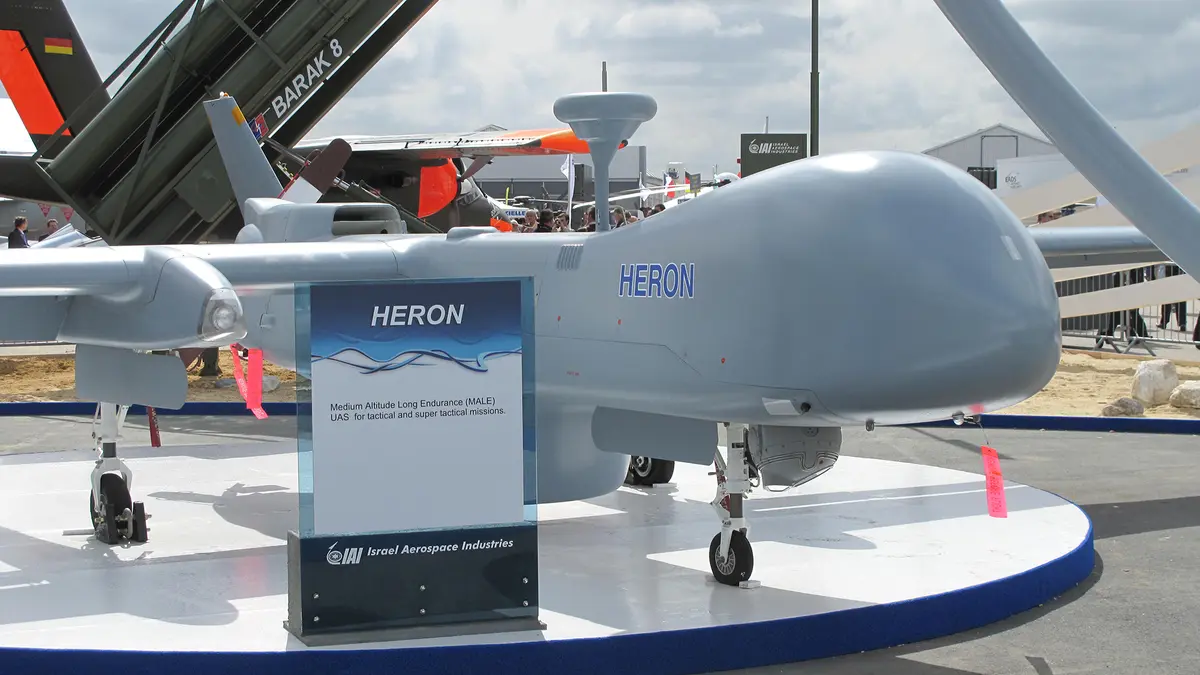
India has decided to procure additional Heron Mk II unmanned aerial vehicles (UAVs) from Israel to strengthen intelligence, surveillance and reconnaissance (ISR) capabilities. The decision follows the drones’ successful deployment during Operation Sindoor earlier in 2025. Under emergency procurement rules, the Army, Navy and Air Force will receive these long‑endurance aircraft, while a separate tri‑service programme aims to build a larger fleet under the Make‑in‑India initiative.
Background
The Heron Mk II is a medium‑altitude long‑endurance (MALE) unmanned aerial system developed by Israel Aerospace Industries. It is an upgraded version of the widely used Heron UAV. The Mk II measures about 8.5 m in length, has a wingspan of 16.6 m and a maximum take‑off weight of around 1,430 kg. It can carry a payload of roughly 490 kg on its under‑fuselage and wing stations. With endurance of up to 45 hours and a service ceiling of about 35,000 ft, the UAV provides continuous, wide‑area surveillance. It cruises at roughly 150 knots (around 280 km/h) and can operate beyond line of sight via satellite communications. Automatic take‑off and landing systems and improved avionics make it reliable in difficult weather conditions.
Key features and uses
- Multi‑sensor payload: The Heron Mk II can carry electro‑optical and infrared cameras, synthetic aperture radar, maritime patrol radar and signals intelligence receivers. These sensors provide high‑resolution imagery and real‑time video for intelligence gathering.
- Long endurance: Up to 45 hours of flight allows the platform to loiter over a target area for extended periods, making it ideal for border surveillance, maritime patrol and monitoring of critical infrastructure.
- Beyond‑line‑of‑sight communication: Satellite‑based control links enable operators to fly the aircraft hundreds of kilometres from its base, enhancing situational awareness across vast distances.
- Tri‑service procurement: All three services placed orders under emergency provisions. A larger programme, worth over ₹20,000 crore, aims to acquire 87 medium‑altitude long‑endurance drones through Indian companies in partnership with foreign manufacturers. The procurement will be split between two domestic vendors, with at least 60 per cent indigenous content.
- Operational roles: The Army will deploy the Heron Mk II to monitor the Line of Actual Control and counter insurgency in border states; the Navy will use it for maritime domain awareness and anti‑piracy patrols; and the Air Force will employ it for airspace monitoring, target acquisition and communications relay. The platform’s endurance and high‑altitude performance make it versatile across services.
Significance
The acquisition of the Heron Mk II reflects India’s growing emphasis on unmanned systems for persistent surveillance and precision targeting. It enhances the military’s ability to monitor remote frontiers without risking pilot lives. The tri‑service programme’s focus on domestic manufacturing can spur the indigenous drone industry and reduce dependency on imports. As India faces evolving security challenges, integrating advanced UAVs like the Heron Mk II into its force structure will improve situational awareness and response time.
Source: TH

