
Why in news?
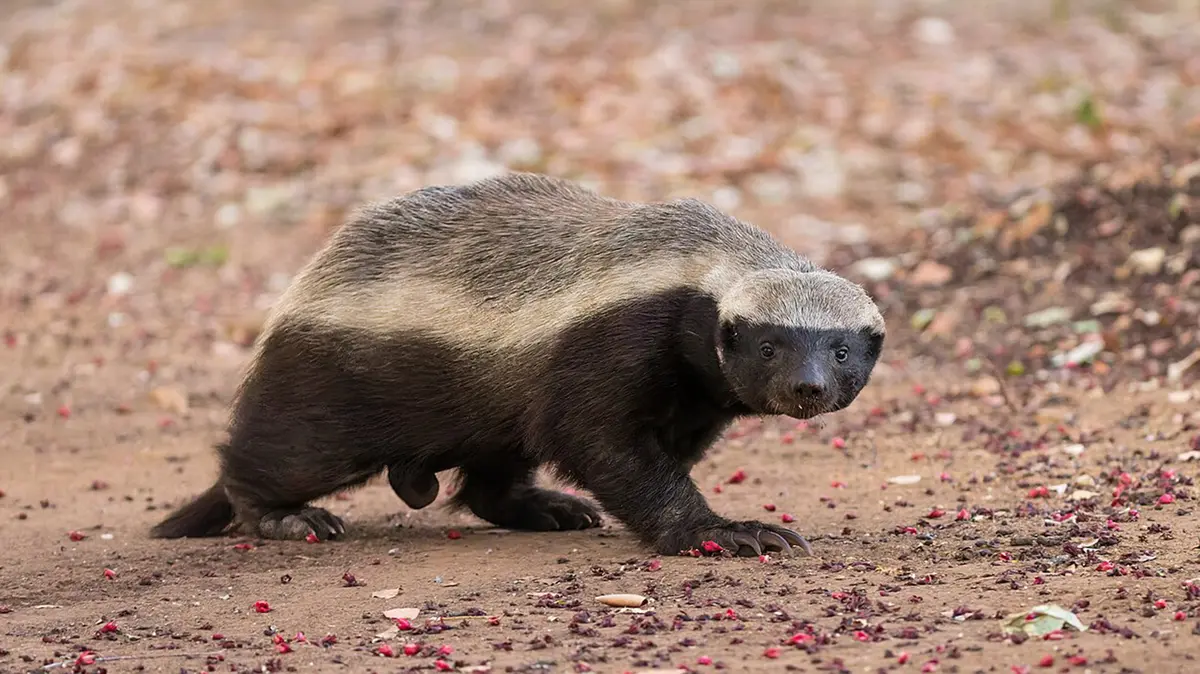
The Dewas forest department of Madhya Pradesh confirmed the presence of the elusive honey badger (also called ratel) in the Kheoni Wildlife Sanctuary after a pair was recorded on CCTV cameras. The sighting highlights the ecological recovery of the sanctuary and draws attention to the conservation status of this rarely seen mammal.
Background
The honey badger (Mellivora capensis) is a stocky carnivore belonging to the weasel family (Mustelidae). It has a body length of about 60–70 centimetres and weighs between 8 and 12 kilograms. The species is characterised by a dark black body with a contrasting grey or white “mantle” running from the head to the base of the tail. Its thick, loose skin and powerful musculature make it extremely resilient; the loose skin allows the animal to twist and bite even when held by a predator. Honey badgers inhabit a wide range of habitats, from forests and grasslands to arid steppes and rocky hills, across sub‑Saharan Africa, the Arabian peninsula, India and parts of Central Asia. They are omnivorous, eating insects, small mammals, birds, reptiles and fruit, and are known for their fearless and tenacious nature.
Details of the Kheoni sighting
- Fearless creatures: According to sanctuary officials, honey badgers have a dense hide and strong muscles that enable them to defend themselves against larger predators such as tigers and leopards. The local name ‘qabar bijju’ reflects the belief that the animal is fearless even when faced with formidable opponents.
- Legal protection: Globally, honey badgers are classified as “Least Concern” on the IUCN Red List because of their wide distribution. In India they are afforded the highest level of legal protection under Schedule I of the Wildlife (Protection) Act, 1972, placing them on par with tigers and elephants.
- Indicator of habitat health: The sighting underscores the improved condition of the Kheoni Wildlife Sanctuary. Once a little‑known patch of forest, the sanctuary has become a thriving corridor for wildlife due to habitat management and anti‑poaching efforts. Rising numbers of tigers, leopards, deer and wild boar signal a robust food chain that supports rare species like the honey badger.
Conservation significance
- Awareness and research: Honey badgers are generally solitary and nocturnal, making them hard to study. Documenting their presence helps scientists understand their distribution and behaviour in India.
- Habitat connectivity: Protecting wildlife corridors such as Kheoni ensures that animals can move between larger reserves like Pench and Satpura. Such connectivity is essential for genetic diversity and long‑term species survival.
- Community participation: Engaging local communities in wildlife protection, eco‑tourism and reporting sightings can generate support for conservation. People living near the sanctuary benefit from sustainable livelihoods and education programmes that accompany conservation initiatives.
Source: Times of India

