

Why in news?
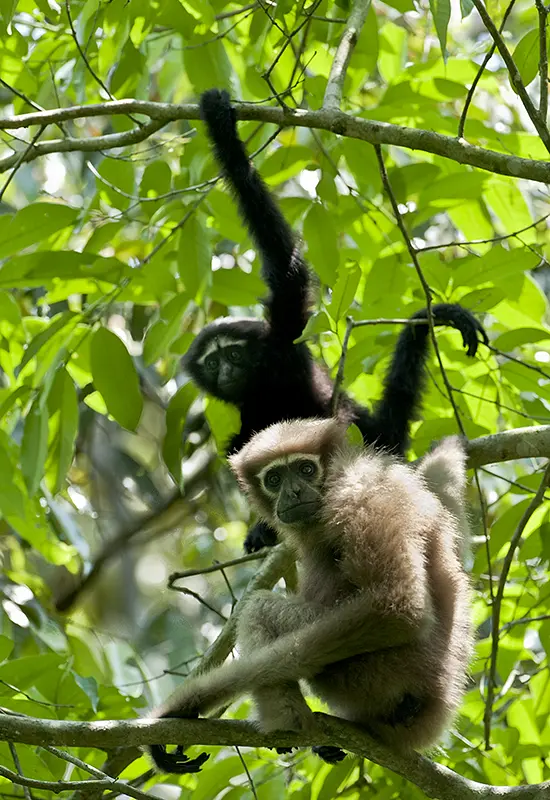
Wildlife officials and volunteers in Arunachal Pradesh recently rescued a family of hoolock gibbons that had been trapped on a lone tree due to fragmented forest canopy. After a four‑day operation, an adult male, an adult female and their juvenile were safely relocated to Mehao Wildlife Sanctuary. The incident highlights the challenges posed by habitat fragmentation to India’s only apes.
Background
Hoolock gibbons are the only apes native to India. Two species exist: the western hoolock gibbon (Hoolock hoolock) found across northeast India, eastern Bangladesh and north‑west Myanmar, and the eastern hoolock gibbon (Hoolock leuconedys) inhabiting parts of Arunachal Pradesh, Assam, Myanmar and southern China. The western species is listed as Endangered on the IUCN Red List, while the eastern species is Vulnerable.
Ecology and threats
- Hoolock gibbons are strictly arboreal and move by brachiation—swinging beneath branches at speeds up to fifty‑five kilometres per hour.
- They are frugivorous, consuming fruits, leaves and flowers. Mated pairs live in small family groups and defend territories with loud duets.
- Populations have declined by around ninety percent over the past half‑century due to deforestation, habitat fragmentation, hunting and infrastructure projects.
- The species is protected under Schedule I of India’s Wildlife (Protection) Act, 1972, and is included in Appendix I of CITES.
Conservation efforts include the creation of the Hollongapar Gibbon Wildlife Sanctuary in Assam and community‑based programmes to preserve canopy connectivity. The recent rescue operation involved training forest personnel to climb ropes and safely handle the apes. Experts stressed that restoring continuous tree cover is essential so gibbons can move freely, find food and maintain genetic diversity.
Source: The Print