Why in news?
The United Nations Development Programme’s Human Development Report 2024/25 released in early 2026 ranked India 130th out of 193 countries with a human development value of 0.685 for 2023. This is a modest improvement from the 0.676 recorded in 2022 and reflects gains in life expectancy and average years of schooling. The report also noted that inequality reduced India’s overall score by nearly one‑third, underscoring persistent disparities.
Background
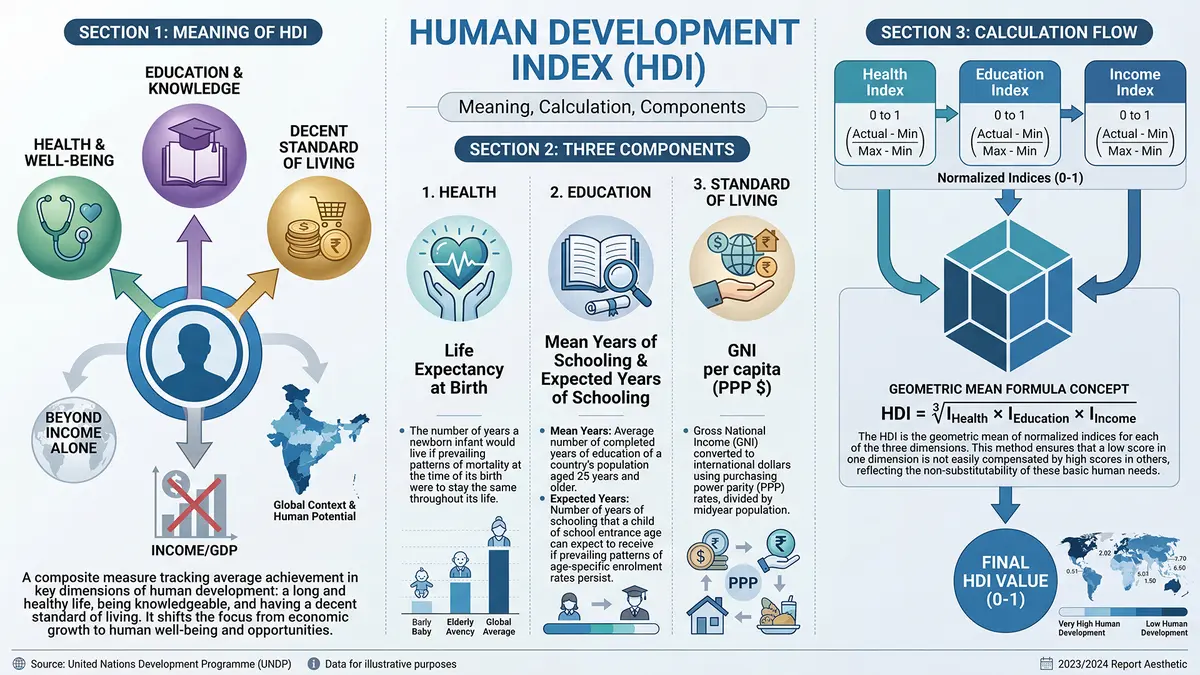
The Human Development Index was introduced in 1990 by economist Mahbub ul Haq, with inputs from Amartya Sen, to measure development from a people‑centric perspective rather than solely by economic growth. The index combines achievements in three dimensions: a long and healthy life (measured by life expectancy at birth), knowledge (mean years of schooling for adults and expected years of schooling for children) and a decent standard of living (gross national income per capita, adjusted for purchasing power). Each dimension is normalised on a scale of 0 to 1, and their geometric mean gives the overall HDI. Countries are classified as having very high (≥ 0.800), high (0.700–0.799), medium (0.550–0.699) or low (< 0.550) human development. Although widely used, the HDI does not capture inequality, poverty, empowerment or environmental sustainability.
India’s performance
- Score and ranking: India’s HDI value rose to 0.685 in 2023, placing it in the ‘medium human development’ category at 130th position.
- Life expectancy: Average life expectancy at birth increased to about 72 years, helped by improvements in public health and vaccination programmes.
- Education indicators: Mean years of schooling rose gradually, while expected years of schooling reached around 12.9 years, reflecting expanding access to primary and secondary education.
- Income: Gross national income per capita improved but remains below the global average; growing inequalities mean that benefits are unevenly distributed.
- Inequality‑adjusted HDI: When adjusted for disparities in health, education and income, India’s HDI falls by about 30.7 percent, highlighting regional and gender gaps.
Significance and limitations
- Policy tool: The HDI allows comparisons across countries and over time, guiding governments to focus on human wellbeing rather than only economic output.
- Broad perspective: By combining health, education and income, the index encourages balanced development strategies.
- Limitations: The HDI does not capture wealth distribution, quality of education, gender equality, environmental sustainability or human rights. High correlations among its components also mean that the index can mask complex realities.
Conclusion
India’s gradual improvement on the Human Development Index shows progress, yet the country still faces challenges in ensuring that gains reach all citizens. Policymakers need to address inequality, environment and social justice while continuing to expand healthcare and education.
Source: UNDP India · UN Human Development Reports · Investopedia