Why in news?
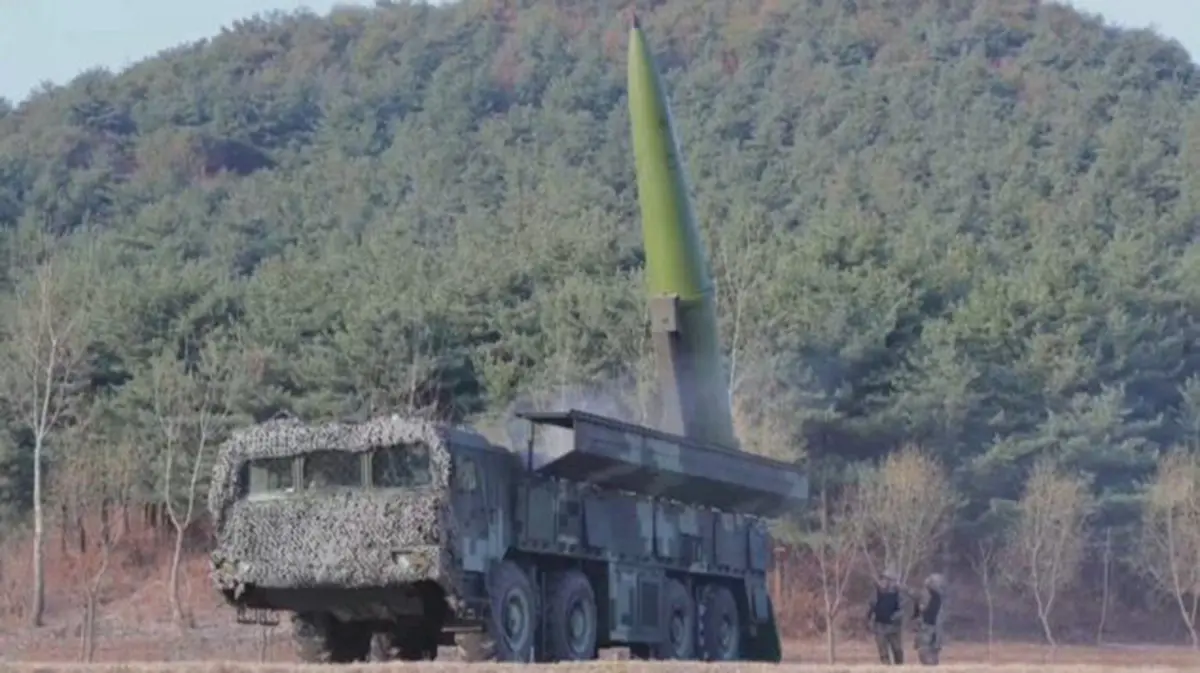
North Korea conducted a series of weapons tests in early April 2026, including the launch of a Hwasong‑11Ga short‑range ballistic missile fitted with a cluster munition warhead. State media boasted that the cluster warhead could devastate an area the size of 16 to 17 acres, raising concerns about the destructive power and indiscriminate nature of such weapons.
Background
The Hwasong‑11Ga, also known by the Western designation KN‑23, is a single‑stage, solid‑fuel ballistic missile developed by North Korea. Unveiled in 2018 and test‑fired in 2019, it resembles the Russian Iskander‑M missile and flies on a quasi‑ballistic trajectory. Analysts estimate its range at roughly 600 to 700 kilometres when carrying a 500‑kilogram warhead, making it capable of striking targets throughout the Korean Peninsula. The missile can be launched from road‑mobile or rail‑borne platforms, enhancing its survivability.
Technical features
- Dimensions: Approximately 7.3 metres long and about 0.9 metres in diameter, the missile is larger than earlier North Korean SRBMs and can carry warheads up to 500 kilograms.
- Solid‑fuel propulsion: Using solid composite propellant allows for rapid launch with minimal preparation time compared to liquid‑fuel missiles.
- Guidance and accuracy: It employs inertial navigation and possibly satellite guidance, giving it a circular error probable (CEP) as low as 35 to 200 metres.
- Warhead options: The missile can deliver conventional, chemical or nuclear warheads. The recent test featured a cluster munition warhead that disperses many small bomblets over a wide area.
Cluster munitions – the ‘devil’s weapon’
- Wide dispersal: Cluster munitions release dozens to hundreds of smaller submunitions mid‑air, saturating a large area. This makes them effective against dispersed targets but also indiscriminate.
- Civilian harm: Submunitions often fail to explode on impact, remaining as unexploded ordnance that can kill or injure civilians long after hostilities have ended.
- International stigma: More than 100 countries have ratified the Convention on Cluster Munitions banning their use, though major powers such as the United States, Russia and China have not. North Korea’s use of cluster warheads heightens regional tensions and raises humanitarian concerns.
Significance
- Threat to regional security: The Hwasong‑11Ga’s combination of solid‑fuel mobility and high precision poses a challenge to missile defence systems in South Korea and Japan.
- Arms escalation: Developing cluster‑armed ballistic missiles signals North Korea’s focus on battlefield lethality and area denial, potentially provoking an arms race in the region.
- Humanitarian implications: The indiscriminate nature of cluster munitions underscores calls for global adherence to the cluster munitions convention and for diplomatic efforts to curb North Korea’s weapons programmes.
Conclusion
The latest missile tests underscore the evolving sophistication of North Korea’s arsenal. International pressure and multilateral dialogue remain essential to prevent escalation and to address the humanitarian risks posed by weapons such as cluster munitions.