Why in news?
Austrian Chancellor Christian Stocker paid an official visit to India on 16 April 2026. He met Prime Minister Narendra Modi and the two leaders signed a series of agreements spanning defence, trade, investment, culture and education. The visit marks a resurgence of high‑level engagement between the two countries and aims to deepen bilateral cooperation.
Background
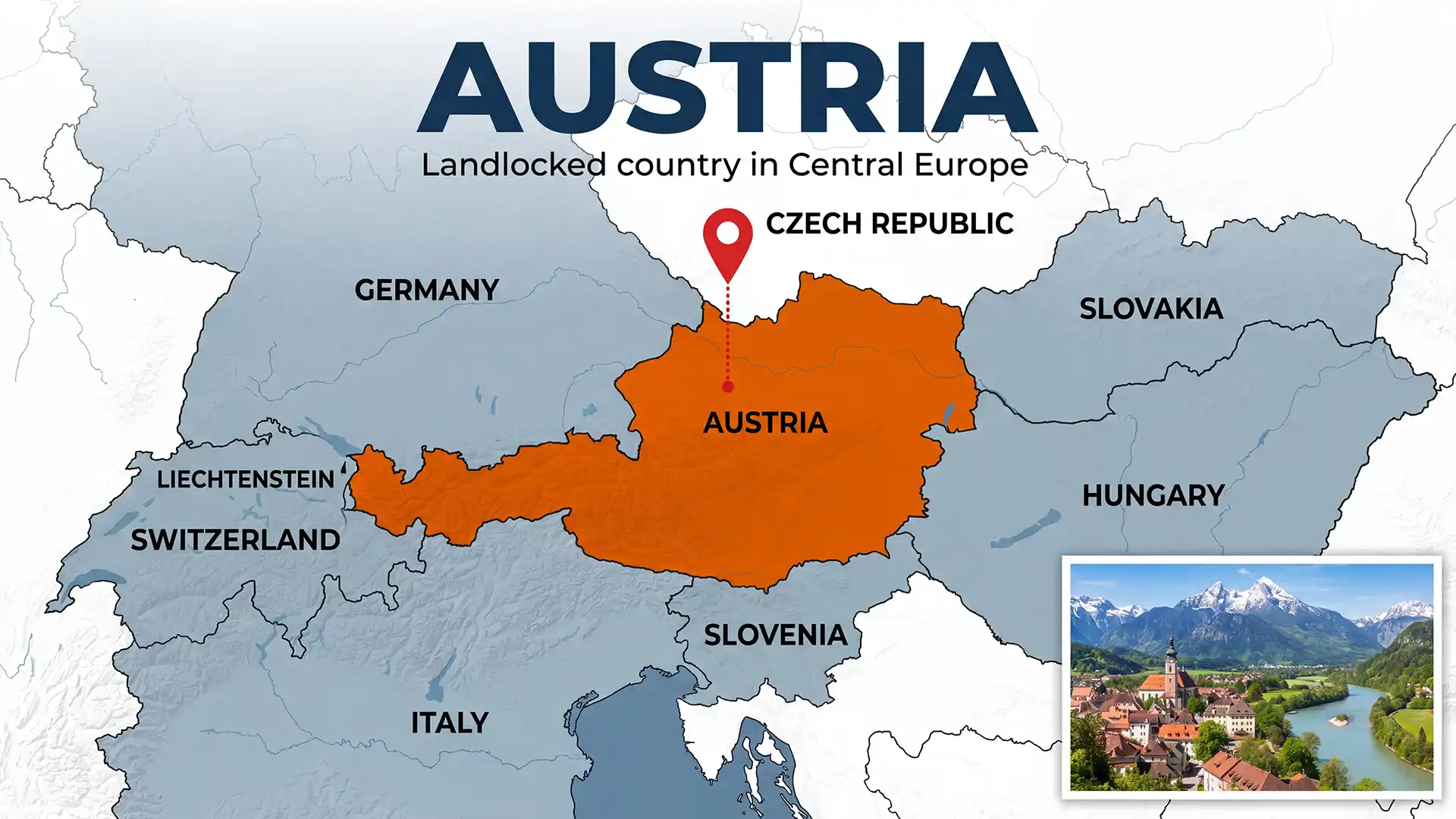
Austria is a landlocked country in central Europe. Covering about 84 thousand square kilometres, it is bordered by eight countries, including Germany, Italy, Switzerland and Hungary. Roughly 70 percent of its territory is mountainous, dominated by the Eastern Alps. The capital, Vienna, sits on the Danube River and is known for its classical music heritage and well‑preserved architecture. Austria was once part of the powerful Austro‑Hungarian Empire. After the First World War it became a republic, was annexed by Nazi Germany in 1938 and regained independence in 1955, adopting a policy of permanent neutrality. Today Austria is a prosperous federal parliamentary republic with a highly developed economy and strong social welfare system.
Key agreements signed
- Defence cooperation: The two sides signed a letter of intent to explore collaboration in the defence sector, covering research, technology sharing and potential joint production.
- Investment facilitation: A fast‑track mechanism was established to address issues faced by Austrian investors in India and to encourage new investments.
- Film and media production: An audio‑visual co‑production agreement will allow filmmakers from both countries to jointly produce movies and television programmes, promoting cultural exchange.
- Food safety and standards: India’s Food Safety and Standards Authority (FSSAI) signed a memorandum of understanding with Austria’s food safety agency to share best practices and build capacity in laboratory testing.
- Space and high‑technology cooperation: A joint statement outlined cooperation in satellite navigation, remote sensing and high‑tech research and development, including renewable energy and advanced materials.
- Cybersecurity and law enforcement: The two governments agreed to hold regular cyber‑dialogue and enhance cooperation on counter‑terrorism and transnational crime.
- Education and youth exchange: A working‑holiday programme will allow young people to live and work in each other’s country for up to a year, and both sides agreed to increase academic exchanges and vocational training.
- Infrastructure development: India and Austria will cooperate on road construction technologies and share expertise in avalanche protection and tunnelling in mountainous regions.
Significance
- The agreements reflect India’s efforts to diversify its partnerships in Europe beyond its traditional focus on larger economies.
- Defence and high‑tech cooperation will support Make‑in‑India initiatives and help Austrian firms access one of the world’s largest markets.
- Cultural and educational exchanges will strengthen people‑to‑people links, while the working‑holiday scheme offers new opportunities for young professionals.
- The visit underscores Austria’s recognition of India as an important partner in the Indo‑Pacific and as a growing economic power.
Conclusion
The India–Austria summit goes beyond symbolic gestures, creating a framework for substantive cooperation in defence, investment, technology and culture. If these agreements are implemented effectively, they can open new avenues for trade and innovation while bringing the two societies closer together.