

Why in news?
A recent census in Debrigarh Wildlife Sanctuary in Odisha counted 848 Indian bison, locally known as gaurs, showing a 28 percent increase compared with the previous year. The survey, conducted in January 2026, recorded 235 juveniles and attributed the rise to better habitat management, village relocation and the creation of grass‑dominated meadows.
Background
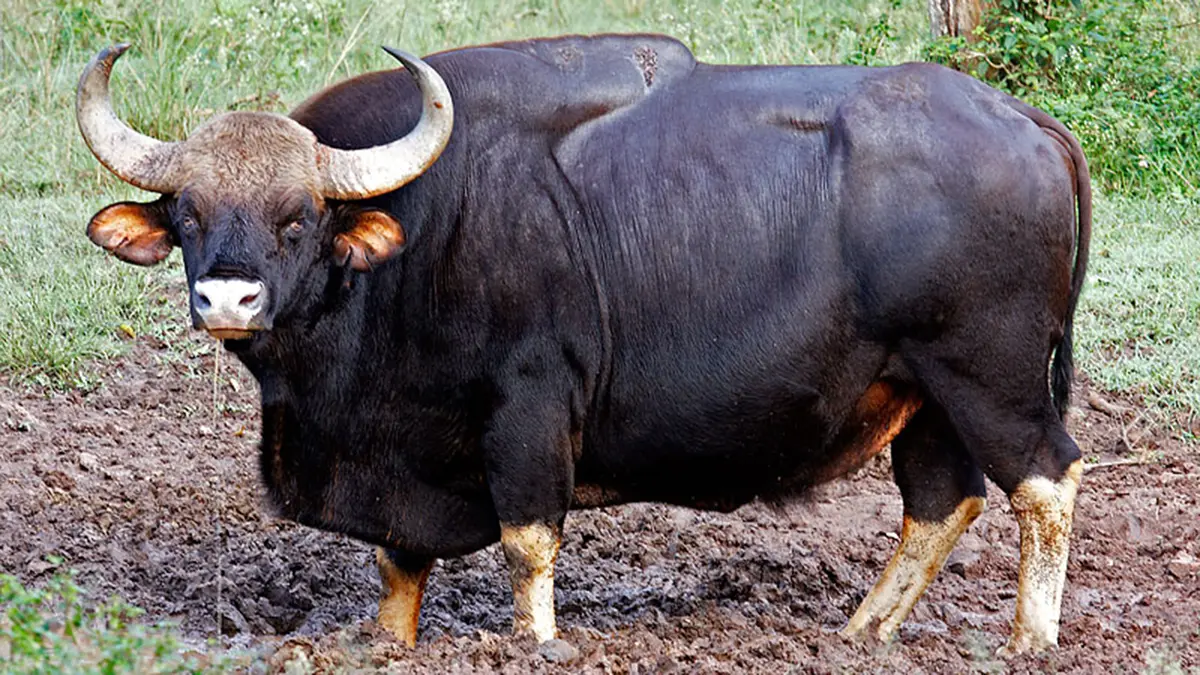
The gaur (Bos gaurus) is the largest wild cattle species in the world and is often called the Indian bison. Males can weigh 600–1,500 kilograms and stand up to 2.2 metres tall at the shoulder, while females are slightly smaller. These massive herbivores have a deep body, a prominent hump over their shoulders and a dewlap of skin hanging from the neck. Their coat ranges from reddish‑brown to dark brown or black; legs are lighter, giving the appearance of white “stockings”. Both sexes carry upward‑curving horns with a pale base and black tip.
Distribution and ecology
- Range: Gaurs are native to South and Southeast Asia. They inhabit forested hills and moist deciduous or evergreen forests across India, Nepal, Bhutan, Bangladesh, Myanmar, Thailand, Laos, Cambodia, Vietnam, Malaysia and parts of southern China.
- Habitat: These bovines prefer large, undisturbed tracts of forest with plenty of water and forage. They graze on grasses and browse on leaves, bamboo, shrubs and tree bark. Gaurs form herds of around 8–11 animals, led by females and accompanied by a dominant bull. Males may form bachelor groups or live alone.
- Behaviour: Gaurs are mainly diurnal but may become nocturnal near human settlements. When threatened, a gaur bull will lower its head and charge sideways with its horns. Their resonant whistles serve as alarm calls.
- Reproduction: Mating occurs year‑round with a peak between December and June. Females give birth to a single calf after a gestation of about 270–280 days. Calves stay with the mother for nine months and reach maturity at 2–3 years.
Conservation status and threats
The International Union for Conservation of Nature (IUCN) lists the gaur as Vulnerable. Major threats include habitat loss due to deforestation and agricultural expansion, fragmentation of populations, disease transmission from domestic cattle and poaching for meat and trophies. Conservation programmes focus on creating and connecting protected areas, controlling disease and monitoring populations.
Debrigarh census highlights
- Debrigarh Wildlife Sanctuary recorded 848 gaurs in its January 2026 census, up from 659 the previous year – a 28 percent increase.
- The census covered 73 units using direct sighting and camera traps. Counts indicated 444 individuals in the Kamgaon range and 404 in the Lakhanpur range.
- Officials attribute the rise to relocation of villages outside the sanctuary, improved grassland management and protection from poaching. The presence of 235 juveniles suggests healthy breeding.
- Regular monitoring and habitat restoration are planned to ensure continued growth and long‑term viability of the gaur population.
Sources: The New Indian Express