

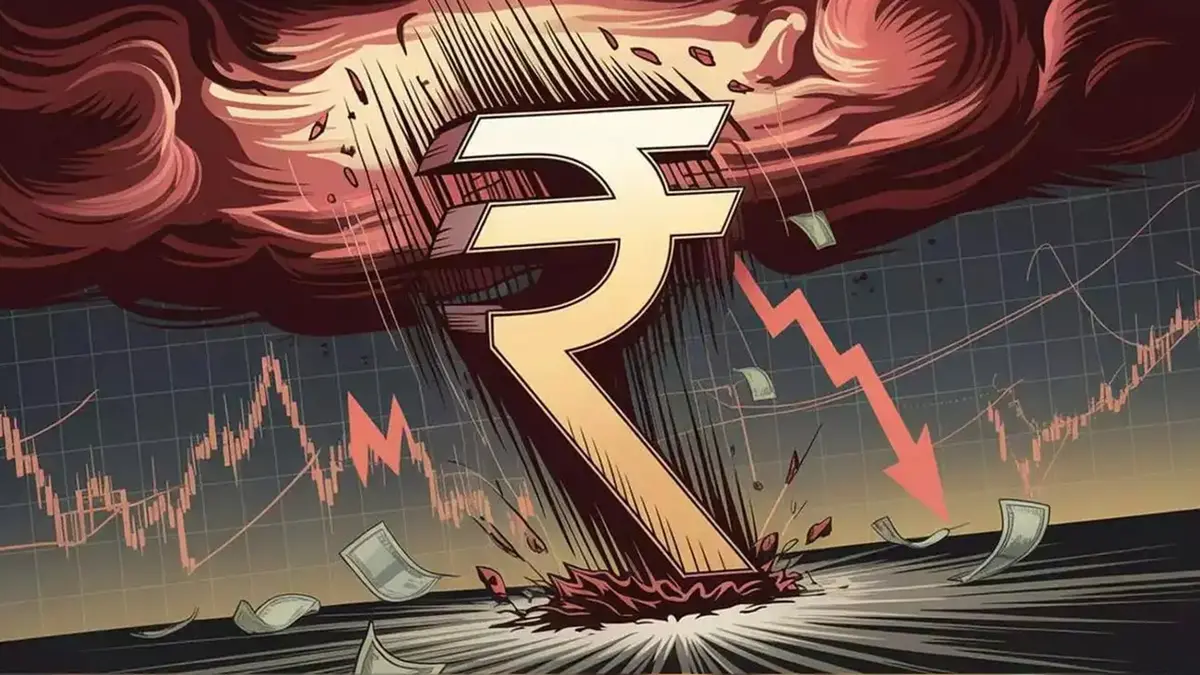
Why in news?
The Indian rupee ended 2025 at ₹89.87 per U.S. dollar, marking a depreciation of about 4.7 percent for the year. Reuters reported that this was the currency’s largest annual fall since 2022, driven by record foreign portfolio outflows and the absence of a trade agreement with the United States.
Background
Currency values fluctuate based on trade flows, investment inflows, interest‑rate differentials and market sentiment. During 2025, India faced significant capital outflows as foreign investors sold equity holdings amid uncertainty over a proposed India–U.S. trade deal. A depreciation in the rupee raises import costs and inflation but can make exports more competitive.
Factors behind the decline
- Record equity outflows: Foreign portfolio investors withdrew around US$18 billion from Indian equities during 2025, the highest outflow on record. Weak inflows in debt and direct investment compounded the pressure.
- Trade deal uncertainty: Prolonged negotiations over an India–U.S. trade agreement created uncertainty about future market access, dampening investor confidence and hampering exports.
- External deficit: India’s balance of payments slipped into a deficit of about US$22 billion between April and November, reflecting higher imports and lower investment inflows.
RBI’s evolving approach
- Greater tolerance for depreciation: Under Governor Sanjay Malhotra, appointed in December 2024, the Reserve Bank of India (RBI) adopted a more flexible stance toward the rupee’s movements. Instead of defending a particular level, the RBI intervened to curb extreme volatility and counter speculative positions.
- Targeted interventions: The RBI intervened heavily when the rupee breached the ₹91 per dollar mark in mid‑December, selling dollars to stabilise the currency without fixing a strict threshold.
- Real effective exchange rate (REER): The rupee’s 40‑currency trade‑weighted REER index declined from 104.7 in January to 97.5 in November 2025, moving from overvalued to slightly undervalued territory. A modestly undervalued rupee helps exporters remain competitive.
Outlook
- Possible rebound if trade deal is signed: Economists expect the rupee to strengthen temporarily to around ₹88.50 if India and the U.S. finalise a trade pact. However, underlying pressures from capital outflows may persist.
- Benefits for exporters: A weaker rupee increases earnings in local currency for exporters, partially cushioning them against U.S. tariffs and global demand swings.
- Risks for imports and inflation: Depreciation makes imports like crude oil, electronic components and machinery costlier, which can feed into inflation and widen the fiscal deficit.
Source: Reuters