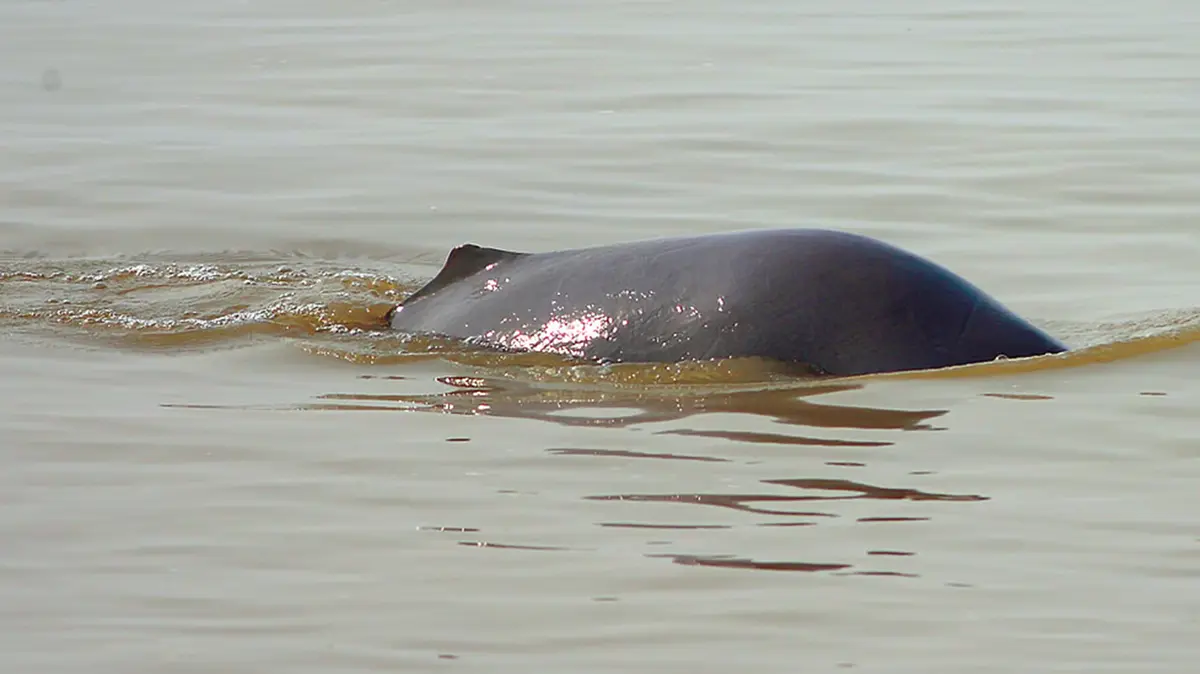
Why in news?
The Indus river dolphin, locally called the bhulan, has drawn attention because of ongoing conservation campaigns and surveys highlighting its precarious status. India’s small population in the Beas river has been declared the state aquatic animal of Punjab, and environmentalists are calling for stronger protection measures.
About the species
The Indus river dolphin (Platanista gangetica minor) is one of the world’s most endangered cetaceans. Adults grow about 2.1–2.6 metres long and weigh 70–90 kilograms, with females slightly larger than males. They have a rounded, stocky body, a long beak with sharp teeth and a small triangular dorsal fin located far back. Their eyes are tiny and function mainly to detect light; instead, they rely on echolocation to navigate and find prey in the turbid river.
Behaviour and habitat
- Echolocation: The dolphins emit a series of clicks and whistles almost continuously to sense their surroundings. They make a sneeze‑like sound when surfacing to breathe.
- Diving and feeding: Individuals usually dive for 30–90 seconds but can stay underwater for several minutes. They forage along the riverbed using their beak to stir up fish, shrimp and clams, often cooperating in small groups.
- Range: Historically the species lived throughout the Indus river system from the delta to the Himalayan foothills. Today it survives mainly in the lower and middle reaches of the Indus in Pakistan and a small population persists in India’s Beas river. Freshwater and shallow, muddy habitats are preferred.
Threats and conservation
- Habitat fragmentation: Dams, barrages and irrigation canals have divided the river into isolated segments, preventing dolphins from migrating and reducing genetic exchange.
- Bycatch: Dolphins are accidentally entangled in gill nets and longlines set for fish. Many drown when they cannot reach the surface to breathe.
- Pollution and water extraction: Sewage, industrial effluents and pesticides contaminate the Indus and reduce fish stocks. Intensive water diversion for irrigation leaves some stretches dry for months.
- Conservation actions: Governments and NGOs conduct rescue operations to save stranded dolphins from canals, educate fishing communities, monitor populations and lobby for environmental flows. In Pakistan, community‑based programmes have rescued dozens of dolphins since 2000. In India, the Beas Conservation Reserve provides legal protection for the species.
Significance
- Indicator species: As top predators, river dolphins reflect the health of freshwater ecosystems. Their decline warns of broader environmental degradation.
- Cultural and ecological value: The dolphin is revered in local folklore and is the state aquatic animal of Punjab. Protecting it helps preserve biodiversity in one of the world’s most heavily used river basins.
Source: DTE