

Why in news?
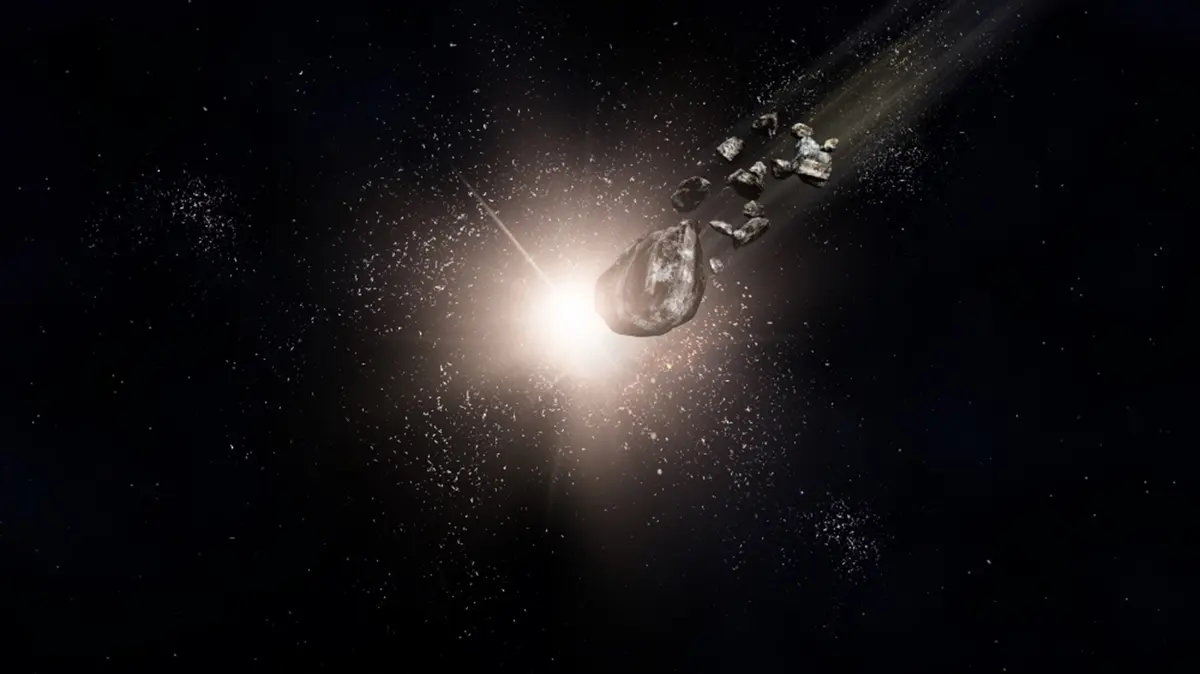
NASA recently released detailed images of Comet 3I/Atlas, an interstellar visitor travelling through our Solar System. The photographs, captured as the comet passed near the Sun, provide astronomers with valuable data about material that comes from beyond our planetary neighbourhood. This is only the third known interstellar object, following ʻOumuamua in 2017 and Comet Borisov in 2019, so each new discovery attracts global attention.
Background
Interstellar objects are celestial bodies that originate outside our Solar System. Unlike asteroids and comets that orbit the Sun, these objects travel on hyperbolic paths – open‑ended trajectories that carry them past the Sun only once before they head back into interstellar space. Scientists believe such objects are fragments ejected from distant planetary systems by gravitational interactions or collisions. The first confirmed interstellar visitor, 1I/ʻOumuamua, was discovered in 2017, followed by the comet 2I/Borisov in 2019 and 3I/Atlas in 2023. Because these bodies are not bound to the Sun, they move at high speeds and are detectable only briefly as they pass through the inner Solar System.
Characteristics and examples
- Origin outside our system: Interstellar objects are thought to be debris from other star systems, perhaps ejected during the early stages of planet formation.
- Hyperbolic orbits: They follow open hyperbolic paths, meaning they have a perihelion (closest approach to the Sun) but no aphelion and never return.
- High velocities: These objects travel so quickly that the Sun’s gravity cannot capture them, allowing them to escape back into deep space after a single pass.
- Few known examples: The only confirmed interstellar objects are 1I/ʻOumuamua, a cigar‑shaped rock discovered in 2017; 2I/Borisov, a comet rich in ices observed in 2019; and the recently photographed 3I/Atlas.
Why they matter
- Windows into other worlds: Interstellar objects carry material formed around other stars, offering clues about the composition and evolution of distant planetary systems.
- Planetary formation: Studying their structure and chemistry helps scientists understand how planets and comets form and evolve under different conditions.
- Delivery of organics: Some researchers suggest that interstellar objects may transport organic compounds across star systems, seeding young planets with the building blocks of life.
- Technological challenges: Observing and, in future, intercepting such fast‑moving objects pushes the limits of our telescopes and spacecraft, driving innovation in planetary defence and exploration.
Conclusion
Each newly discovered interstellar object provides a rare glimpse into the processes shaping distant star systems. The detailed images of Comet 3I/Atlas will help astronomers refine models of its origin and composition, deepening our understanding of the broader cosmos. Continued vigilance with wide‑field telescopes and future missions may reveal more of these cosmic messengers in the years ahead.
Sources: The Indian Express · NASA/JPL