
Why in news?
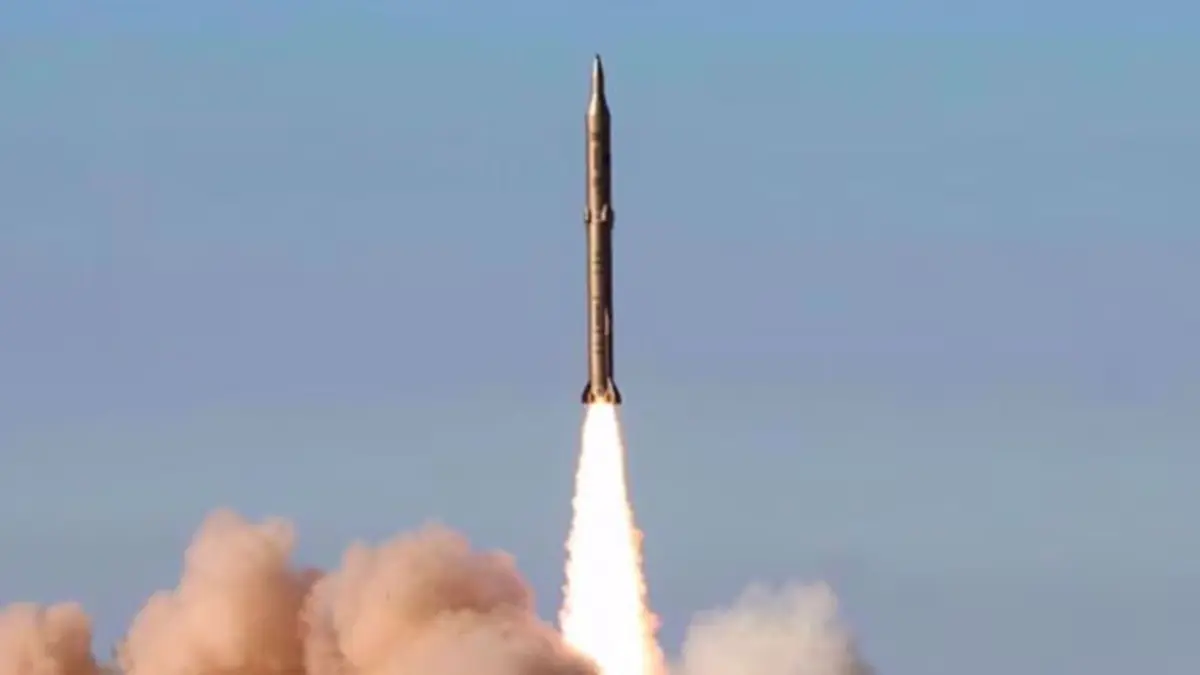
On 16 March 2026, Iran’s Islamic Revolutionary Guard Corps announced that it had used Sejjil missiles during retaliatory strikes against Israeli targets in the Middle East. The use of this home‑grown missile marks an escalation in regional tensions and raised questions about its capabilities and origin.
Background
The Sejjil missile is a two‑stage, solid‑fuel medium‑range ballistic missile (MRBM) developed by Iran. Work on the design likely began in the late 1990s, building on earlier Zelzal rocket projects. The first test flight took place in November 2008, and subsequent tests in 2009 and later years demonstrated improvements in range and guidance. Because it uses solid propellant, the missile can be transported and launched from mobile road vehicles with relatively little preparation.
Key features
- Configuration: two‑stage, solid‑propellant ballistic missile measuring about 18 metres long with a 1.25 metre diameter.
- Range and payload: estimated range of about 2,000 kilometres, with some sources suggesting the potential to reach 2,500 kilometres. It can carry a warhead of roughly 700 kilograms.
- Guidance: the missile uses inertial navigation and jet‑vane control; later variants appear to have improved sensors and guidance allowing the warhead to manoeuvre, making interception difficult.
- Mobility: Sejjil is launched from road‑mobile transport‑erector‑launcher vehicles, which increases survivability by allowing dispersal across different locations.
Significance of the recent strike
The March 2026 attack was the first confirmed operational use of Sejjil missiles. Using solid fuel reduces launch preparation time compared with liquid‑fuel missiles, enabling Iran to respond quickly. A 2,000 km range allows targets across the Middle East, including Israel, to be within reach. Analysts see the strike as a signal of Iran’s growing capability to deter adversaries and to strike from within its own territory.
Source: The Economic Times

