
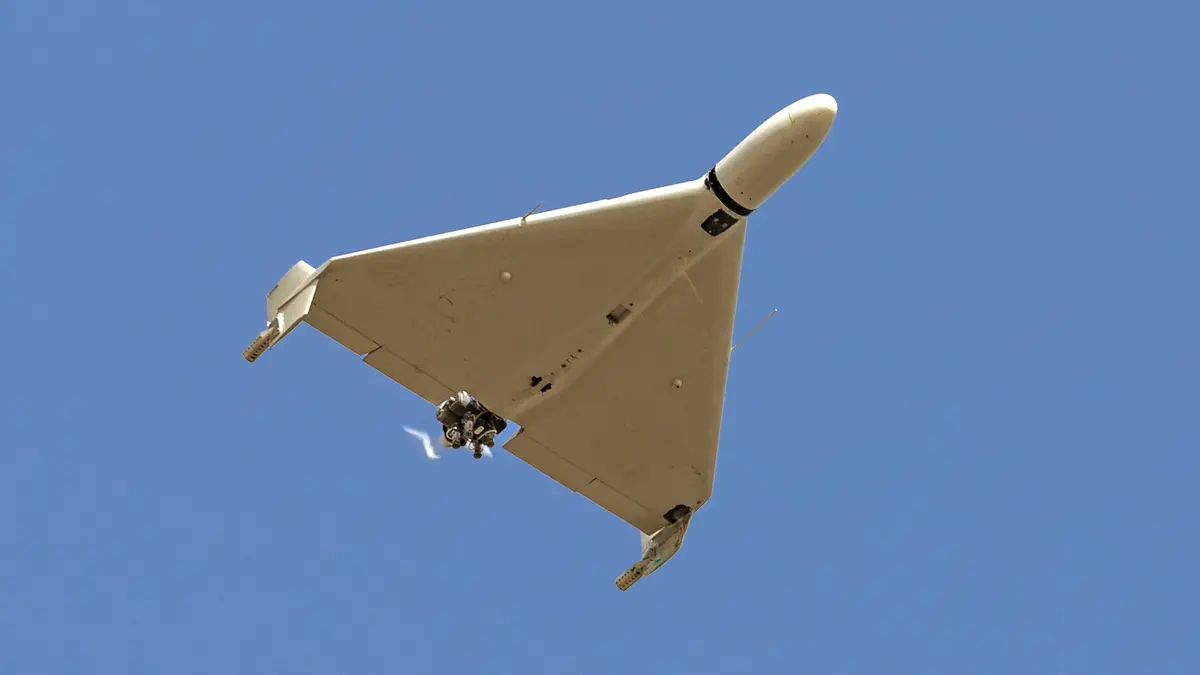
Why in news?
United States defence officials have raised alarms about Iran’s growing production and export of low‑cost Shahed attack drones. These unmanned aerial vehicles are being supplied to Russia and other actors and have been used in recent conflicts. Their affordability and swarm tactics make them difficult to intercept, prompting renewed calls for stronger air‑defence systems.
Background
The Shahed series of drones—named after the Persian word for “witness”—are one‑way attack drones developed by Iran. Unlike reusable reconnaissance drones, these craft are designed to fly towards a target and detonate on impact, earning them the labels “kamikaze” or “suicide” drones. The most widely deployed variants are the Shahed‑131 and the larger Shahed‑136. Russia refers to them as Geran‑1 and Geran‑2 respectively, reflecting their rebranding in Russian service.
According to defence analysts, each drone costs between US$20,000 and US$50,000—far cheaper than cruise missiles or ballistic missiles that can cost millions. Their low price point allows operators to launch large numbers simultaneously, overwhelming enemy air defences. The drones are launched from rail platforms or modified vehicles using rocket boosters; once airborne, a piston engine provides propulsion. Navigation is achieved through a combination of GPS/GLONASS receivers and inertial navigation systems pre‑programmed with target coordinates.
Characteristics
- Range: The Shahed‑131 can fly 700–900 kilometres, while the larger Shahed‑136 may reach 2,000–2,500 kilometres.
- Size: They are between 2.5 and 3 metres long and weigh roughly 200 kilograms at launch.
- Launch mechanism: A disposable rocket booster propels the drone off its launcher; the booster is jettisoned after lift‑off, and a gasoline engine takes over.
- Warheads: The drones can carry high‑explosive, thermobaric or shrapnel‑filled warheads designed to maximise damage upon impact.
- Swarm tactics: Because they are inexpensive, multiple Shahed drones can be launched in waves from different directions, saturating air‑defence systems and creating a “poor man’s cruise missile” effect.
Sources: Times of India

