

Why in news?
The Union Minister for Environment, Forest and Climate Change recently attended the 11th Joint Crediting Mechanism Partner Countries’ Meeting, held on the sidelines of the UN climate conference in Brazil. The meeting highlighted Japan’s collaborative initiative to accelerate clean‑technology deployment, and India reaffirmed its commitment to using the JCM to meet its climate goals.
Background
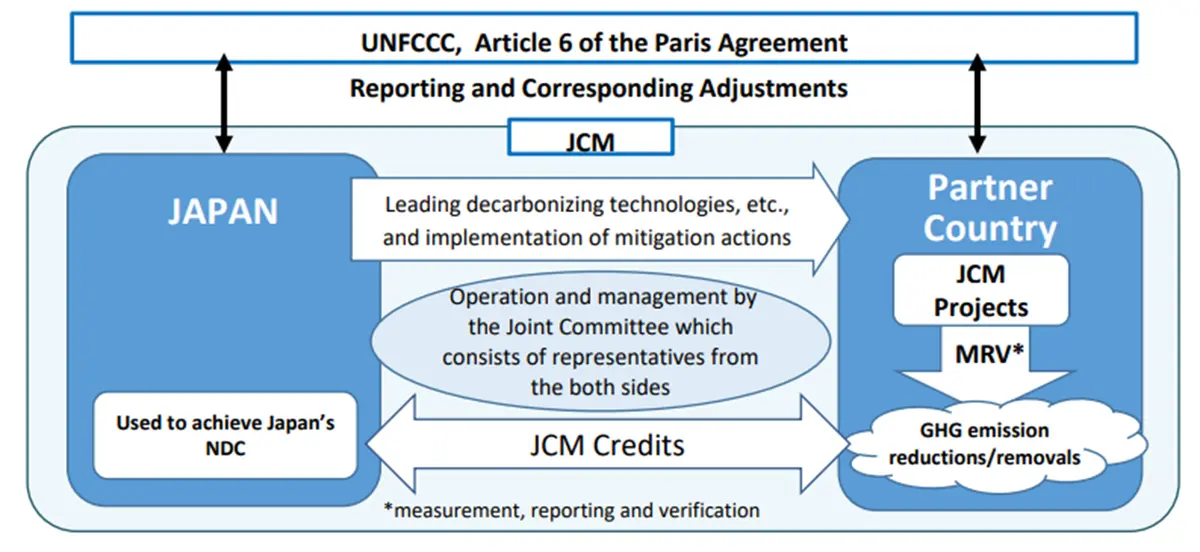
The Joint Crediting Mechanism (JCM) was launched by Japan in 2013 as a bilateral framework under Article 6 of the Paris Agreement. It allows Japanese companies to invest in emission‑reduction projects overseas in partnership with host countries. The resulting greenhouse‑gas reductions are measured and verified, and the credits are shared between Japan and the partner nation. Unlike the earlier Clean Development Mechanism, the JCM is designed to promote advanced low‑carbon technologies and infrastructure in areas such as renewable energy, energy efficiency and waste management.
How the JCM works
- Bilateral agreements: Japan signs individual agreements with partner countries outlining project criteria, credit sharing arrangements and governance.
- Project implementation: Japanese and local entities collaborate to deploy technologies such as solar power, biomass plants, energy‑efficient air‑conditioning or green hydrogen.
- Measurement and verification: Independent bodies quantify emission reductions against a baseline, ensuring transparency and comparability with international standards.
- Credit allocation: Emission reductions are divided between Japan and the host country, helping both meet their Nationally Determined Contributions (NDCs) under the Paris Agreement.
India and the JCM
- Partner status: India is one of the 31 partner countries participating in the mechanism.
- Focus sectors: Recent discussions have identified renewable energy with storage, sustainable aviation fuel, compressed biogas, green hydrogen and green ammonia as priority areas for collaboration.
- Co‑benefits: Beyond reducing emissions, JCM projects can create jobs, transfer technology to Indian industries and support sustainable development in rural areas.
- Complementary initiatives: The JCM operates alongside other carbon‑market tools and domestic policies, helping India diversify its climate‑finance options while safeguarding national sovereignty over projects.
Conclusion
By combining Japan’s technological prowess with the needs of partner countries, the JCM fosters cooperative climate action. India’s active participation underscores its commitment to harnessing international support for a low‑carbon transition. Clear rules on credit sharing and robust measurement will ensure that JCM projects deliver genuine emission reductions and local benefits.
Sources: Press Information Bureau · Japan Ministry of the Environment