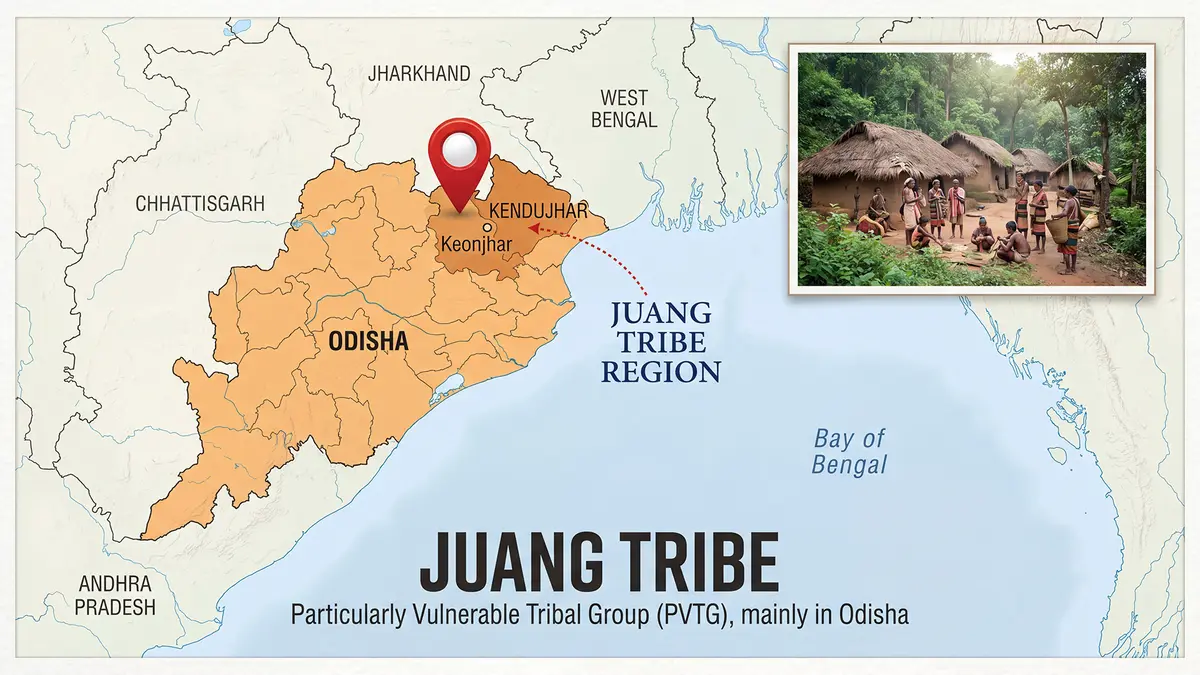
Why in news?
The welfare of the Juang tribe came into focus in April 2026 as the Odisha government rolled out new projects under the PVTG Empowerment and Livelihoods Improvement Programme aimed at improving infrastructure and livelihoods for Particularly Vulnerable Tribal Groups.
Background
The Juang are one of 13 Particularly Vulnerable Tribal Groups (PVTGs) in Odisha. They belong to the Austro‑Asiatic Munda ethnolinguistic family and primarily inhabit remote forested hills of Keonjhar and Dhenkanal districts. The term “Juang” translates to “man”; the community considers themselves the progenitors of humankind.
Cultural practices
- Juang settlements are typically small and scattered. Villages maintain a youth dormitory called majhang or mandaghar, where unmarried boys and girls receive social education and participate in music and dance.
- Social organisation is divided into four exogamous territorial groups (pirh)—Satkhand, Jharkhand, Kathua and Rebena. Each pirh has a headman (sardar) who mediates disputes and conducts rituals.
- They practise shifting cultivation and hunting; the Hill Juang (Thaniya) depend more on forest produce, while the Plain Juang (Bhagudia) engage in settled agriculture and wage labour.
- Juang spiritual life revolves around worship of the sun and earth deities, and of ancestral and forest spirits. Festivals include Pus Punei (harvest festival), Amba Nua (mango festival), Chaitra Parab and Dhan Nua (new rice festival).
Challenges and initiatives
- The community faces isolation, limited access to education and healthcare, and threats of land alienation.
- Government schemes under the Odisha PVTG Empowerment & Livelihoods Improvement Programme (OPELIP) aim to provide roads, housing, healthcare centres, solar lighting and skill training.
- Non‑governmental organisations work to document Juang language and oral traditions and to support land and forest rights under the Forest Rights Act.
Source: SCSTRTI · Odisha Tribal Museum