
Why in news?
The jungle cat has featured in wildlife discussions because of renewed conservation assessments highlighting its wide distribution across India and Asia. Although listed as “Least Concern” on the IUCN Red List, researchers note that habitat loss, wetland degradation and trapping threaten local populations in parts of its range.
Background
The jungle cat (Felis chaus), also known as the reed cat or swamp cat, is a medium‑sized wildcat native to the eastern Mediterranean, the Caucasus and large parts of South and Southeast Asia. Despite its name, it is not closely related to lynxes; rather, it is more similar to domestic cats. Modern genetic studies recognise three subspecies: F. c. chaus in the Middle East and Central Asia, F. c. affinis in the Indian subcontinent and Sri Lanka, and F. c. fulvidina in Southeast Asia.
Description
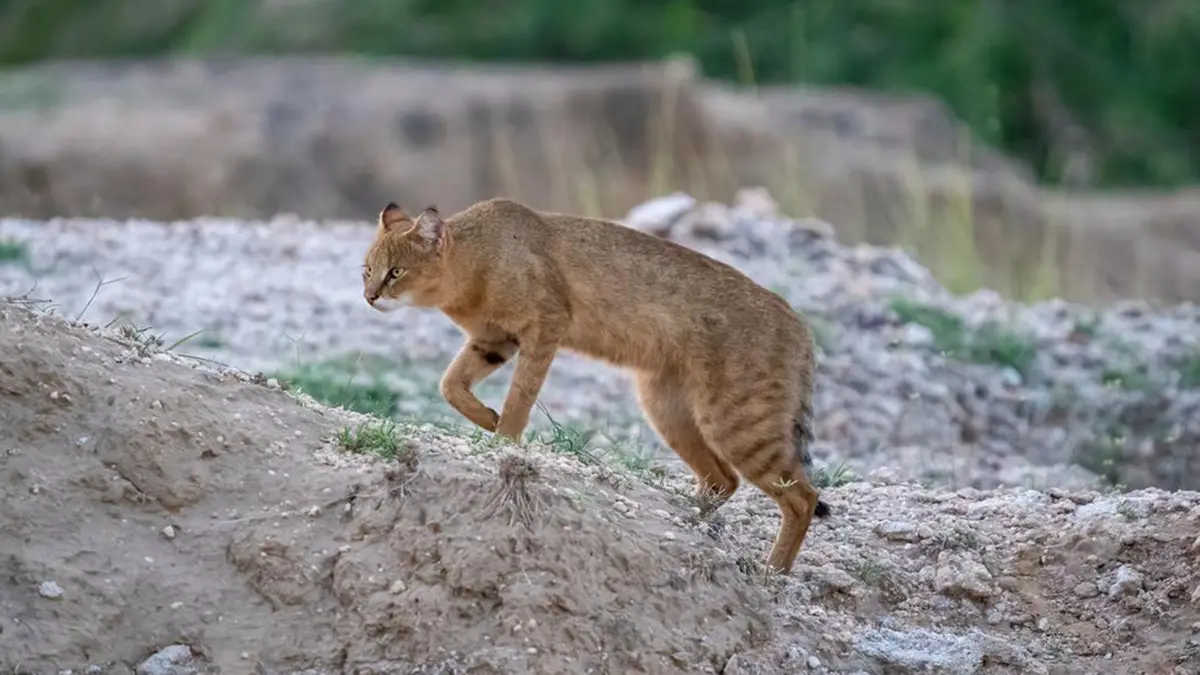
- Appearance: Jungle cats have a slender body, long legs and a short tail that makes up about one‑third of their head‑and‑body length. The coat is usually sandy brown, reddish or grey with faint stripes on the legs and sometimes the throat. The belly and throat are lighter in colour. The ears are tall, close together and tipped with small black tufts up to 15 mm long, giving the cat a lynx‑like appearance.
- Size: Adults weigh between 5 kg and 9 kg. Body length ranges from 58 cm to 76 cm, with a tail length of 21–27 cm.
- Adaptations: The species thrives in varied habitats but prefers wetlands, reed beds, marshes, tall grasslands and riparian forests. Its long legs and strong swimmers allow it to hunt in dense vegetation and shallow water. Melanistic (black) individuals are occasionally recorded in south‑eastern Pakistan and India.
Distribution and habitat
- Range: Jungle cats occur from Egypt across the Caucasus and Central Asia, through the Indian subcontinent and Sri Lanka to Southeast Asia. In India and Nepal they are considered common and widespread, while in Europe and parts of the Middle East they are declining.
- Preferred habitats: Despite the name, jungle cats are rarely found in dense forests. They favour scrublands, savannahs, wetlands, reed swamps, marshes and riverine vegetation where they can hide and ambush prey. They also adapt to agricultural landscapes and can be seen around irrigation canals.
- Conservation status: The IUCN Red List categorises the jungle cat as Least Concern globally, but national listings vary—from Near Threatened in Bangladesh and Sri Lanka to Vulnerable in Israel and Endangered in China. Major threats include habitat loss, draining of wetlands, poaching and road mortality.
Why conservation matters
As a mid‑sized predator, the jungle cat plays a role in controlling rodent populations and maintaining ecological balance in wetlands and agricultural fields. Protecting wetlands and grasslands benefits not only jungle cats but also numerous birds and other wildlife. Conservationists advocate maintaining intact reed beds, preventing poisoning and trapping, and monitoring populations to ensure this adaptable feline remains secure across its range.

