

Why in news?
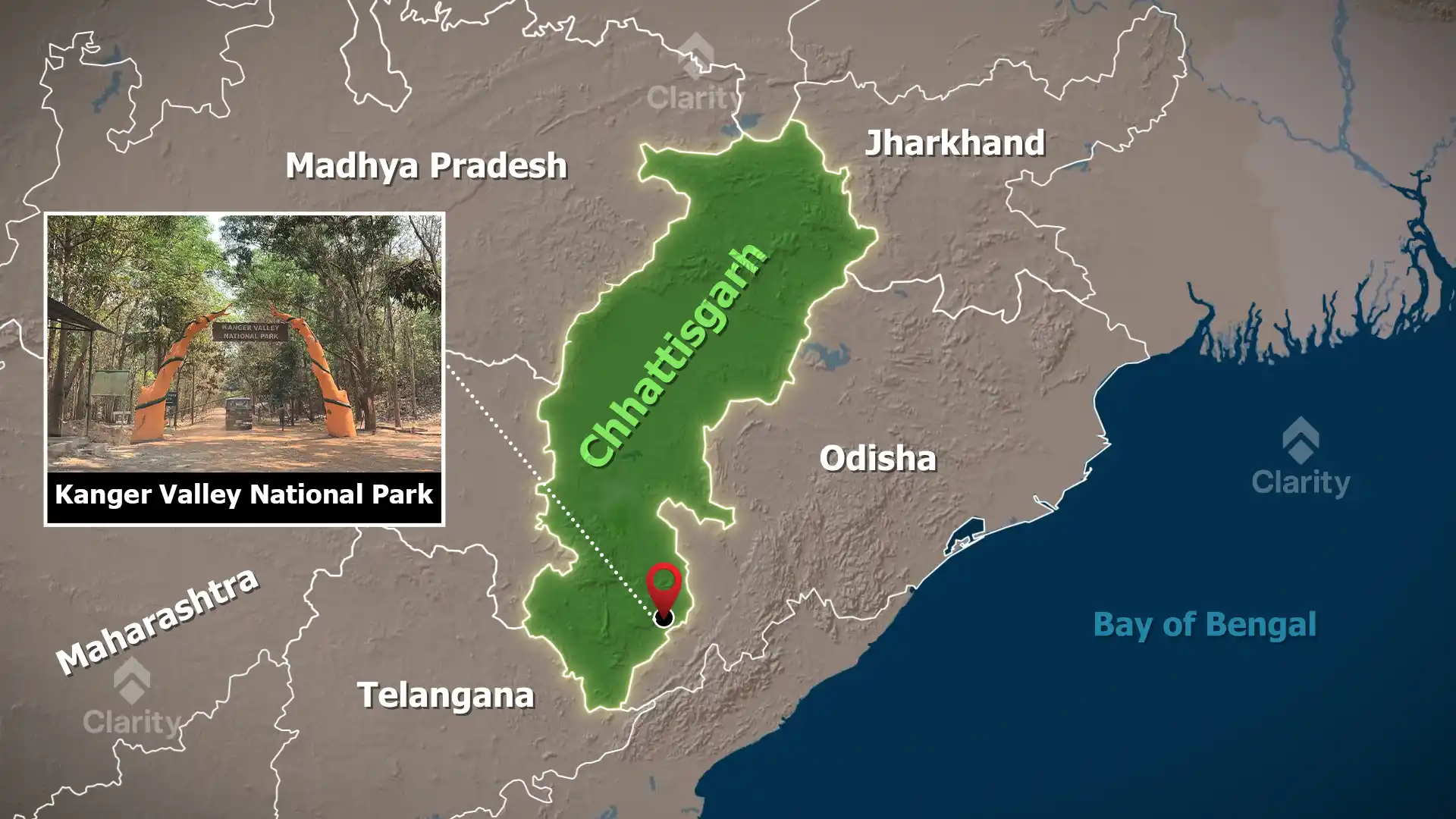
Chhattisgarh’s Kanger Valley National Park has been placed on UNESCO’s Tentative List of World Heritage Sites, and the state government has tasked the Wildlife Institute of India with conducting a biodiversity survey to support its nomination. The park, located in the Bastar district, is renowned for its spectacular karst formations, limestone caves and rich biological diversity.
Background
Established in 1982 and covering about 200 square kilometres, Kanger Valley National Park is situated near Jagdalpur in southern Chhattisgarh. It derives its name from the Kanger River, which flows through the valley from northwest to southeast. The park sits within the moist Peninsular Valley Sal Forests and encompasses varied topography—from low flatlands and gentle slopes to steep gorges, plateaus and seasonal streams. Its elevation ranges between 338 and 781 metres above sea level.
Natural features
- Karst landscape: The park is famous for its limestone caves, including Kotamsar, Kailash, Dandak and Aranyak. These caves are adorned with stalactites, stalagmites and other speleothems and support unique cave fauna such as blind fish and cave crickets.
- Tirathgarh waterfall: A major attraction within the park, this waterfall plunges about 150 feet over sandstone cliffs. The surrounding gorge and evergreen forests create a picturesque setting.
- Biodiversity hotspot: Kanger Valley harbours more than 450 species of flowering plants and nearly 50 species of mammals, including leopards, wildcats, sambar deer and flying squirrels. It is also home to over 200 bird species, among them the endangered Bastar Hill Myna. Dozens of reptile and amphibian species and more than 140 species of butterflies have been recorded.
- Tribal heritage: The region is inhabited by indigenous communities whose cultural practices are closely tied to the forest. Many of the caves are sacred and visited during festivals such as Mahashivratri.
Path to UNESCO recognition
- Tentative listing: Before a site is nominated as a World Heritage Site, it must be included on the country’s Tentative List for at least one year. Kanger Valley’s inclusion in 2025 marks the first step towards full nomination in the natural heritage category.
- Survey and documentation: The Wildlife Institute of India will conduct detailed studies on the park’s geology, flora, fauna and cultural values. These data will be compiled into a nomination dossier for UNESCO.
- Conservation management: Achieving World Heritage status requires a robust management plan that addresses threats such as forest fires, invasive species and unregulated tourism. Community participation will be vital to maintaining the park’s ecological integrity.
Conclusion
Kanger Valley National Park’s journey towards UNESCO recognition highlights its exceptional natural beauty and ecological importance. Securing World Heritage status would bring international attention and resources to conserve the park while promoting sustainable tourism that benefits local communities.
Source: Deccan Chronicle