

Why in news?
India’s indigenous train protection technology, Kavach, has expanded its coverage to more than 2,000 kilometres of railway track. Recent announcements by the Ministry of Railways indicate that the latest version, Kavach 4.0, has been approved and is being installed on busy corridors. The system is credited with reducing accident risk by automatically controlling trains when drivers fail to respond to signals.
Background
Kavach (Hindi for “armour”) is a radio‑based automatic train protection system developed by Indian Railways in partnership with private industry. Its purpose is to prevent collisions and signal‑passed‑at‑danger incidents. The pilot version was deployed on the South Central Railway in 2016–18 and covered about 1,465 route kilometres. Following successful trials, the technology was adopted as the national standard for automatic train protection in 2022.
How Kavach works
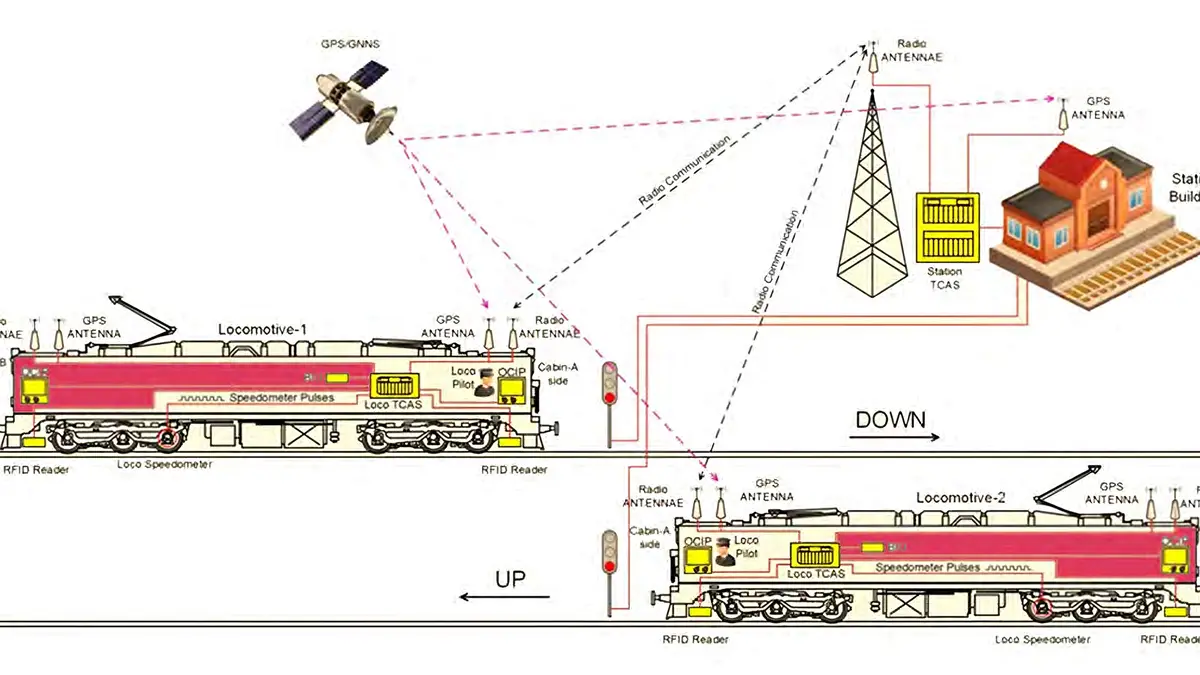
- Trackside and onboard equipment: The system consists of balises (electronic beacons) placed along the tracks, radio towers, and onboard units in locomotives. These devices communicate to exchange information about signal aspects, speed limits and train positions.
- Automatic braking: If a driver attempts to pass a signal at danger or exceeds the permitted speed, Kavach automatically applies the brakes to stop the train. It also enforces speed restrictions in work zones and on curves.
- Integration with signalling: Kavach interfaces with existing Indian Railways signalling and is being upgraded to use 4G/LTE communication and modern cab signalling in version 4.0.
- Scalability: The system can be fitted on a wide range of locomotives and rolling stock and works across different route types.
Recent achievements
- Network coverage: More than 2,000 km of tracks have been equipped with Kavach. The government plans to bring 90 percent of the busy rail network under the system by 2030.
- Infrastructure build‑out: Implementation has included laying over 7,000 km of optical fibre cable, erecting 860 telecommunication towers and fitting nearly 4,200 locomotives with onboard Kavach units.
- Human resource development: About 40,000 technicians and engineers have been trained to install, operate and maintain the system.
- Accident reduction: Railway authorities report a significant drop in collisions and near‑miss incidents, demonstrating Kavach’s effectiveness as a safety layer.
Significance
- Enhancing passenger safety: Automatic intervention minimises human error, which is a major cause of rail accidents.
- Boosting confidence in rail travel: By preventing high‑profile accidents, Kavach encourages more people to choose trains over road transport, supporting sustainable mobility.
- Indigenous development: Developing and deploying Kavach domestically reduces reliance on expensive imported train protection systems and builds local technical expertise.
Conclusion
Kavach represents a major stride towards modernising India’s railway infrastructure and improving safety. Continued expansion and technological upgrades, such as integrating satellite navigation and advanced communication, will be crucial to achieving the goal of near‑zero accidents on Indian Railways.
Source: TH