

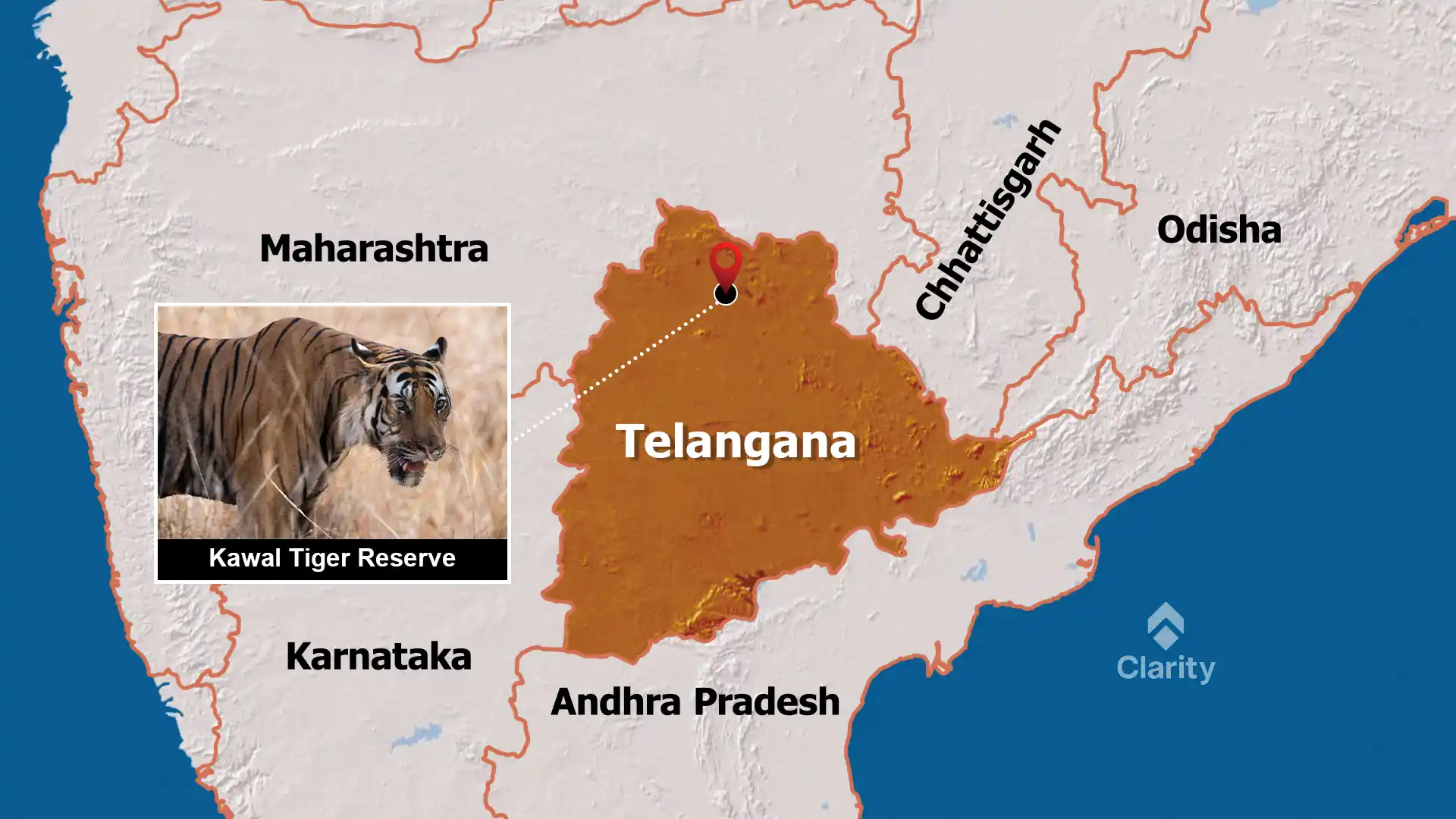
Why in news?
The Kawal Tiger Reserve in Telangana has been in the spotlight due to discussions on wildlife corridors and conservation. As India expands efforts to protect tigers across central India, understanding Kawal’s role in the landscape has become important.
Background
Kawal was first declared a wildlife sanctuary in 1965 and notified as a tiger reserve in 2012 under Project Tiger. It lies in the northern part of Telangana along the Godavari River, within the Deccan plateau’s central highlands. Covering approximately 1,015 square kilometres, the reserve comprises a core area of about 892 square kilometres and a buffer area of 123 square kilometres. Its location gives it connectivity to the Tadoba–Andhari Tiger Reserve in Maharashtra to the north and the Indravati Tiger Reserve in Chhattisgarh to the northeast.
Ecology and wildlife
- Vegetation: The forests are classified as southern tropical dry deciduous. Extensive teak stands mixed with bamboo dominate, along with tree species such as Anogeissus latifolia, Madhuca indica, Terminalia species and Butea monosperma. More than 673 plant species have been recorded.
- Fauna: Surveys list around 68 mammal species, including tigers, leopards, wild dogs (dholes), wolves, sloth bears, Indian gaur, sambar deer, nilgai, four‑horned antelope (chousingha), chinkara (Indian gazelle) and black buck. The reserve also shelters about 310 species of birds, 10 species of amphibians and 34 species of reptiles.
- Climate: Summers can be very hot, with temperatures exceeding 47 °C, while winters are cool with temperatures falling below 6 °C. Annual rainfall averages about 1,000 millimetres.
Conservation challenges and initiatives
- Low tiger density: Though designated a tiger reserve, Kawal currently supports a small tiger population. Enhancing prey availability, mitigating human–wildlife conflict and expanding habitat connectivity are priorities.
- Threats: Illegal sand mining along riverbeds, poaching, livestock grazing, fire, and invasive weeds like Lantana camara threaten the habitat. Strict protection measures, anti‑poaching camps and relocation of villages are being pursued.
- Corridor conservation: By securing forest corridors to Tadoba–Andhari and Indravati reserves, conservationists hope to facilitate gene flow between tiger populations and reduce inbreeding.
Significance
- Ecological link: Kawal occupies the southern tip of the central Indian tiger landscape. Its forests act as a bridge between major tiger strongholds, making its protection vital for landscape‑level conservation.
- Biodiversity hotspot: The rich assemblage of flora and fauna underscores the need to preserve dry deciduous ecosystems, which are often undervalued compared with rainforests.
- Community involvement: Engaging local communities in eco‑tourism, forest management and alternative livelihoods helps build support for wildlife protection.