

Why in News?
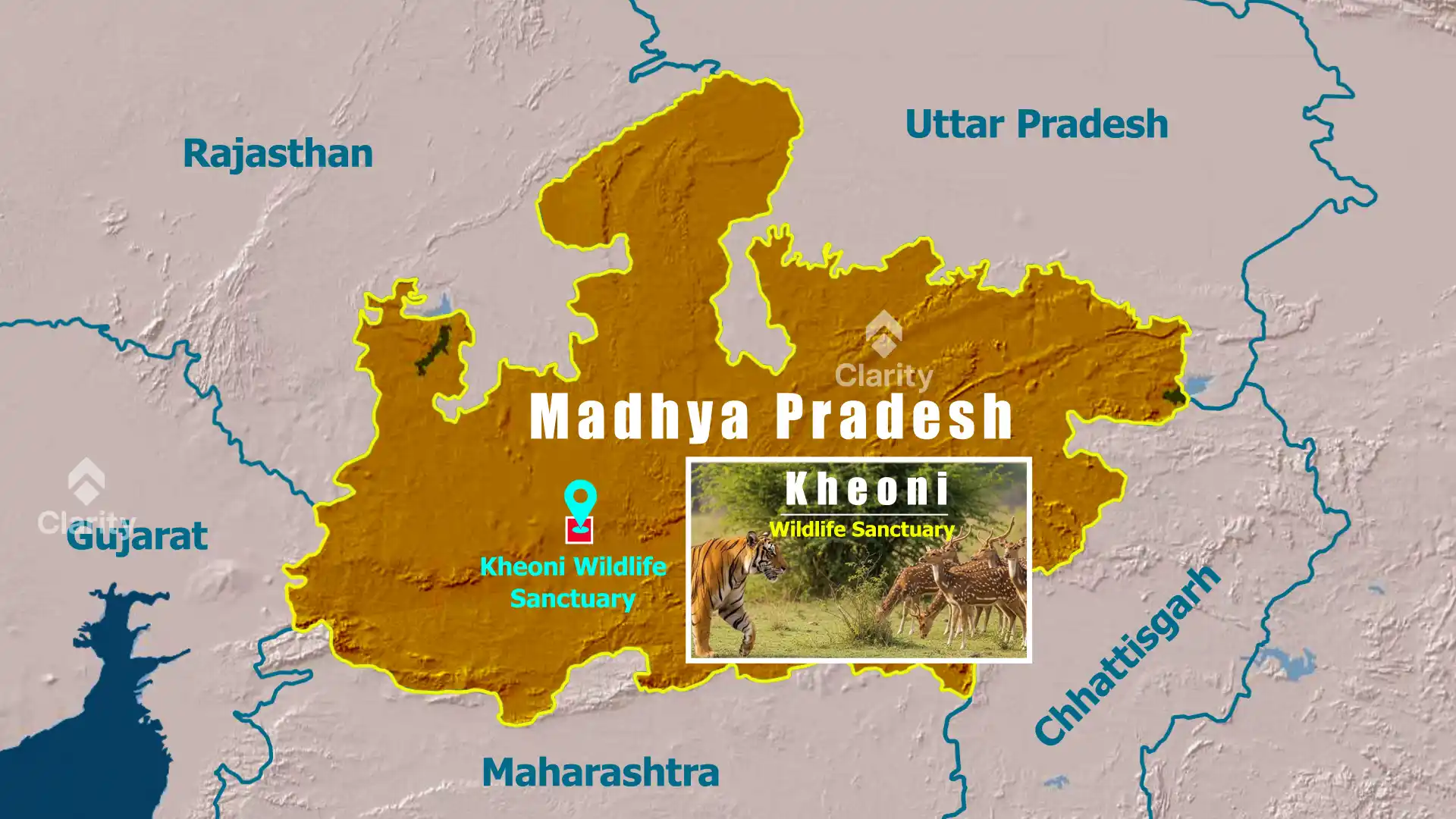
Ecologists have recently drawn attention to the Kheoni Wildlife Sanctuary in Madhya Pradesh after reports of the Indian wild dog (dhole) using the area as part of its roaming corridor. The dhole’s presence underscores the conservation importance of this small sanctuary and highlights the need for habitat connectivity with neighbouring reserves.
Background
Kheoni Wildlife Sanctuary lies in the Dewas and Sehore districts of Madhya Pradesh. Established in 1974 and covering approximately 135 square kilometres, it forms part of a forested corridor linking the Satpura landscape to the Ratapani Tiger Reserve. The sanctuary’s dry deciduous forests are dominated by teak and tendu trees, bamboo clumps and a variety of flowering species such as kusum, kanak champa and kadamb.
Wildlife
- Mammals: Kheoni provides habitat for jackals, jungle cats, palm civets, leopards, sloth bears, striped hyenas and small carnivores. Herbivores include sambar, chital, nilgai, blackbuck, chinkara and barking deer.
- Birdlife: More than one hundred bird species have been recorded, including the Indian paradise flycatcher, grey hornbill and various raptors.
- Dhole (Indian wild dog): The dhole (Cuon alpinus) is a social canid known for its whistling calls. Once widespread across Asia, dholes now survive mainly in the Western and Eastern Ghats of India. They live in packs and prefer dense forests but will also use scrub and open woodland. The International Union for Conservation of Nature (IUCN) lists the dhole as Endangered due to habitat loss, prey depletion, competition with other predators and disease.
Significance
- Habitat connectivity: Kheoni acts as a stepping‑stone between larger protected areas. Maintaining forest corridors allows wide‑ranging animals like dholes and leopards to move safely, exchange genes and avoid inbreeding.
- Biodiversity conservation: Despite its small size, the sanctuary supports a rich assemblage of flora and fauna, making it valuable for conservation education and ecotourism.
- Species recovery: Sightings of dholes indicate that conservation measures in central India are helping the species reclaim parts of its historical range.