Why in news?
A multi‑institute study led by Nagaland University has found that a traditional five‑plant herbal formulation used by the Konyak tribe of Nagaland shows promising anti‑cancer potential. Using computational and analytical techniques, researchers identified compounds in the remedy that can inhibit a protein involved in tumour blood vessel growth.
Background
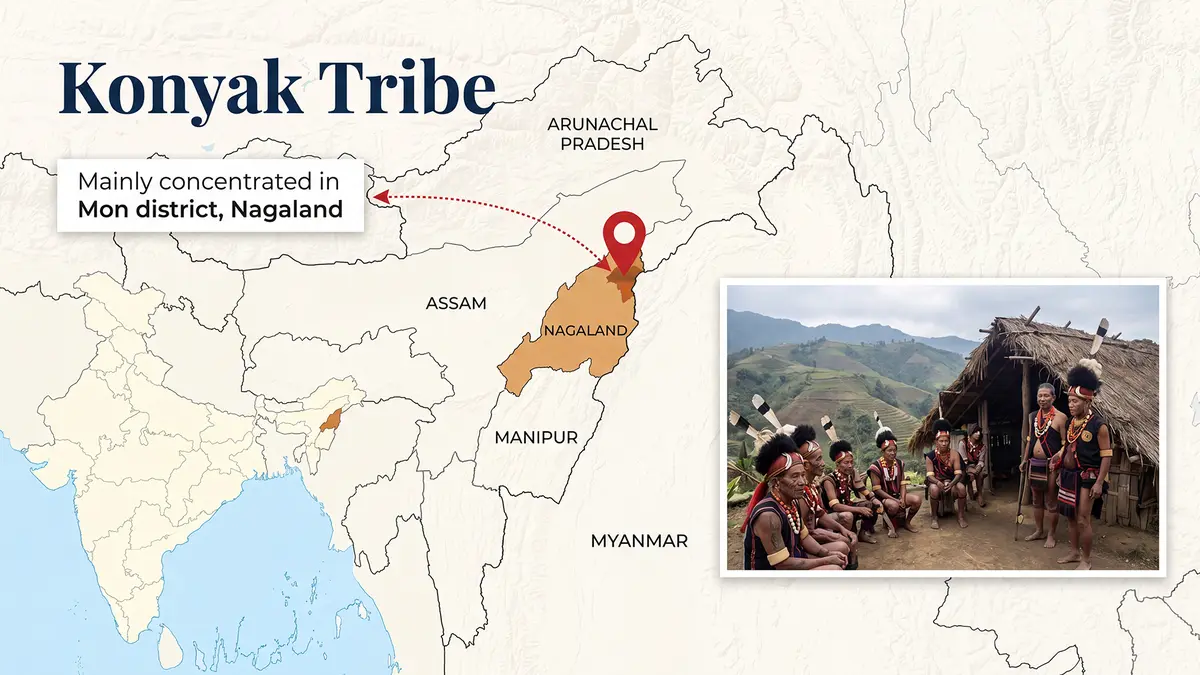
The Konyaks are one of the 16 officially recognised Naga tribes. They primarily inhabit Mon district in Nagaland and parts of Arunachal Pradesh. Historically renowned as tattooed headhunters, the Konyaks have a patriarchal society led by chiefs known as Anghs. Their language belongs to the Northern Naga branch of the Sino‑Tibetan family.
About the Konyak tribe
- Origin of the name: The term “Konyak” may derive from the words “Whao” (head) and “Nyak” (black), meaning “men with black hair.” The community is divided into groups such as the Thendu (“tattooed face”) and Thentho (“white face”).
- Culture: Facial and body tattoos historically signified courage and achievements. Although headhunting has long been abolished, older men still bear tattooed faces. Today many Konyaks follow Christianity.
- Society and economy: The eldest son usually inherits property. Agriculture is the main occupation, supplemented by handicrafts such as basket weaving, brasswork, and making firearms. Festivals like Aolingmonyu (spring), Aonyimo (post‑harvest) and Laoun‑ongmo (thanksgiving) are important cultural events.
- Language: Each village has its own dialect, but Wakching dialect is widely understood. The Konyak language belongs to the Naga‑Kuki branch of the Tibeto‑Burman family.
The study
- A team of researchers from Nagaland University, Berhampur University and Saveetha Medical College analysed a traditional Konyak remedy made from five plants. Using gas chromatography‑mass spectrometry (GC‑MS) and molecular simulations, they identified bioactive compounds.
- The compounds showed strong binding to VEGFR2, a protein that controls the formation of blood vessels (angiogenesis) in tumours. Inhibiting VEGFR2 can starve tumours by cutting off their blood supply.
- The study found that these natural compounds have favourable safety profiles and low predicted toxicity compared with some existing anti‑angiogenic drugs.
- Researchers emphasised that their results are preliminary and based on computational analysis. Laboratory and clinical trials are needed to validate the effectiveness and safety of the formulation in treating cancers such as colon cancer.
- The findings highlight the value of indigenous knowledge and could pave the way for cost‑effective drug discovery.
Source: Down To Earth · Morung Express · District of Mon, Government of Nagaland · India Development Review