

Why in news?
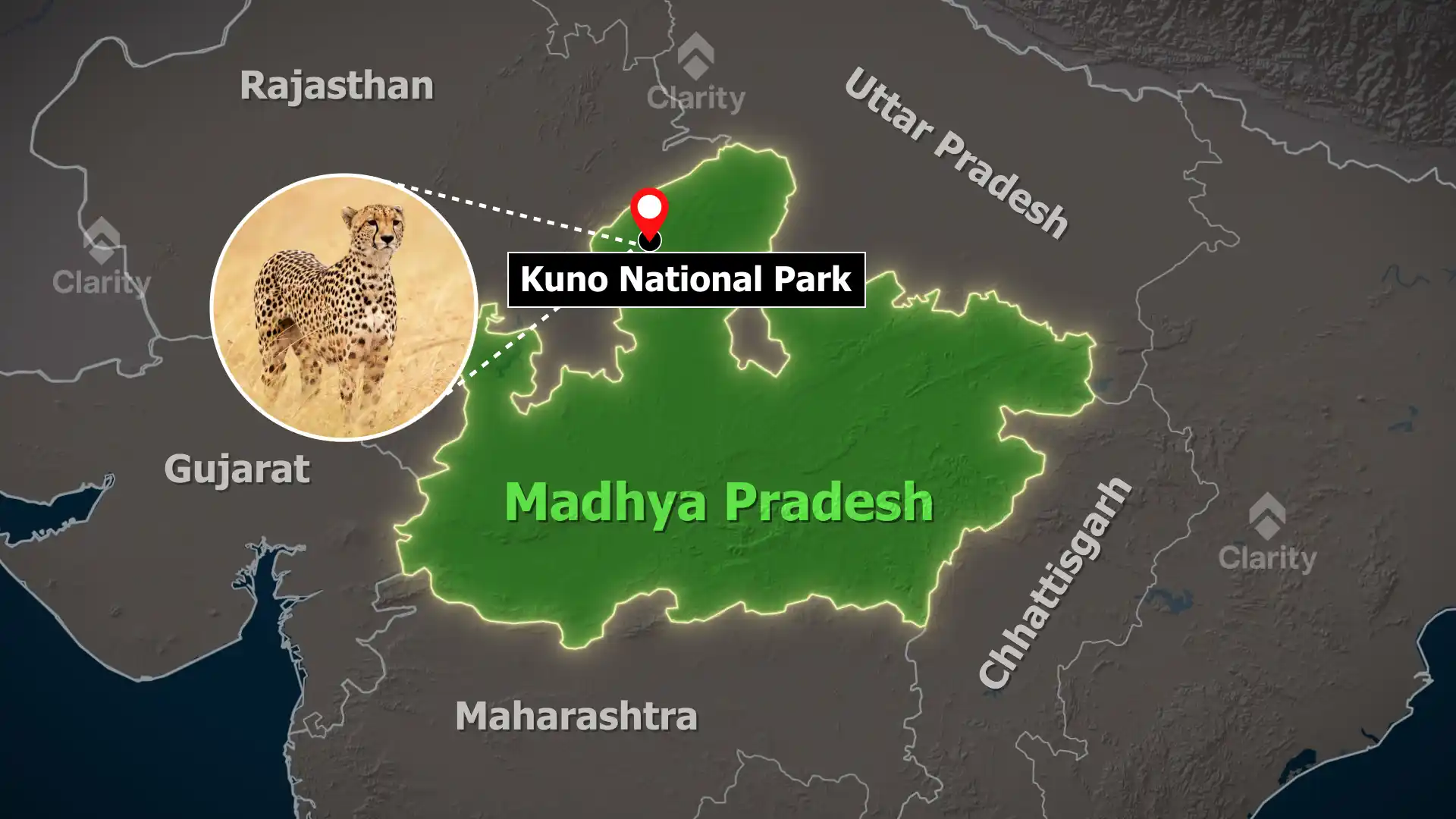
Mukhi, the first female cheetah born in India after the species was declared extinct in 1952, has given birth to five cubs at Kuno National Park in Madhya Pradesh. The births signal hope for the success of the country’s cheetah reintroduction programme.
Background
Kuno National Park is located in the Sheopur district of Madhya Pradesh, near the Vindhyan Hills. Initially notified as Kuno Wildlife Sanctuary in 1981, it was upgraded to a national park in 2018. The park covers about 750 square kilometres and is named after the Kuno River, a tributary of the Chambal. Its varied terrain includes plateaus, valleys, grasslands and riverine forests. Historically, the park was proposed as a relocation site for Asiatic lions, and 24 villages were relocated to create a core area free from human settlement. Today it is part of a crucial wildlife corridor connecting the Ranthambore and Madhav National Parks.
Flora and fauna
- Vegetation: Kuno’s forests are primarily tropical dry deciduous with pockets of savannah grassland. Common trees include khair (Acacia catechu), salai (Boswellia serrata) and ber (Ziziphus mauritiana). The grassy meadows resemble the African savanna, making them suitable for cheetahs.
- Wildlife: The park supports predators such as the Indian leopard, jungle cat, Indian wolf, striped hyena, golden jackal and dhole. Herbivores include chital, sambar, nilgai, chousingha and blackbuck. More than 120 species of birds have been recorded.
Cheetah reintroduction programme
- India imported eight cheetahs from Namibia in September 2022 and twelve more from South Africa in February 2023 under Project Cheetah. They were released into enclosures at Kuno National Park after a quarantine period.
- The first litter of cheetah cubs was born in March 2023. Mukhi, one of those cubs, survived a severe heat wave that killed her siblings and has now reached maturity.
- With the birth of Mukhi’s cubs, India now has 32 cheetahs. Twenty‑one were born in India. More cheetahs are expected to arrive from Botswana to further boost the population.
Significance
- The successful reproduction of cheetahs in the wild shows that the species is adapting to Indian conditions. It strengthens confidence in the long‑term viability of Project Cheetah.
- Bringing back an apex predator can help restore ecological balance by controlling herbivore numbers and promoting healthier grasslands.
- The story of Mukhi highlights the importance of protected habitats and careful wildlife management. Continued monitoring will be crucial to ensure that cheetahs thrive without conflict with local communities.
Source: Hindustan Times, NOA, Sheopur District, Madhya Pradesh Tourism