

Why in news?
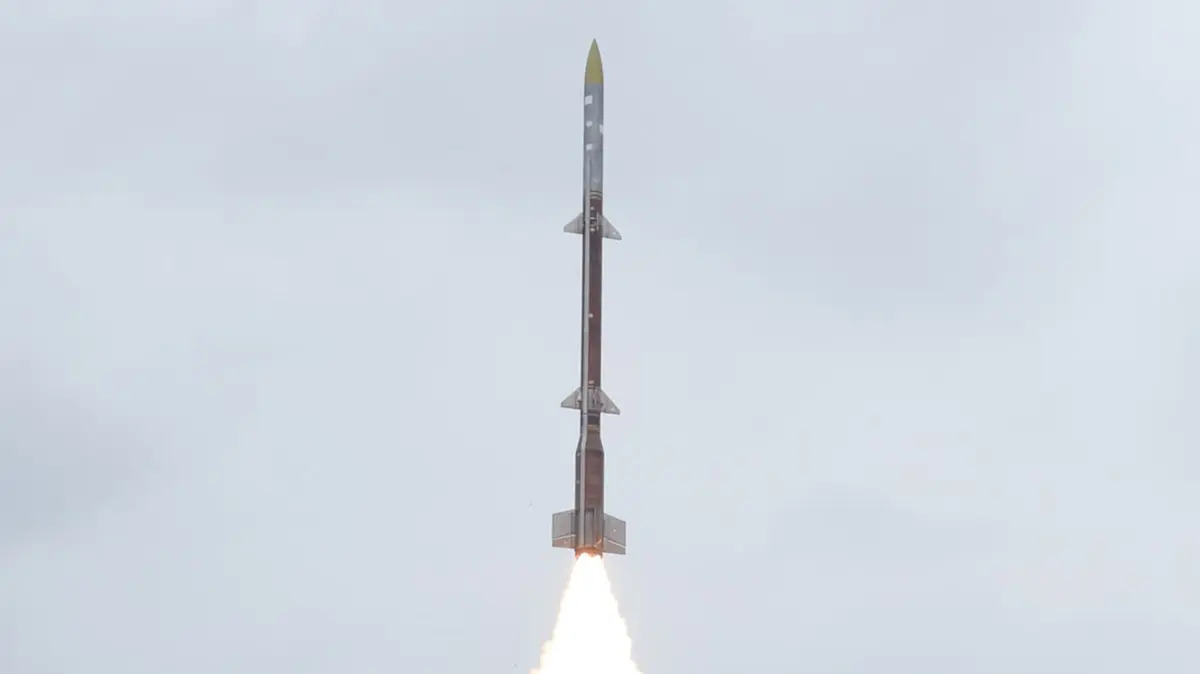
The Defence Research and Development Organisation conducted Kusha’s maiden flight test on 23 July 2026. The test occurred at Abdul Kalam Island, off Odisha’s coast. An electronic target simulated a fast and high-altitude aerial threat. The missile system successfully intercepted that simulated target.
Background
Air defence protects territory and forces from airborne threats, including aircraft, missiles and unmanned aerial vehicles.
A surface-to-air missile attacks an airborne target after radar detects and tracks the approaching threat.
A command centre studies this track, selects a response and guides the interceptor towards its target.
Since one weapon cannot handle every threat, modern countries build layered networks covering short, medium and long ranges.
What exactly is Kusha?
Kusha is India’s developing long-range surface-to-air system, led by the Defence Research and Development Organisation (DRDO).
The wider system includes interceptors, radars, launchers, communications and a command-and-control centre.
Kusha is a name, not an officially expanded abbreviation, so students should never invent its full form.
What did the maiden test establish?
- The test was the first publicly announced Kusha flight test.
- An electronic target represented a high-speed, high-altitude aerial threat.
- The missile system successfully intercepted the simulated electronic target.
- DRDO laboratories and Indian industry developed all major system elements.
An electronic target need not be physical, because controlled signals reproduce a selected threat profile for sensors.
This method tests detection, tracking and interception safely, while later trials examine harder targets and operating conditions.
Threats mentioned in the official release
The official statement lists fighter aircraft, missiles, unmanned aerial vehicles and large aircraft across varied ranges and altitudes.
Since the statement omits missile classes and engagement distances, other figures are not test-confirmed specifications.
Official confirmation and open reporting
| Point | Status on 23 July 2026 |
|---|---|
| Long-range surface-to-air role | The Government officially confirmed this role. |
| Threat categories | The official release named aircraft, missiles and unmanned aerial vehicles. |
| Indigenous system elements | DRDO laboratories and industry partners developed all principal elements. |
| Three interceptor tiers | Defence reporting describes M1, M2 and M3 interceptors. |
| Reported engagement ranges | Open reports cite roughly 150, 250 and 350–400 kilometres. |
| Alternative reported name | Some reports call it the Extended Range Air Defence System (ERADS). |
| Integration with India’s air-defence network | Open reporting describes planned network integration. |
How would a networked system work?
Open reports describe integration with India’s Integrated Air Command and Control System, combining radars and defence units.
A shared picture helps commanders select suitable weapons and prevents duplicate engagement of one target.
Different interceptor tiers could cover separate distance bands, but this test release did not confirm their details.
Why is the programme important?
- Longer reach can engage some threats before they approach protected assets.
- Indigenous development reduces dependence on imported system components.
- Networked radars can improve warning time and engagement coordination.
- Domestic production can support maintenance and future system upgrades.
The Government said only a handful of nations possess comparable capability in advanced long-range air-defence technology.
Conclusion
The maiden test marks an early milestone, while future trials must validate the complete system against varied threats.