

Why in news?
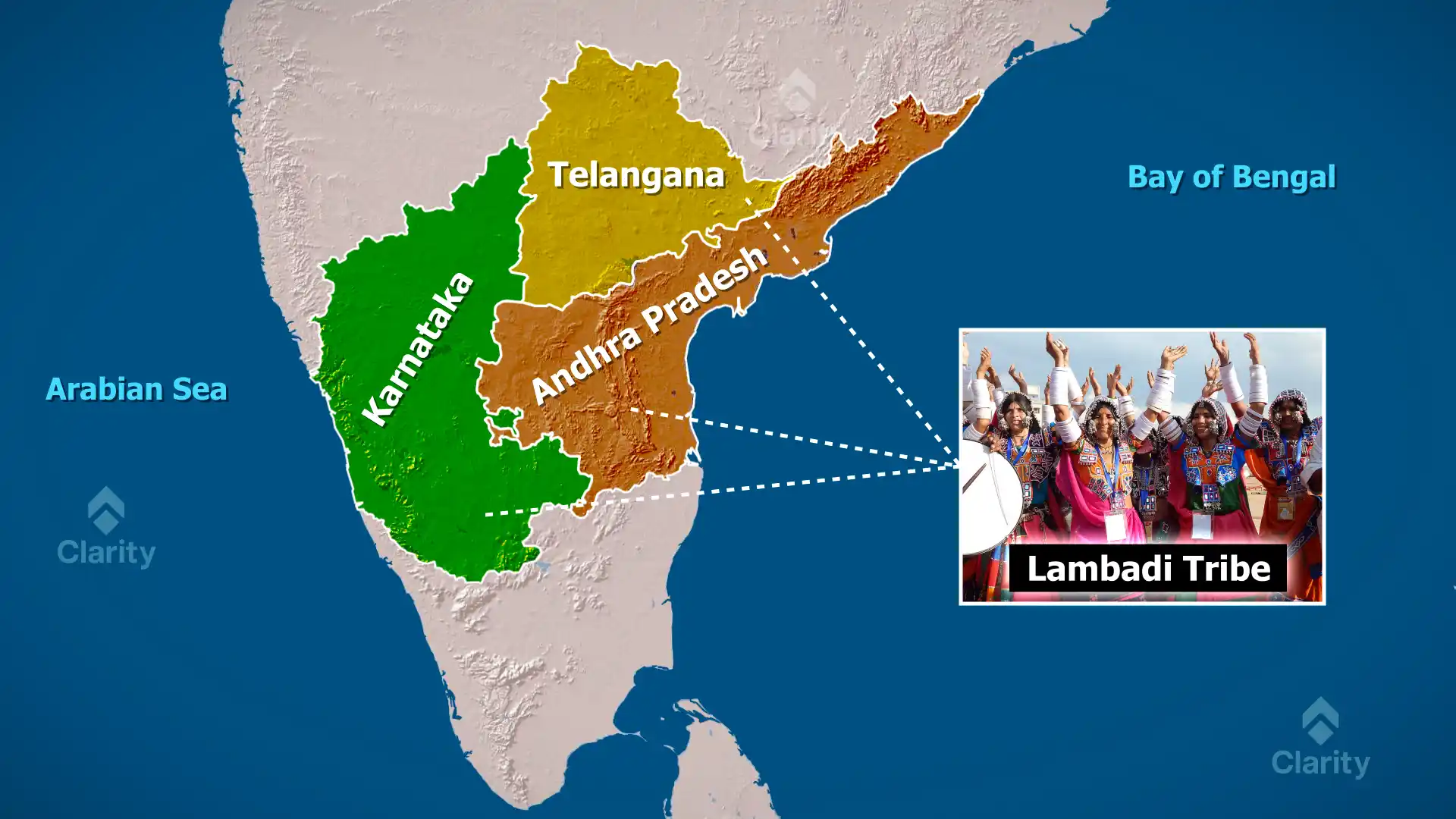
The Supreme Court of India heard petitions challenging the inclusion of the Lambadi, or Banjara, community in Telangana’s list of Scheduled Tribes. Some Adivasi groups argue that the Lambadis were historically nomadic traders rather than indigenous forest dwellers and that their inclusion dilutes quotas meant for tribal people. The Telangana government contends that Parliament has the final say on such classifications.
Background
The Lambadi, also called Banjara or Sugali, are a nomadic community found across many Indian states. Traditionally they were traders and transporters, moving goods along caravan routes with their herds of cattle. Under British rule they were labelled a “criminal tribe” but were de‑notified after independence. The Lambadis speak Lambadi or Gor Boli, an Indo‑Aryan language without its own script, and their cultural identity is expressed through vibrant clothing, mirror embroidery (lepo), dances like Ghoomar and Chari, and festivals such as Sheetala Bhavani and Teej.
Arguments before the court
- Petitioners’ view: They claim the Lambadis were not listed as a Scheduled Tribe in the original 1950 presidential order and that their inclusion in 1976 has reduced the benefits available to other tribal groups. They argue that Lambadis are socio‑economically advanced relative to forest tribes and should be classified separately.
- Government’s stance: Telangana says that Parliament’s Scheduled Castes and Scheduled Tribes Orders (Amendment) Act of 1976 lawfully added Lambadas to the list. Article 342 of the Constitution states that once a group is notified as a Scheduled Tribe, only Parliament can exclude it. The state points out that Lambadis now constitute about 64 percent of the state’s ST population.
Why it matters
- Reservation benefits: Scheduled Tribes receive quotas in education, employment and politics. Including or excluding a community affects access to these opportunities.
- Identity and rights: The case raises questions about who counts as “tribal,” the historical experiences of nomadic groups, and how the law recognises diverse communities.
- Precedent: A judgment could influence how other communities across India seek inclusion or removal from Scheduled Tribe lists.
Conclusion
The Supreme Court’s eventual decision will have implications for affirmative action in Telangana and beyond. Balancing the rights of nomadic communities with those of forest‑dwelling tribes requires a nuanced understanding of history and socio‑economic realities.
Source: Down To Earth