Why in news?
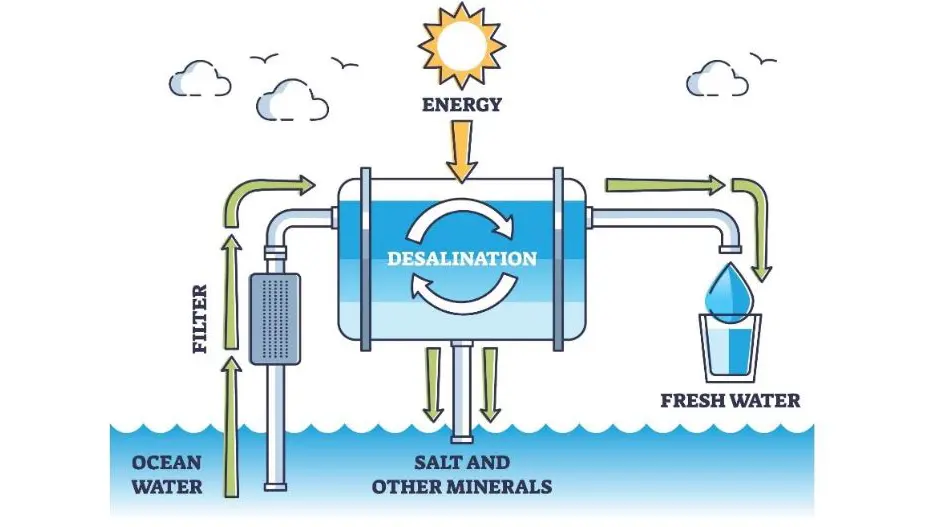
India’s Ministry of Earth Sciences reviewed the performance of low-temperature thermal desalination (LTTD) plants installed in the Lakshadweep archipelago. These plants convert seawater into fresh drinking water using the temperature difference between warm surface water and cold deep-sea water. Officials highlighted the technology’s role in addressing water scarcity on islands.
Background
Lakshadweep, a group of coral islands in the Arabian Sea, faces chronic shortages of freshwater because of limited land and rainwater harvesting. To provide clean water, the National Institute of Ocean Technology (NIOT) set up LTTD plants on several islands starting in the early 2000s. The technology uses natural temperature gradients rather than chemicals or complex membranes.
How LTTD works
- Surface water heating: Warm surface seawater is drawn into a chamber where it is exposed to low pressure, causing it to evaporate at temperatures around 25-30 °C.
- Condensation with cold water: Cold seawater is pumped from depths of about 600 metres and passed through a condenser. The vapour condenses on the outside of the condenser tubes, producing fresh water.
- Zero chemical use: Unlike reverse osmosis, LTTD does not require chemical pretreatment or membranes, making it environmentally friendly.
- Installed capacity: By 2026, eight LTTD plants were operating in the Lakshadweep islands, each supplying thousands of litres of freshwater daily.
Advantages and challenges
LTTD provides a reliable source of drinking water for remote islands where traditional desalination is difficult or costly. It consumes less energy because it exploits the natural temperature difference in seawater. However, the technology requires maintenance of deep-sea pipes and may have limited capacity compared with large-scale desalination plants.
Source: Press Information Bureau