

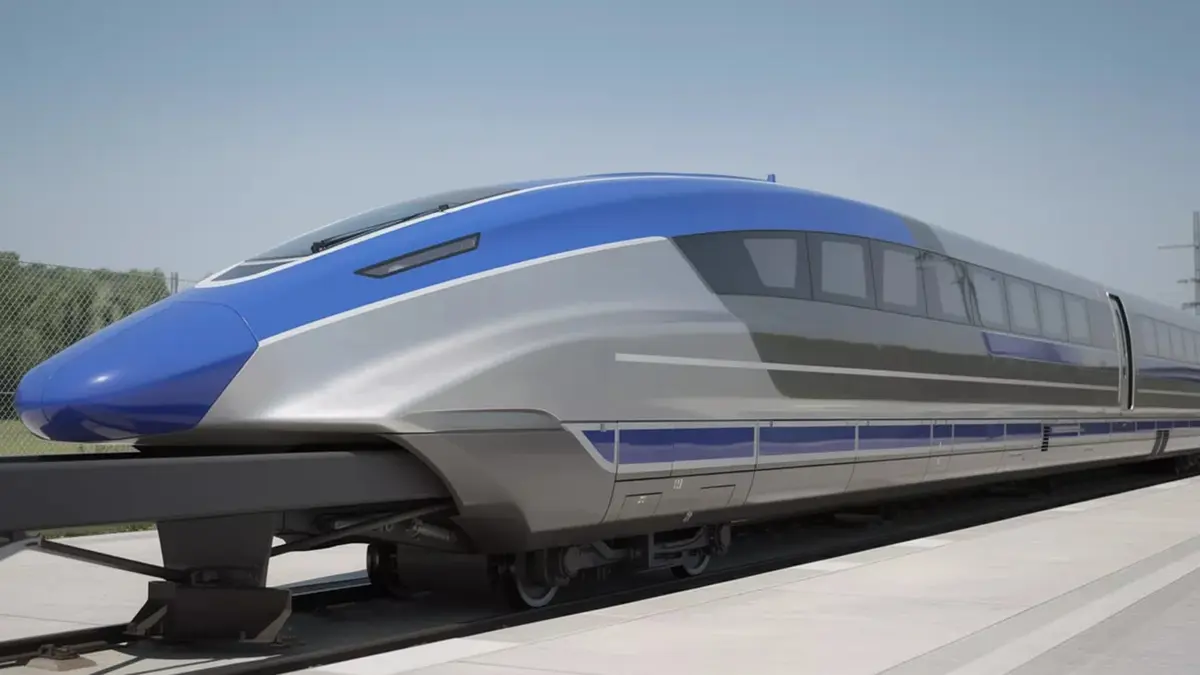
Why in news?
Researchers at China’s National University of Defence Technology announced on 27 December 2025 that they had accelerated a one‑tonne maglev vehicle to 700 km/h in just two seconds on a 400‑metre test track. The achievement demonstrates the immense thrust available from superconducting magnets and hints at the potential for future high‑speed trains and even space launch systems.
Background
Magnetic levitation (maglev) uses magnetic forces to lift, guide and propel vehicles without physical contact with rails. The concept was first proposed in the 1960s by Brookhaven physicists James Powell and Gordon Danby. There are two main technologies: Electromagnetic Suspension (EMS), where electromagnets on the train attract to ferromagnetic rails to achieve lift; and Electrodynamic Suspension (EDS), where superconducting magnets induce currents in the guideway creating repulsive forces. In both cases, eliminating wheel‑rail friction allows trains to travel much faster and more quietly than conventional rail.
Principles and advantages
- Levitation: Powerful magnets lift the train a few centimetres above the guideway, eliminating contact and nearly all mechanical friction.
- Guidance: Additional magnets keep the train centred, preventing lateral sway. In EMS systems the magnets continually adjust to maintain a stable gap.
- Propulsion: Linear motors in the track create a moving magnetic field that pulls or pushes the train forward. The train acts like the rotor of an electric motor, with the track as the stator.
- Benefits: Maglev trains are quieter, require less maintenance, and can achieve speeds above 500 km/h. With no wheel‑rail friction they are more energy‑efficient and produce fewer emissions.
Recent developments
The 2025 Chinese experiment showcased rapid acceleration using superconducting magnets cooled by liquid nitrogen. The team suggested similar technology could power future hyperloop‑style travel or assist rocket launches by providing an initial boost. The test highlights the growing global interest in maglev, with projects underway in Japan, China and South Korea.
Conclusion
Magnetic levitation represents a leap forward in transportation technology. While commercial maglev lines currently operate at lower speeds, advances in materials and control systems may soon make ultra‑high‑speed travel a reality. Further research is needed to reduce costs and integrate maglev systems into existing transport networks.
Source: HowStuffWorks