

Why in news?
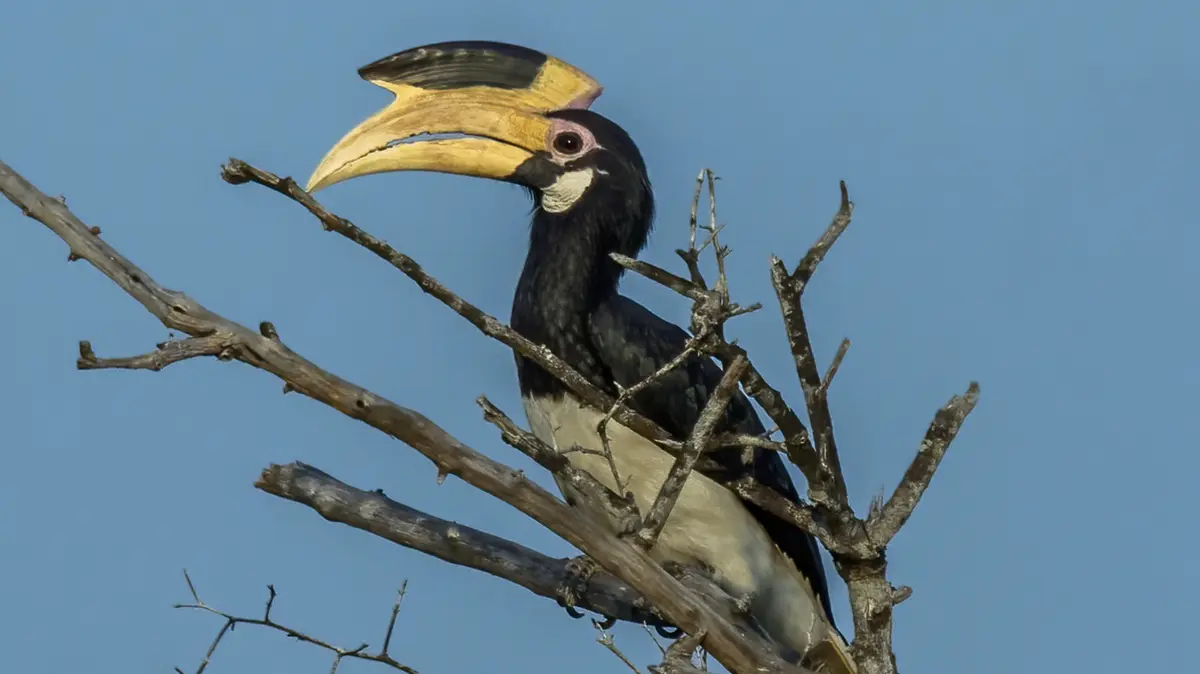
The Chhattisgarh Forest Department is setting up clusters of fruit‑bearing trees, dubbed “hornbill restaurants,” in the Udanti Sitanadi Tiger Reserve. These natural orchards aim to provide a permanent food source for the rare Malabar Pied Hornbill and encourage natural forest regeneration. Sightings of this Western Ghats species have risen in the reserve since 2017.
Background
The Malabar Pied Hornbill (Anthracoceros coronatus) is a medium‑sized hornbill with striking black‑and‑white plumage and a prominent casque on its bill. Native to the Western Ghats, north‑eastern Himalayas and Sri Lanka, it inhabits evergreen and moist deciduous forests near human settlements. The bird is primarily frugivorous, feeding on figs and other fruits but also eats small animals during the breeding season. Hornbills play a critical ecological role as “keystone seed dispersers”: by consuming fruits and dispersing seeds over wide areas they help maintain plant diversity and forest health. The species is listed as Near Threatened on the IUCN Red List due to habitat loss and fragmentation.
The hornbill restaurant initiative
Forest officials have noticed a gradual increase in the hornbill’s population within the Udanti Sitanadi Tiger Reserve, where elevations and climate resemble those of the Western Ghats. To support this growing population, the forest department is establishing natural clusters of fig trees (peepal, banyan and other Ficus species) across six sites. These “restaurants” provide year‑round fruit and safe nesting sites.
- Habitat enrichment: Planting fruit trees helps sustain the hornbills while simultaneously restoring degraded forest patches.
- Community involvement: Teams of trained trackers, drawn from local communities, use cameras and traditional ecological knowledge to monitor nests and identify hornbill habitats.
- Anti‑poaching measures: Over the past three years more than 500 poachers and encroachers have been apprehended. Drones are used to monitor illegal activities and prevent forest fires.
- Tourism and education: Fruit trees are planted near villages and waterfalls to allow visitors to observe hornbills without disturbing them, encouraging eco‑tourism.
- Conservation status: According to the IUCN, 3 000–32 000 mature individuals remain. The initiative aims to stabilise and expand their population beyond the Western Ghats.
Source: Indian Express