

Why in news?
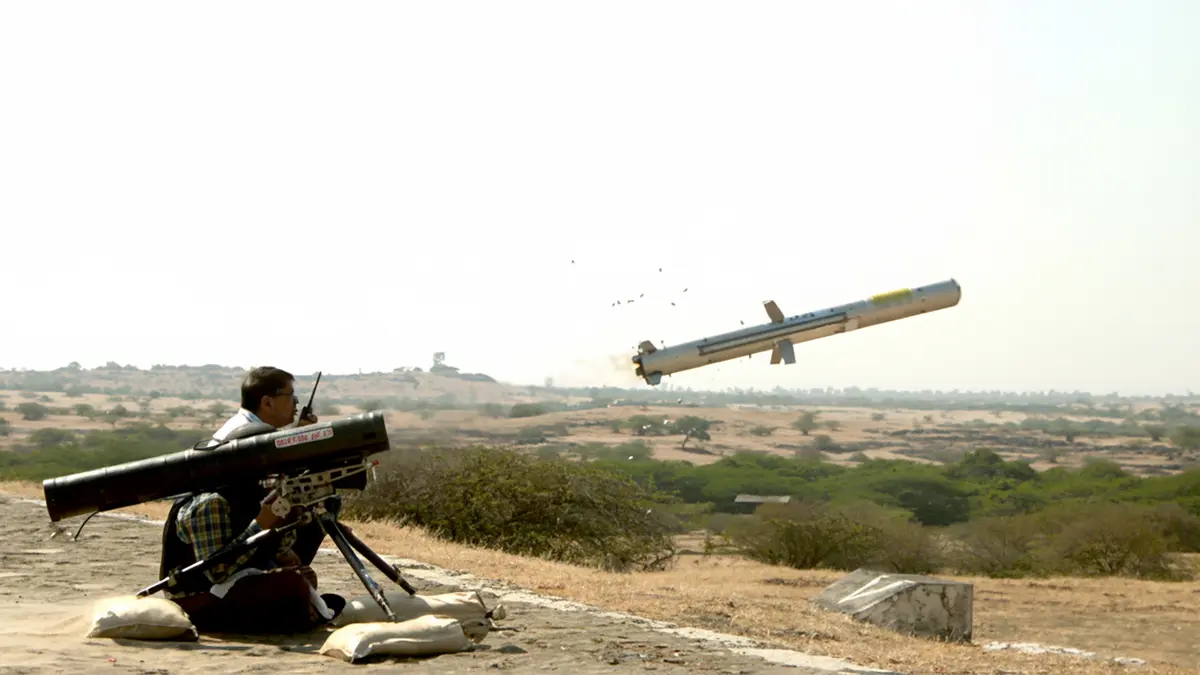
India’s Defence Research and Development Organisation (DRDO) and the Army successfully carried out trials of a new Man‑Portable Anti‑tank Guided Missile (ATGM) system. The tests demonstrated its top‑attack capability against moving targets, bringing the indigenous missile closer to induction.
Background
India has long sought a portable anti‑tank missile to replace imported systems. The DRDO began developing a man‑portable ATGM in the late 2010s, with support from the Army. Recent trials at the desert ranges involved a launcher, target acquisition system and fire‑control unit designed to be carried by infantry.
Key features
- Tandem warhead: The missile carries a tandem high‑explosive warhead capable of penetrating modern armour, including tanks protected by explosive reactive armour.
- Imaging infrared seeker: An imaging infrared seeker guides the missile and provides day‑and‑night capability. It enables both direct and top‑attack modes, the latter striking armoured vehicles in their weakly protected upper surfaces.
- All‑electric actuation: Control surfaces are moved by electric actuators, reducing reliance on hydraulics and improving reliability.
- Lightweight launcher: The complete system, including missile, launcher and sighting unit, is designed to be carried by two soldiers and quickly deployed.
- Indigenous production: DRDO laboratories in Hyderabad, Chandigarh, Pune and Dehradun led development, with public‑sector firms Bharat Dynamics Ltd. and Bharat Electronics Ltd. gearing up for manufacturing.
Significance
- Self‑reliance: Developing a modern ATGM indigenously reduces dependence on foreign suppliers like the U.S. Javelin and allows the Army to tailor features to local requirements.
- Enhanced infantry capability: Portable anti‑tank missiles provide infantry units with the ability to engage armoured threats without heavy support weapons.
- Technological advancement: The project advances India’s expertise in guidance, seeker and warhead technologies, which can be applied to other missile programmes.
Conclusion
The successful trials of India’s man‑portable ATGM mark a step toward fielding a domestically built weapon capable of neutralising modern tanks. Continued testing and production will bolster the Army’s firepower and contribute to the broader push for defence self‑sufficiency.
Source: Press Information Bureau