

Why in news?
Astronomers recently weighed a rogue planet — one that does not orbit any star — by observing a gravitational microlensing event. By combining measurements from telescopes on Earth and the European Space Agency’s Gaia satellite, researchers estimated that the planet’s mass is roughly one‑fifth that of Jupiter and that it lies about 3,000 parsecs from the centre of our galaxy.
What is microlensing?
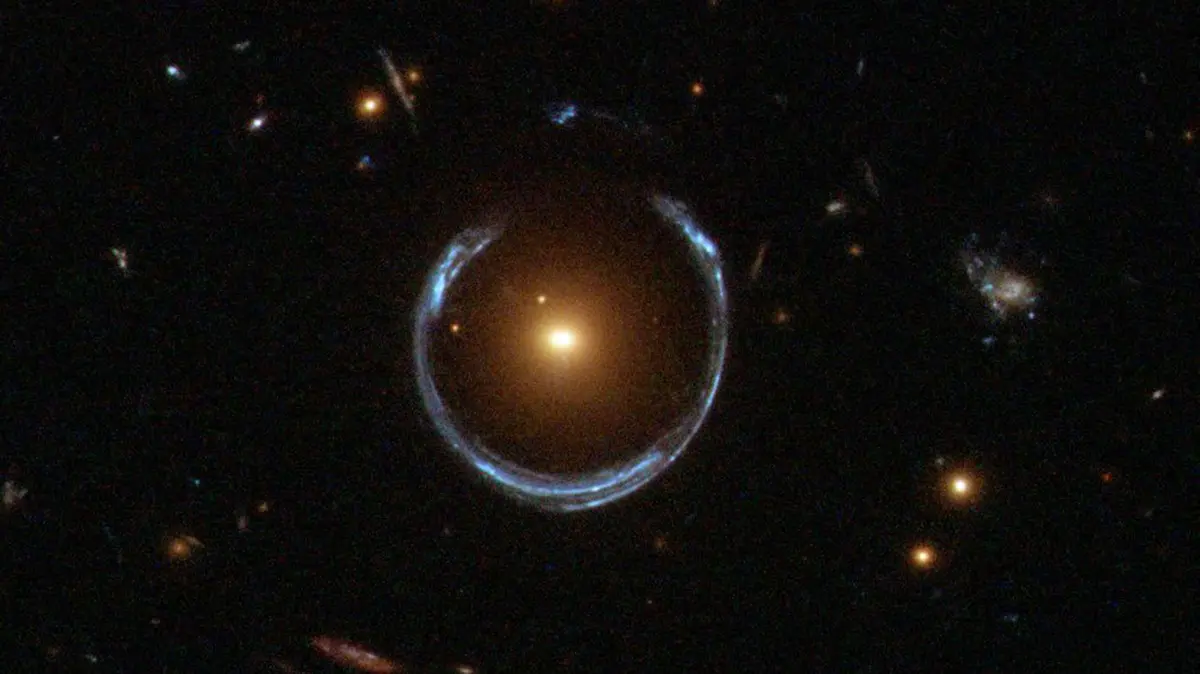
Gravity bends the path of light. When a massive object, such as a star or planet, passes between a distant background star and an observer, its gravity can act like a lens, magnifying and distorting the background star’s light. This phenomenon, predicted by Einstein’s general theory of relativity, is called gravitational lensing. Microlensing refers to cases where the intervening object is relatively small — a star or planet — and the magnification is temporary as the objects align. Because the foreground object does not need to emit light, microlensing allows astronomers to detect dark or faint objects, including free‑floating planets and black holes.
Why microlensing matters
- Probing unseen objects: Microlensing can reveal the mass and distance of an otherwise invisible foreground object by analysing how long the light curve is magnified and how its brightness changes.
- Completing the exoplanet census: Other planet‑hunting methods, such as the transit or radial‑velocity techniques, favour planets close to their stars. Microlensing is sensitive to planets at wider separations, including those similar to Jupiter and Saturn and even rogue planets adrift in interstellar space.
- Future surveys: NASA’s upcoming Roman Space Telescope and ground‑based networks will monitor millions of stars for microlensing events, helping to map the full diversity of planetary systems in our galaxy.
Although microlensing events are rare and unpredictable, each one offers a unique opportunity to study celestial objects otherwise beyond reach. The recent weighing of a rogue planet demonstrates the precision achievable when space‑ and ground‑based observations are combined.
Source: The Hindu