

Why in news?
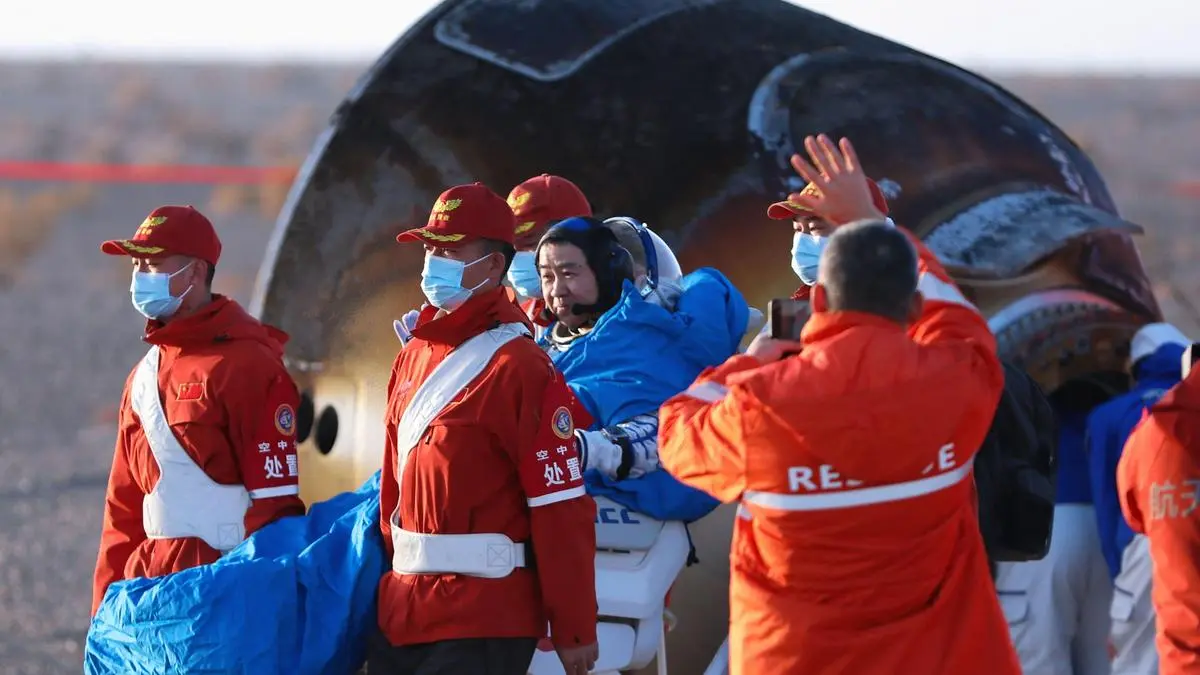
The Chinese spacecraft Shenzhou‑20 was recently delayed when a tiny piece of space debris less than a millimetre wide struck its window, creating a crack more than a centimetre long. This incident underscored the growing threat of micrometeoroids and orbital debris to satellites, crewed missions and future space exploration.
Background
What are micrometeoroids? These are natural dust‑sized particles originating from comets and asteroids. They continuously bombard Earth and objects in orbit at speeds averaging around 10 km/s. When they strike spacecraft at such velocities, even tiny grains can release enormous energy.
What is orbital debris? Also called “space junk,” it refers to human‑made objects in orbit that no longer serve a useful purpose. This includes spent rocket stages, defunct satellites, paint flakes and fragments from past collisions or explosions.
- Hypervelocity impacts: A 1 cm paint fleck travelling at orbital speed can impart the same energy as a 250 kg object moving at 100 km/h. Collisions can puncture spacecraft, disable instruments or threaten astronaut safety.
- Population growth: More than 25,000 trackable objects larger than 10 cm and millions of smaller fragments orbit Earth. The “Kessler syndrome” is a scenario in which collisions produce cascading debris, rendering certain orbits unusable.
- Shielding: Modern spacecraft use Whipple shields—thin sacrificial outer layers that break up incoming projectiles before they strike the main hull. Researchers are experimenting with self‑healing materials and multi‑layered structures to absorb impacts better.
- Mitigation measures:
- Space agencies design satellites to withstand small impacts and practise collision avoidance by tracking debris.
- Satellites are de‑orbited or moved to “graveyard” orbits at end of life to reduce debris.
- International guidelines encourage minimising launch debris and passivation (venting residual fuel) to prevent explosions.
Significance
- Safety: Micrometeoroids and space debris pose one of the greatest hazards to astronauts, satellites and the International Space Station. Preventing damage is critical for sustainable human presence in space.
- Economic impact: Space‑based services—from GPS and weather forecasting to communications—depend on reliable satellites. Debris‑related disruptions could have wide‑ranging economic consequences.
- Global cooperation: Addressing space debris requires international agreements on responsible launch practices, active removal technologies and sharing of tracking data.
Source: TH