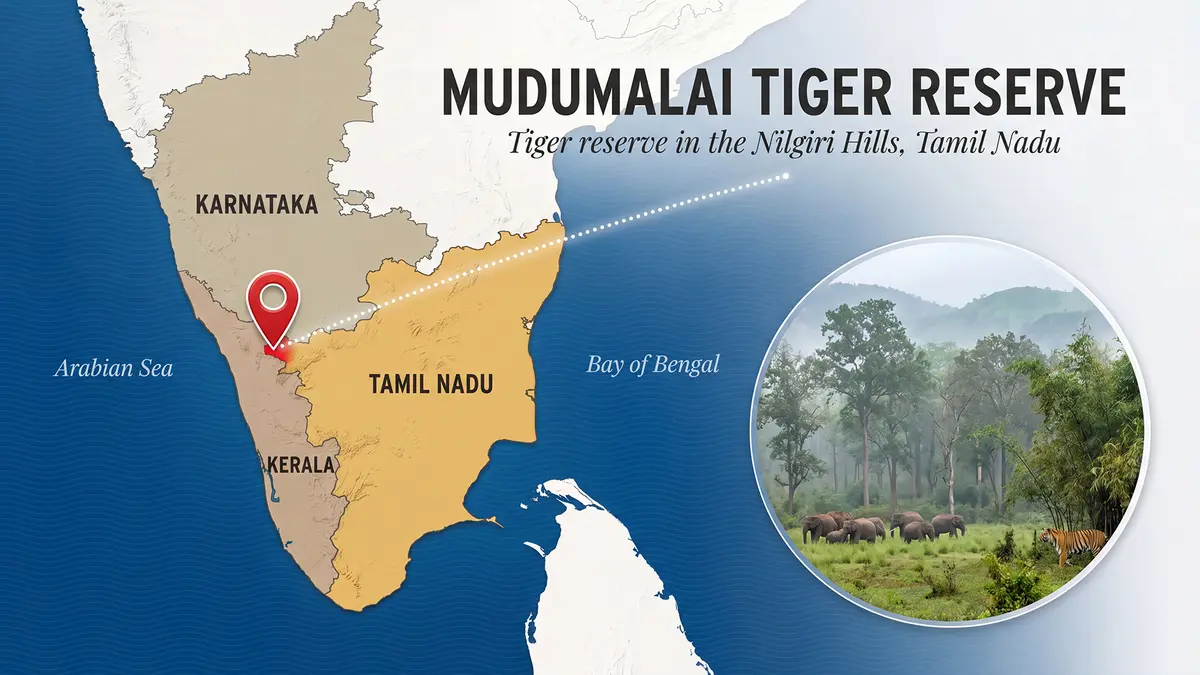
Why in news?
The administration of Nilgiris district in Tamil Nadu recently travelled deep into the Mudumalai Tiger Reserve to check on remote tribal hamlets ahead of the 2026 Lok Sabha elections. Officials crossed the Moyar River by coracle to reach Thengumarahada village and assess whether residents had access to electricity, water, toilets and ramps at polling stations. The visit highlights efforts to make polling accessible for forest dwellers in one of India’s oldest wildlife sanctuaries.
Background
Mudumalai is a protected area straddling the tri‑junction of Tamil Nadu, Karnataka and Kerala. Established as a wildlife sanctuary in 1940, it covers roughly 321 square kilometres of dense forest and open grassland at elevations between 850 and 1,250 metres. In 1986 it became part of the Nilgiri Biosphere Reserve, and in 2007 it was notified as a tiger reserve. The Moyar River drains the reserve and forms the state boundary. Home to more than 400 plant species, elephants, gaurs and leopards, Mudumalai hosts a population of endangered Bengal tigers. It receives heavy monsoon rainfall and its name derives from Tamil words meaning “first hill” or “ancient forest”.
Why voter outreach matters
- Remote settlements: Several tribal communities live inside the buffer zones of the reserve. The only access to some hamlets is by crossing the river in small boats, making it difficult to transport voting materials and to provide civic amenities.
- Inclusiveness: Ensuring water, electricity and toilets at polling booths encourages higher turnout among tribal voters who may otherwise feel neglected. It fulfils India’s constitutional commitment to universal adult suffrage.
- Conservation and livelihoods: Many residents depend on forest produce and eco‑tourism for income. Engaging them in democratic processes strengthens trust and supports long‑term conservation efforts.
Significance
- Protecting wildlife while enabling democracy: Mudumalai shows that preserving wilderness does not preclude human rights. By arranging safe transport and improving facilities, authorities ensure that conservation goals and electoral participation coexist.
- Focus on accessibility: The proactive inspection emphasises barrier‑free infrastructure such as ramps for voters with disabilities and proper sanitation, setting a precedent for other remote areas.
- Model for other reserves: With many tiger reserves containing tribal settlements, the Nilgiris initiative may inspire similar outreach in regions like Sundarbans and Simlipal where villagers face logistical challenges on polling day.
Conclusion
The Nilgiris district’s efforts demonstrate how a sensitive balance can be achieved between protecting biodiversity and upholding democratic rights. By bringing essential services closer to remote forest communities, officials hope to boost turnout and reaffirm that every vote matters—even deep within a tiger reserve.
Sources: The New Indian Express, Mudumalai National Park – Wikipedia