

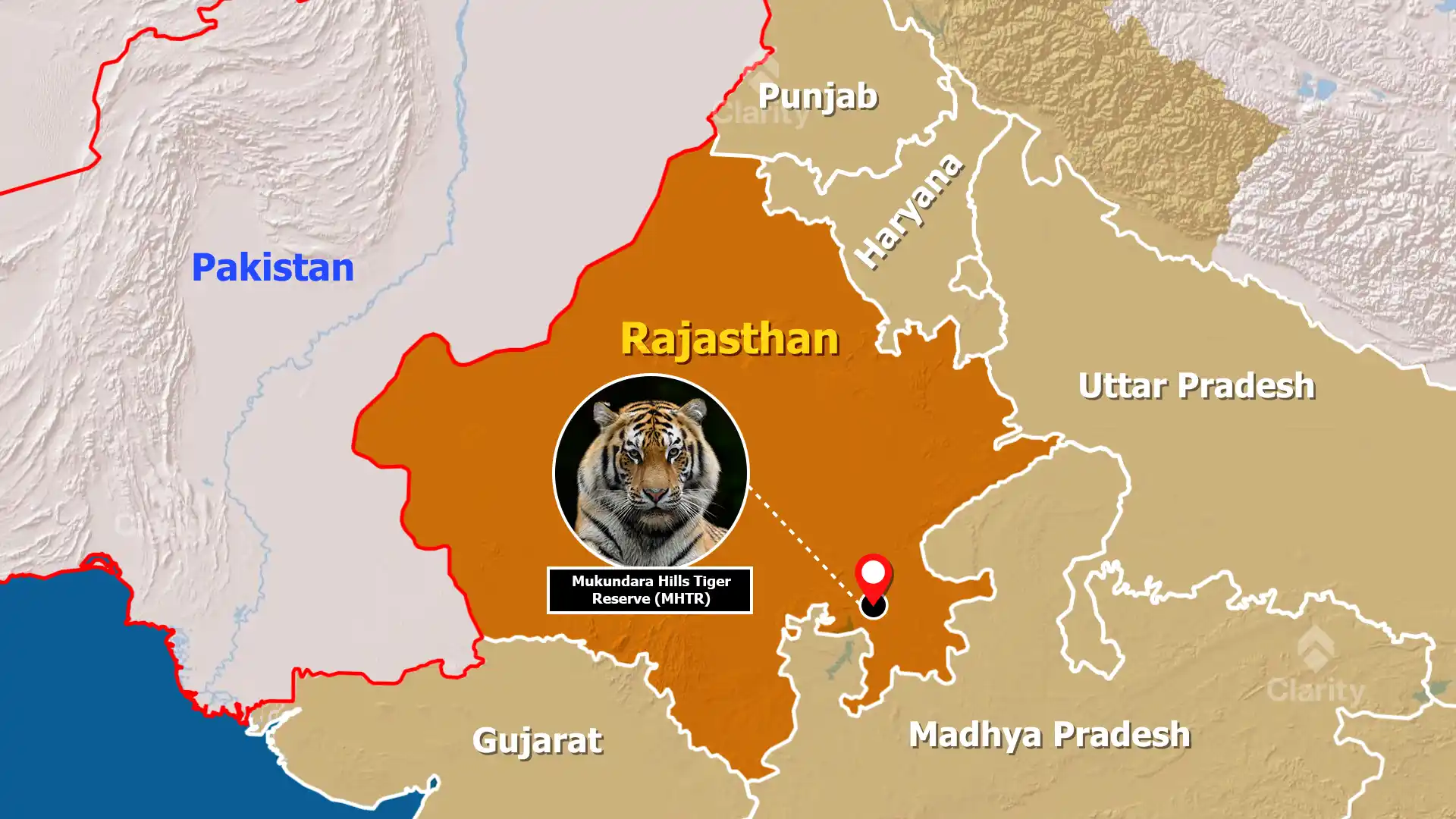
Why in news?
A trailer for a documentary entitled Enchanting Mukundra was released on 23 December 2025. The film aims to promote awareness about the Mukundra Hills Tiger Reserve in Rajasthan, which currently hosts five tigers and attracts tourists to its rugged landscapes.
Background
Formation and geography: Mukundra Hills Tiger Reserve (MHTR) was notified in April 2013 as Rajasthan’s third tiger reserve. It includes Mukandara National Park, Darrah Wildlife Sanctuary, Jawahar Sagar Wildlife Sanctuary and part of the Chambal Gharial Sanctuary. The reserve spans approximately 760 km² (417 km² core and 343 km² buffer) across the districts of Kota, Bundi, Jhalawar and Chittorgarh.
- Landscape: The reserve lies within the Vindhyan hill system, consisting of undulating hills, plateaus and river valleys. The Chambal River flows along its eastern boundary, providing perennial water sources.
- Flora: The vegetation is dry deciduous. Dominant trees include Anogeissus pendula (dhok), Boswellia serrata (salai), Acacia catechu (khair) and Diospyros melanoxylon (tendu). The understorey contains shrubs, climbers, grasses and medicinal herbs.
- Fauna: The reserve supports chital, sambar, nilgai, chinkara, wild boar, sloth bear, striped hyena, jackal, fox, jungle cat and leopard. About 140 species of birds have been recorded. Tigers were reintroduced in 2019 after a gap of many years.
- Connectivity: A forested corridor links MHTR with Ranthambore Tiger Reserve to the north, allowing genetic exchange among tiger populations.
Management challenges and initiatives
- Strengths: MHTR benefits from abundant water, suitable prey and dedicated protection staff. Several villages were voluntarily relocated from the core area, creating a large inviolate zone.
- Challenges: The reserve’s long, linear shape creates a large edge where tigers encounter people and livestock. Feral cattle and invasive weeds such as Lantana and Parthenium degrade habitat. Highways and canals fragment corridors, and there is a shortage of trained field staff.
- Tourism and awareness: The documentary campaign aims to promote responsible tourism and raise funds for conservation. Tourism must be managed carefully to avoid disturbing wildlife.
Source: WEEK