
Why in news?
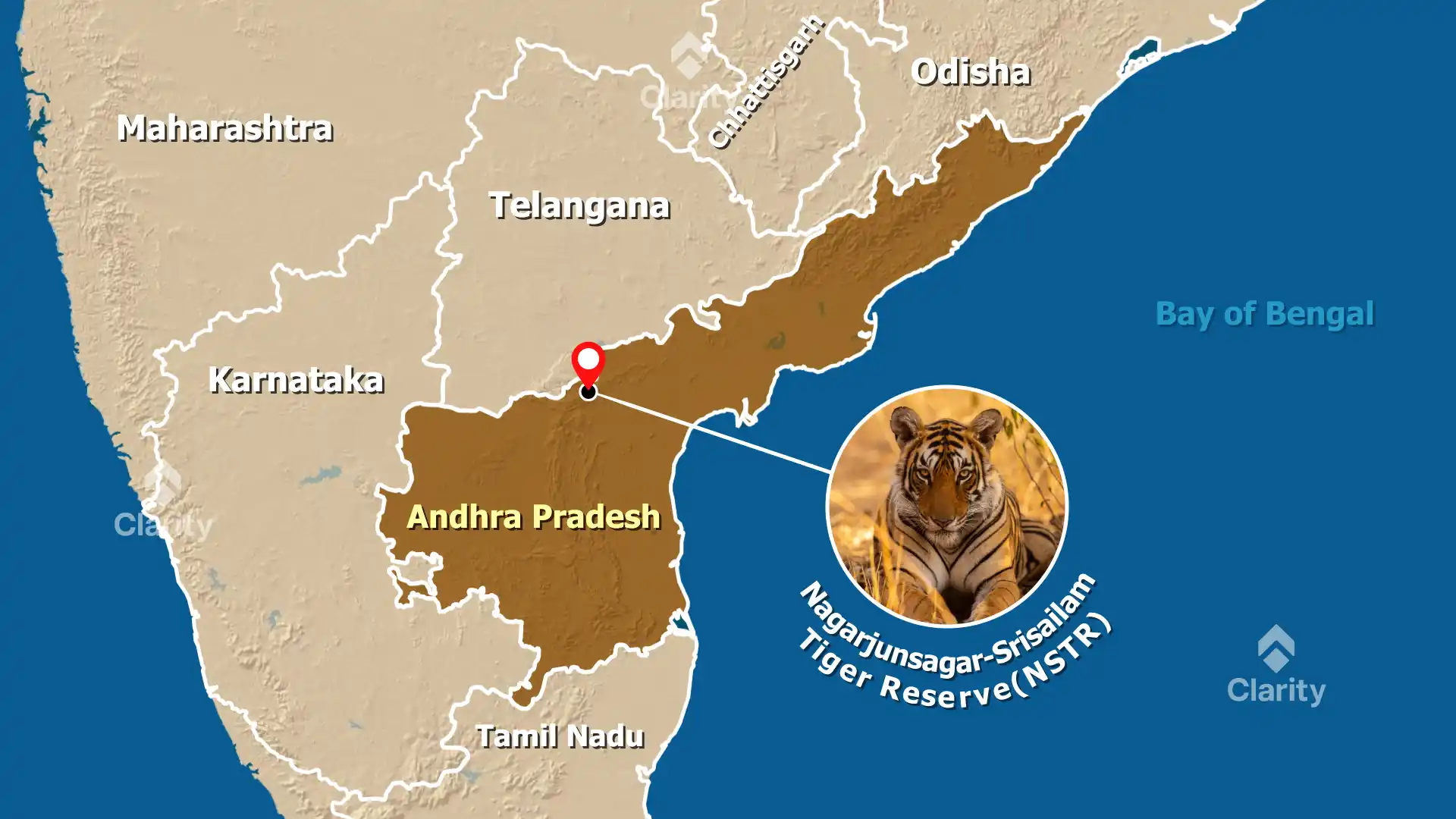
In early January 2026, forest officials launched the third spell of the All India Tiger Estimation 2026 at the Nagarjunasagar–Srisailam Tiger Reserve (NSTR), India’s largest tiger reserve. High‑definition infrared cameras were installed at hundreds of sites to photograph tigers and other wildlife. The census, which runs for about 40 days, is part of a nationwide exercise to update tiger numbers and assess habitat health.
Background
NSTR spans about 3,728 sq km across the Nandyal, Palnadu, Prakasam, Nalgonda and Mahabubnagar districts of Andhra Pradesh and Telangana. Designated as a tiger reserve in 1983, it includes plateaus, deep gorges and valleys carved by the Krishna River. The reserve’s core area covers around 1,200 sq km; the rest is a buffer zone supporting tribal communities and regulated tourism.
All India Tiger Estimation 2026 at NSTR
- Multi‑phase survey: The first phase, held in December 2025, recorded the presence of carnivores, herbivores and habitat features. The second phase used satellite data and sign surveys to map animal movements. The third phase, starting 3 January 2026, focuses on camera trapping.
- Camera deployment: In divisions such as Markapur and Atmakur, officials set up about 1,406 infrared cameras at 703 locations. Two cameras at each point capture animals from both directions to identify individuals by their unique stripe patterns.
- Data analysis: Photos collected up to mid‑February are sent to the National Tiger Conservation Authority (NTCA) and the Wildlife Institute of India (WII) for analysis. Results from NSTR will contribute to the nationwide estimate released in 2026–27.
Importance of NSTR
- Largest tiger habitat: NSTR is the biggest tiger reserve in the country. Tiger numbers have risen from 48 in 2014 to 73 in 2022. Preliminary evidence suggests the population now exceeds 80 thanks to conservation efforts and habitat connectivity.
- Rich fauna: Besides tigers, the reserve supports leopards, sloth bears, Indian pangolins, dholes, chital, sambar and blackbuck. Reptiles such as mugger crocodiles and Indian pythons inhabit its rivers and wetlands.
- Connectivity corridors: Wildlife dispersal routes link NSTR to the Nallamala and Seshachalam ranges. Maintaining these corridors ensures genetic exchange and reduces human–wildlife conflicts.
Significance
- Scientific monitoring: The All India Tiger Estimation uses standardised methods every four years. Accurate data guide policy decisions, resource allocation and conservation planning.
- Community engagement: Forest staff work with local tribal communities, including the Chenchu people, who serve as guides and anti‑poaching patrols. Involving indigenous youth fosters stewardship and provides livelihood opportunities.
- Conservation strategies: Understanding population trends helps identify areas needing stronger protection, habitat restoration or conflict mitigation measures.
Conclusion
The ongoing tiger census in Nagarjunasagar–Srisailam reflects India’s commitment to conserving its national animal. By blending technology, scientific rigour and community participation, the exercise aims to ensure that the roar of the tiger continues to echo through the forests of the Deccan Plateau.
Source: New Indian Express

