

Why in news?
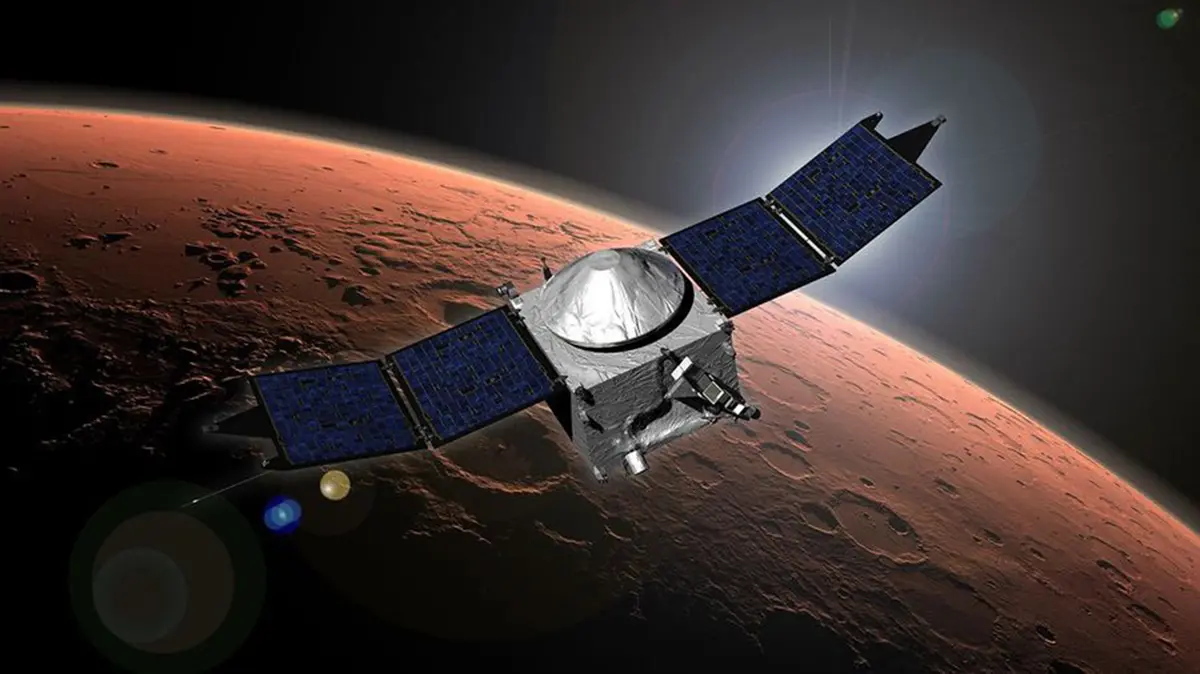
NASA reported on 9 December 2025 that contact was lost with the Mars Atmosphere and Volatile Evolution (MAVEN) mission. Telemetry before loss indicated all systems were normal, but after the spacecraft emerged from behind Mars the Deep Space Network could not detect a signal. Engineers are investigating and hope to re‑establish communication.
Background
MAVEN is a robotic orbiter launched by NASA on 18 November 2013 to study the upper atmosphere of Mars. It entered orbit around Mars on 21 September 2014 and is managed by the University of Colorado’s Laboratory for Atmospheric and Space Physics (LASP). The mission’s goal is to understand how the solar wind and ultraviolet radiation have stripped away the planet’s atmosphere over billions of years, shaping Mars’ climate and habitability.
Instruments and observations
- Particles and Fields Package: A suite of six sensors measures solar wind electrons and ions, energetic particles, thermal ion composition, and magnetic fields. These instruments reveal how charged particles interact with the Martian atmosphere.
- Remote Sensing Package: The Imaging Ultraviolet Spectrograph scans the limb and disc of Mars in ultraviolet wavelengths, mapping hydrogen, deuterium and oxygen loss.
- Neutral Gas and Ion Mass Spectrometer (NGIMS): This instrument analyses the composition and isotopes of neutral gases and ions in the upper atmosphere.
Key findings
- MAVEN discovered that Mars lost much of its early atmosphere when its global magnetic field weakened, allowing the solar wind to erode gases into space. Researchers estimate that about two‑thirds of the original atmosphere was stripped away.
- The mission observed diffuse auroras and measured how solar storms accelerate atmospheric escape.
- MAVEN’s data have helped explain why Mars transformed from a warmer, wetter planet into the cold, dry world seen today. It also provides context for future human missions by characterising radiation and space‑weather conditions around Mars.
Current status and future
NASA is working to regain contact with MAVEN. If communication is re‑established, the spacecraft could continue operating until around 2030. Its loss would be significant but researchers have already extended its mission well beyond the original timeline. The event highlights the challenges of deep‑space operations and the importance of redundancy and early warning systems.
Source: TH