

Why in news?
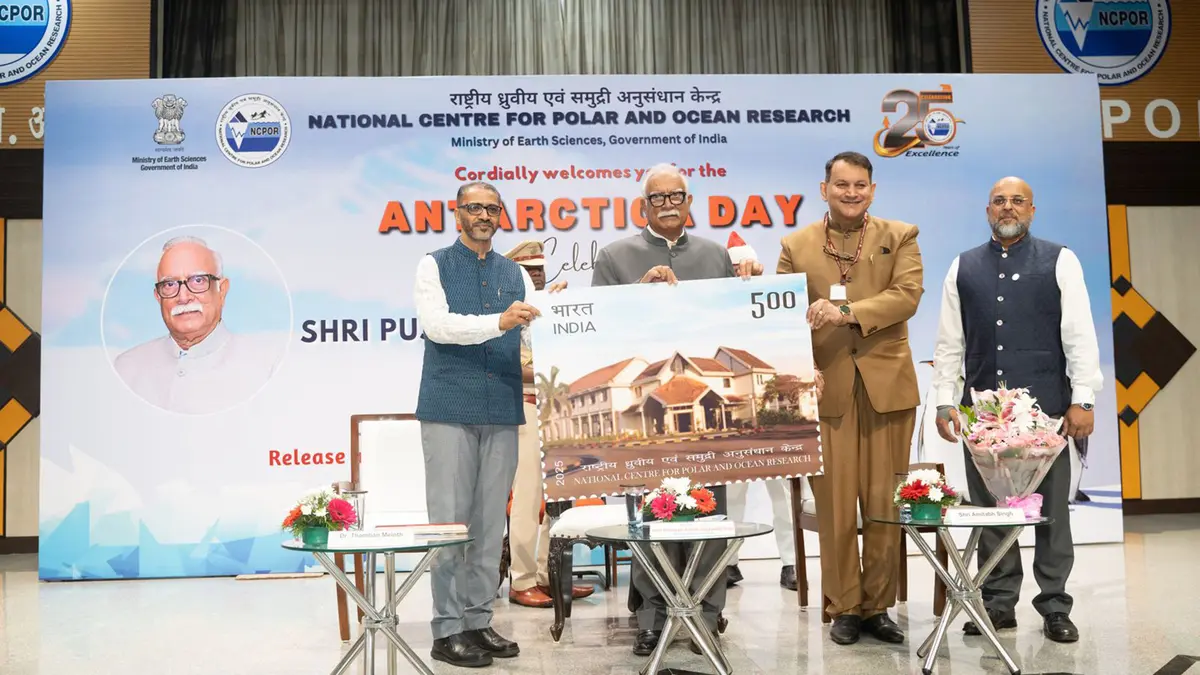
The National Centre for Polar and Ocean Research (NCPOR) celebrated its silver jubilee in November 2025. To mark the occasion, India issued a commemorative postage stamp, and researchers highlighted the institution’s contributions to polar science and oceanic exploration.
Background
NCPOR was established in April 2000 under the Ministry of Earth Sciences. It serves as the nodal agency for India’s polar expeditions and marine research, coordinating activities in Antarctica, the Arctic, the Southern Ocean and the Himalayas. Over the past 25 years, the centre has played a crucial role in understanding climate change, sea‑level rise, glaciology and oceanography.
India’s presence in the polar regions began with the Antarctic expedition of 1981. Since then, NCPOR has developed permanent research stations: Dakshin Gangotri (1983, now a supply base), Maitri (1988) and Bharati (2012) in Antarctica; Himadri (2008) in the Arctic archipelago of Svalbard; and a high‑altitude Himalayan station Himansh (2016) in Spiti Valley. The centre operates research vessels, including ORV Sagar Nidhi and ORV Sagar Kanya, which study the Indian Ocean and Southern Ocean.
Major achievements
- Climate research: NCPOR scientists monitor ice sheets, sea‑ice dynamics and atmospheric processes to understand global warming and its impact on monsoon patterns. Their studies have contributed to international assessments such as those of the Intergovernmental Panel on Climate Change (IPCC).
- India’s Deep Ocean Mission: The centre is a key partner in exploring the deep sea for minerals and biodiversity. It is developing technologies for mining polymetallic nodules from the ocean floor while ensuring environmental safeguards.
- International collaboration: NCPOR works with polar institutes from Norway, Russia, the United States and other countries. Joint projects include Arctic climate modelling, Antarctic geological mapping and ocean‑atmosphere coupling studies.
- Capacity building: Training programmes for young scientists and technicians have expanded India’s expertise in polar logistics and research methodologies.
Significance
- Understanding climate change: Polar regions act as early warning systems for global climate shifts. Data collected by NCPOR help predict sea‑level rise and extreme weather events that affect India.
- Strategic presence: Maintaining research stations enhances India’s voice in international treaties such as the Antarctic Treaty System and contributes to peaceful scientific cooperation.
- Technological advancement: Developing deep‑sea exploration tools and polar logistics improves indigenous capabilities and supports initiatives like the Deep Ocean Mission.
Conclusion
Over 25 years NCPOR has evolved from a fledgling programme into a comprehensive institution driving India’s polar and oceanic research. Continued investment in infrastructure, international cooperation and capacity building will keep India at the forefront of climate science and marine exploration.
Source: Press Information Bureau