

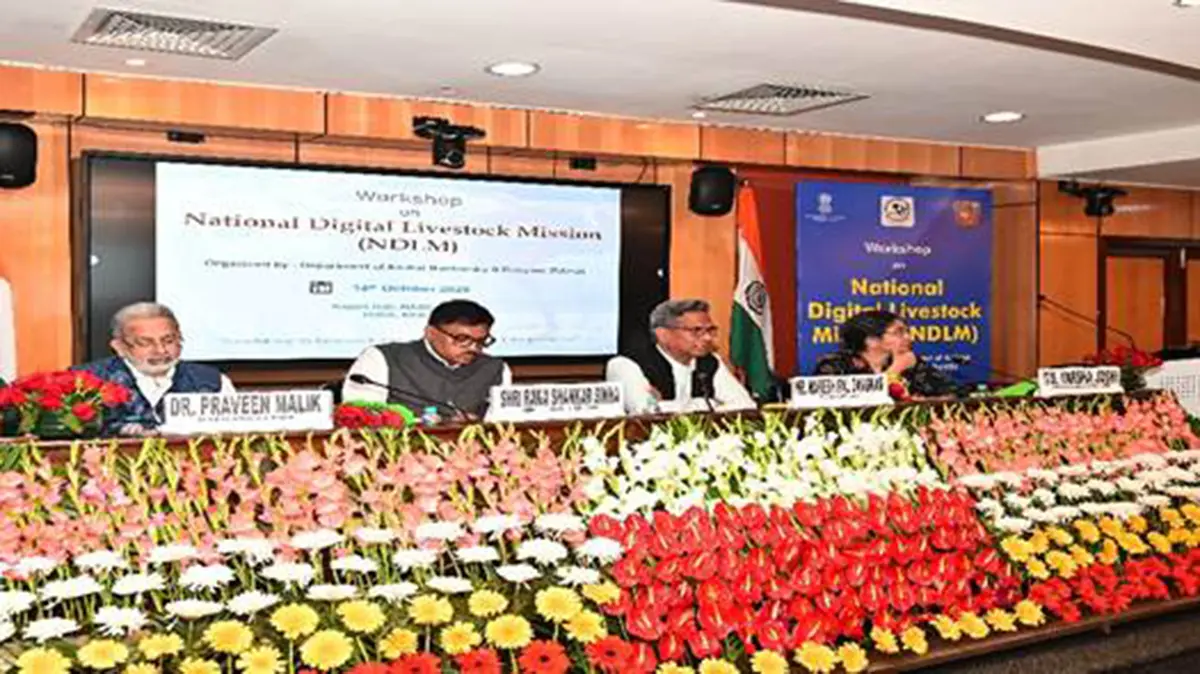
Why in news?
The Department of Animal Husbandry and Dairying recently announced major progress under the National Digital Livestock Mission. Over 35 crore animals have been assigned a unique Pashu Aadhaar identification number, and millions of livestock owners across India are using the digital platform to access breeding and veterinary services.
Background
India is home to the world’s largest livestock population, yet productivity and disease control have long been hampered by the absence of reliable data. The NDLM, launched in 2021, aims to create a digital registry for every farm animal and provide farmers with a single platform to manage breeding, health and marketing information. The system centres on a 12‑digit ear tag known as Pashu Aadhaar and the Bharat Pashudhan mobile and web platform.
Key components
- Unique identification: Each cattle, buffalo, sheep, goat or pig receives a bar‑coded ear tag linked to a cloud‑based database. This record stores details of the animal’s breed, age, lineage and ownership.
- Digital record‑keeping: More than four lakh field workers use mobile devices to record artificial inseminations, pregnancies, vaccinations, milk yield and disease reports in real time. Farmers can track this information through the Bharat Pashudhan app.
- Scale and statistics: By December 2025 the system covered about 35.96 crore animals and registered 9.5 crore livestock owners. Over 146 crore vaccination entries and 250 crore transactions have been logged, demonstrating the platform’s reach.
- Open‑source architecture: The mission uses open standards so that banks, insurance firms and other agricultural programmes can integrate seamlessly. It aligns with initiatives such as the Rashtriya Gokul Mission and National Animal Disease Control Programme.
Benefits
- Breed improvement: Accurate pedigree and performance data help farmers select superior bulls and dams, leading to better milk yields and meat quality.
- Disease surveillance: Real‑time reporting of vaccinations and illnesses enables quick response to outbreaks and supports long‑term disease eradication campaigns.
- Traceability: A robust digital trail from farm to market improves consumer confidence and allows for the certification of disease‑free products, opening export opportunities.
- Farmer empowerment: By accessing advisory services, subsidies and insurance online, small holders gain greater bargaining power and financial inclusion.
Challenges and the way forward
- Data quality: Ensuring that field staff consistently update records and that farmers understand how to use the system remains a challenge. Training and awareness campaigns are essential.
- Infrastructure: Reliable internet connectivity and mobile devices are necessary in remote villages. Efforts are underway to improve rural digital infrastructure.
- Privacy and security: Safeguarding the personal information of farmers and the genetic data of animals requires robust cybersecurity measures and clear data‑sharing protocols.
Conclusion
The National Digital Livestock Mission represents a paradigm shift from paper‑based record‑keeping to a data‑driven livestock sector. By improving productivity, disease control and market access, the mission can substantially increase rural incomes and support India’s goal of becoming a global dairy and meat powerhouse.
Sources: PIB