
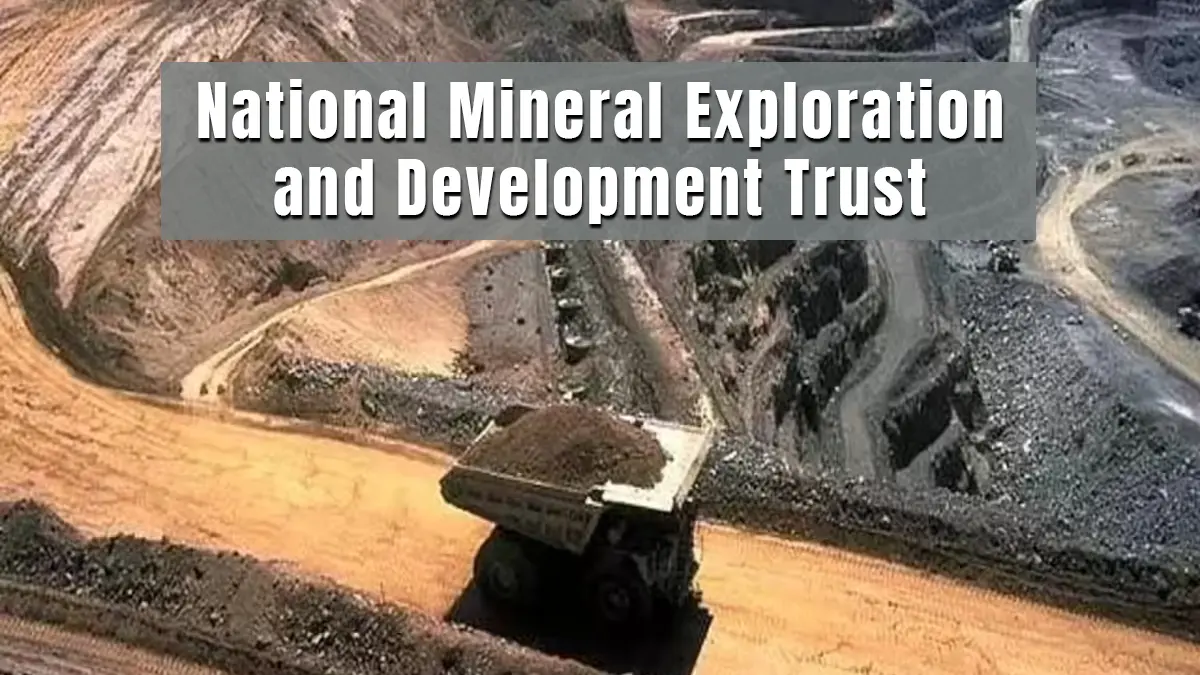
Why in news?
A parliamentary standing committee recently urged the government to strengthen the National Mineral Exploration and Development Trust (NMET) and create a dedicated offshore exploration policy to harness seabed minerals. The panel pointed out that India’s first offshore block auction in 2023 had no takers, highlighting policy gaps.
Background
The NMET was set up in 2015 under the Mines and Minerals (Development and Regulation) Act. Mining companies contribute an extra 3 per cent of royalty on major minerals to the trust. The fund is used for regional and detailed exploration and for capacity building in the minerals sector. It has a Governing Body chaired by the Union Minister of Mines and an Executive Committee led by the Secretary of the Ministry.
Functions of NMET
- Funding exploration: Supports surveys to identify and assess mineral resources, including deep‑seated and offshore minerals like polymetallic nodules and phosphorites.
- Research and development: Finances studies on sustainable mining, mineral beneficiation and new technologies.
- Capacity building: Provides training and grants to national and state geological agencies to improve exploration capability.
- Promoting transparency: Ensures that exploration data is publicly shared to attract private investment.
Issues raised by the committee
- Policy clarity: Lack of a dedicated offshore mining policy has deterred investors from exploring undersea minerals.
- Resource potential: India has significant reserves of cobalt, nickel, and rare earth metals on the seabed. Harnessing these could reduce import dependence and support battery industries.
- Fund utilisation: The committee recommended greater transparency in NMET’s fund flow and a multi‑year roadmap for exploration spending.
The government is expected to revise rules to incentivise offshore exploration and make NMET funds more accessible to explorers.
Sources: Business-Standard

