

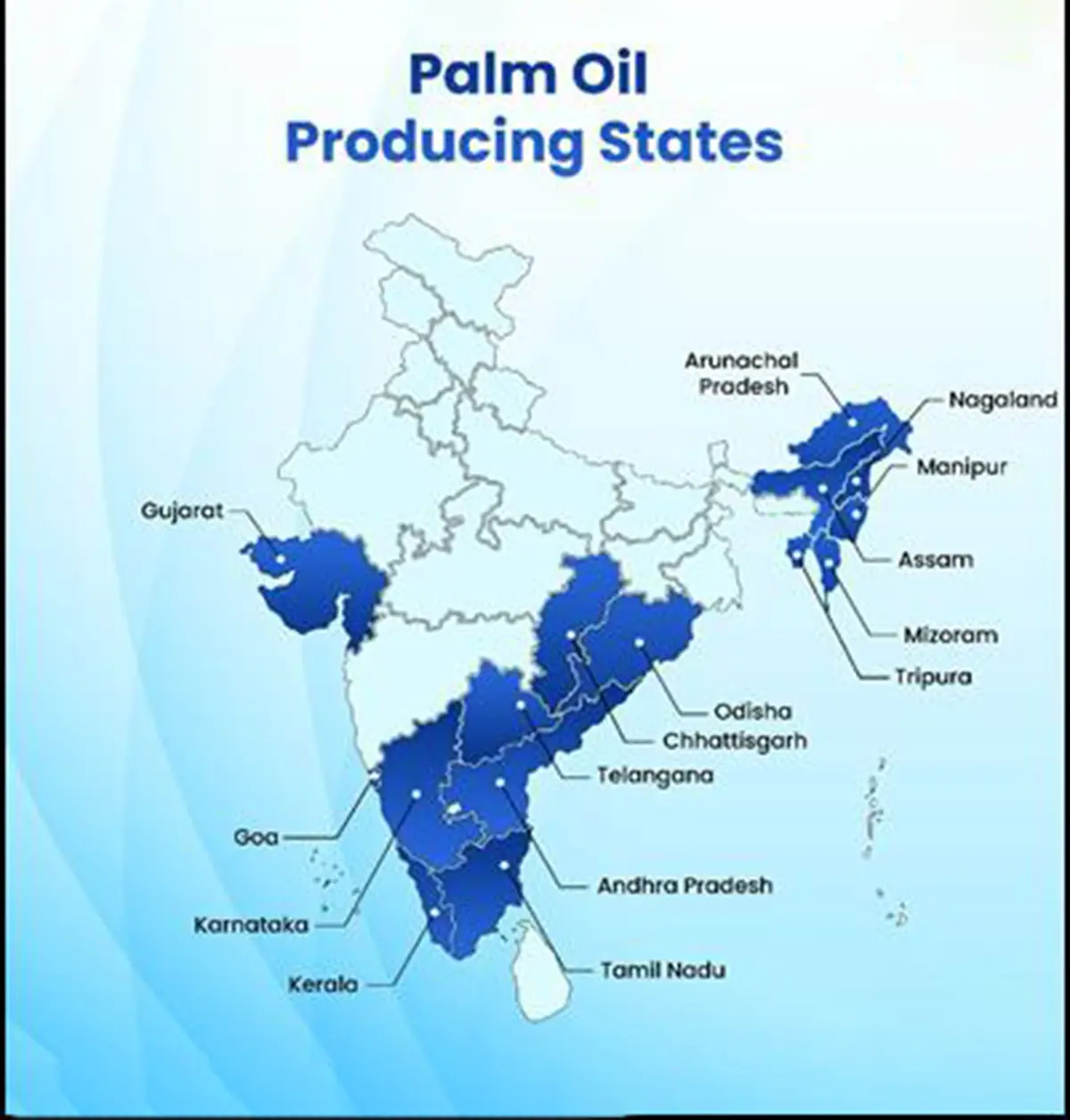
Why in news?
In November 2025, the Ministry of Agriculture reported progress under the National Mission on Edible Oils. Additional area was brought under oil palm cultivation and a new mission for oilseeds was approved to raise domestic production and reduce import dependency.
Background
India is the world’s second‑largest consumer of edible oils but relies heavily on imports, especially palm oil. To achieve self‑sufficiency, the government launched the National Mission on Edible Oils in 2021. The mission has two components: the National Mission on Edible Oils – Oil Palm (NMEO‑OP) and the National Mission on Edible Oils – Oilseeds (NMEO‑OS). NMEO‑OP aims to boost domestic production of crude palm oil, while NMEO‑OS, approved in 2024, seeks to raise the production of other oilseeds such as mustard, soybean, groundnut and sunflower.
National Mission on Edible Oils – Oil Palm (NMEO‑OP)
- Expansion of area: The mission plans to bring 6.5 lakh hectares under oil palm cultivation by 2025‑26. By November 2025, around 2.5 lakh hectares of new plantations had been established, increasing total coverage to about 6.2 lakh hectares.
- Production targets: Crude palm oil (CPO) output is targeted to rise from 3.8 lakh tonnes in 2024‑25 to 28 lakh tonnes by 2029‑30. Improved varieties and better agronomic practices are being promoted to increase yield.
- Support to farmers: The mission offers financial assistance for planting material, setting up nurseries and establishing oil palm processing units. A viability gap funding mechanism ensures farmers receive a remunerative price for fresh fruit bunches.
National Mission on Edible Oils – Oilseeds (NMEO‑OS)
- Production increase: The mission aims to raise oilseed production from about 39 million tonnes in 2022‑23 to 69.7 million tonnes by 2030‑31. Area under oilseeds is to expand from 29 million to 33 million hectares, and yields are to improve through high‑quality seeds and better irrigation.
- Cluster approach: States and districts are being identified for intensive interventions. Farmers in these clusters receive improved seed material, training and linkages to processing units.
- Funding pattern: The Central government provides 60 % of project cost for general states and 90 % for northeastern and Himalayan states, with the remainder borne by states and farmers.
Significance
- Reducing import dependence: Increasing domestic production of edible oils will lower the import bill and enhance food security.
- Farmer welfare: By providing assured prices and support services, the mission seeks to make oilseed cultivation profitable, thereby raising rural incomes.
- Industrial growth: Developing domestic processing infrastructure and promoting value addition will spur agro‑industry and create jobs.
Conclusion: The National Mission on Edible Oils is a comprehensive effort to make India self‑reliant in edible oil production. Success will depend on sustained farmer support, efficient extension services and careful environmental management of oil palm plantations.
Source: Press Information Bureau