

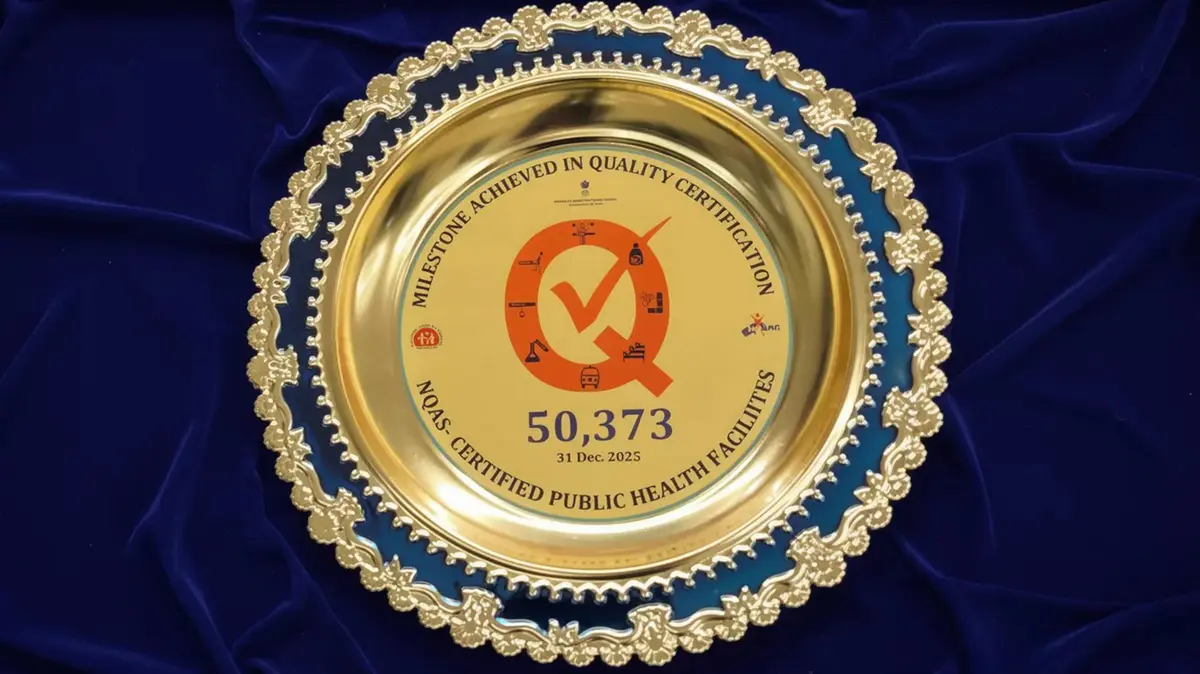
Why in news?
As of 31 December 2025, 50,373 public health facilities across India have been certified under the National Quality Assurance Standards. The milestone represents a dramatic expansion since 2015, when only 10 facilities were certified, and underscores the government’s commitment to improving public healthcare.
Background
Introduced in 2015 by the Ministry of Health and Family Welfare, the NQAS provide a comprehensive framework to ensure that public hospitals and health centres offer safe, patient‑centred, and quality‑assured services. The standards are available for District Hospitals, Sub‑district Hospitals, Community Health Centres and Primary Health Centres (including the Ayushman Arogya Mandir network). The framework is accredited by the International Society for Quality in Health Care (ISQua).
Key features
- Eight areas of concern: NQAS assesses facilities across Service Provision, Patient Rights, Inputs (infrastructure and equipment), Support Services, Clinical Care, Infection Control, Quality Management and Outcome.
- Self‑assessment and certification: Facilities use the standards to identify gaps and improve services. Certification is awarded after independent assessment.
- Coverage: The standards now apply to district and sub‑district hospitals, Community Health Centres, Urban PHCs and the new Ayushman Arogya Mandir–sub health centres.
- Rapid scale‑up: A combination of on‑site and virtual assessments, technical support and capacity‑building has enabled certification to expand from 6,506 facilities in December 2023 to over 50,000 by December 2025.
Why it matters
- Patient safety: Adhering to NQAS helps reduce infections, medical errors and sub‑standard treatment.
- Equitable healthcare: Quality standards ensure that rural and urban health centres provide comparable services, supporting universal health coverage.
- Accountability: Transparent assessment and accreditation build public trust and encourage continuous improvement.
- Goal setting: The government aims for at least half of all public health facilities to be NQAS‑certified by March 2026.
Source: Press Information Bureau