
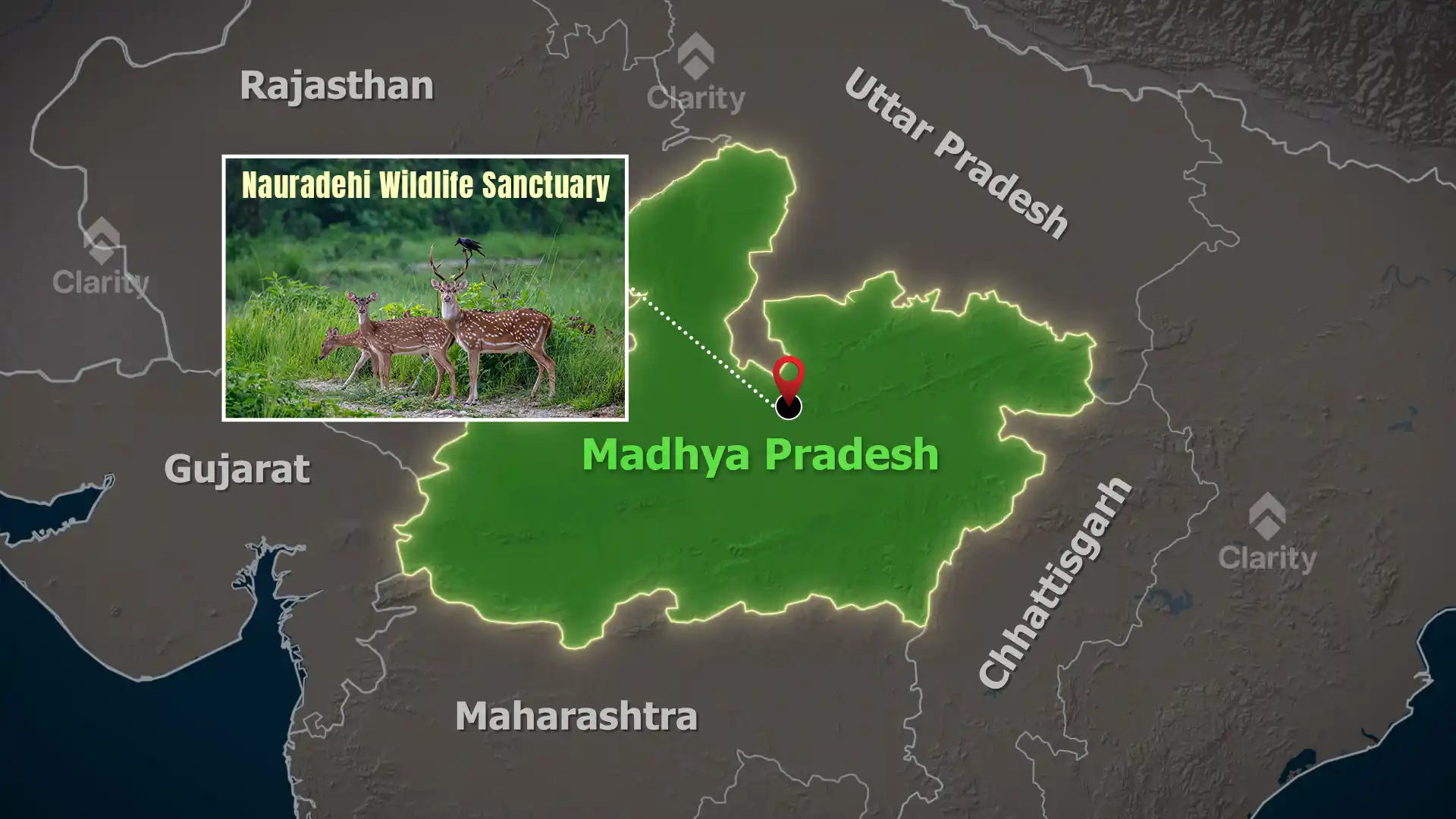
Why in news?
The Madhya Pradesh government announced in March 2026 that Nauradehi Wildlife Sanctuary will become the third release site for cheetahs under India’s reintroduction programme. Following the successful birth of cubs at Kuno National Park, authorities plan to translocate some cheetahs to Nauradehi in the coming months.
Background
Nauradehi, renamed Rani Durgavati Wildlife Sanctuary, spans more than 1 000 square kilometres across Narsinghpur, Damoh and Sagar districts in Madhya Pradesh. Lying on the Vindhyan plateau, it is the largest sanctuary in the state. It forms a vital corridor linking the Panna and Satpura Tiger Reserves.
Key features
- Diverse fauna: Unlike Kuno and Gandhi Sagar (the other two cheetah sites), Nauradehi already supports a variety of large carnivores, including about 25 tigers, leopards, Indian wolves, wild dogs and sloth bears. This means released cheetahs will have to coexist with other predators.
- Varied landscapes: The sanctuary comprises tropical dry deciduous forest interspersed with grasslands and scrub. Tree species include teak, saj, tendu and bamboo. Open plains provide suitable habitat for cheetahs.
- Rich birdlife: More than 170 bird species have been recorded here, including vultures, eagles, hornbills and rollers. The presence of healthy prey such as chital, sambar, nilgai and blackbuck supports carnivores.
- Hydrography and geology: Rivers like Kopra, Bamner and Bearma, tributaries of the Ken, drain the area. Soils derive from Vindhyan sandstone and Deccan Trap basalt, creating a mosaic of habitats.
- Cheetah reintroduction plan: Authorities plan to augment the prey base by translocating chital and managing grasslands. Villages on the periphery are being relocated to reduce human–wildlife conflict. Infrastructure such as predator‑proof enclosures and radio‑collar monitoring will be set up.
Why is another site needed?
India reintroduced cheetahs in 2022 by bringing animals from Namibia and South Africa to Kuno National Park. A second site at Gandhi Sagar in Madhya Pradesh is under development. A third site is necessary to spread the population and create meta‑populations that can exchange genes. Nauradehi’s large size and grasslands make it a promising habitat, even though it has resident predators.
Sources: Deccan Chronicle.

