
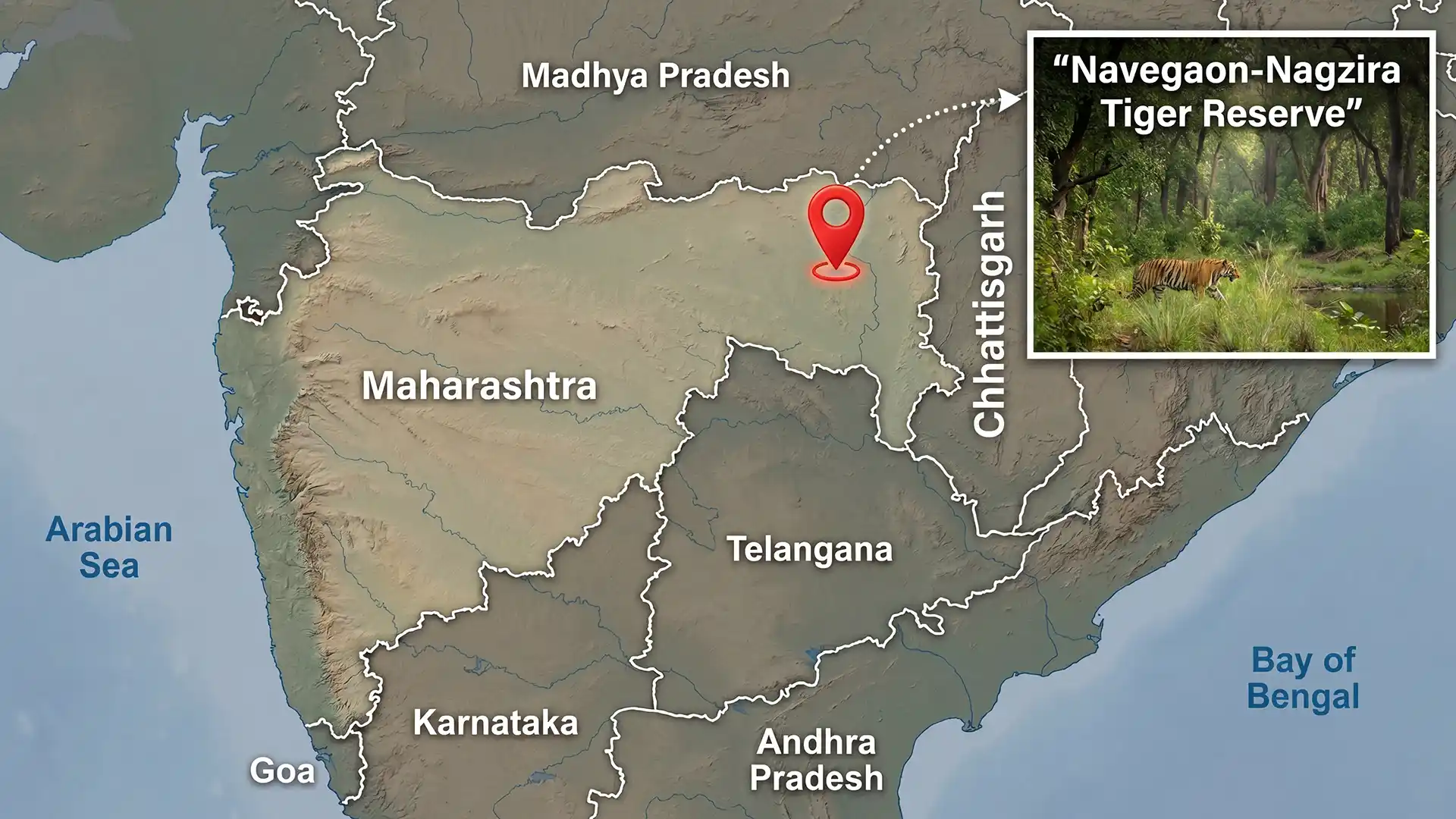
Why in news?
The Navegaon‑Nagzira Tiger Reserve (NNTR) in Maharashtra will assume management of a 652.2 square‑kilometre buffer zone from 1 April 2026. The transfer, announced through a state government resolution, will double the reserve’s area to about 1,305 square kilometres and is expected to improve conservation, tourism and management.
Background
Located in the heart of the Central Indian Tiger Landscape, NNTR was notified as a Tiger Reserve in 2013, becoming Maharashtra’s fifth. It encompasses Navegaon National Park and multiple wildlife sanctuaries—Navegaon, Nagzira, New Nagzira and Koka—and connects to tiger reserves such as Kanha, Pench and Tadoba. The terrain is undulating, rising to Zenda Pahad at about 702 metres above sea level. The forests are of the Southern Tropical Dry Deciduous type and support rich biodiversity. Fauna include tigers, panthers, civets, wolves, wild dogs, sloth bears, gaur, sambar, chital and four‑horned antelopes.
Implications of buffer transfer
- Unified management: Bringing the buffer under reserve control simplifies planning and allows consistent protection strategies across core and buffer zones.
- Enhanced tourism: Authorities plan to open new safari gates, homestays and adventure sports facilities. Safari tourism can continue in the buffer during monsoon when the core area is closed.
- Reduced conflict: Managing the buffer will help address human–wildlife conflict by improving monitoring and regulating activities in fringe areas.
- Better funding and planning: Unified control facilitates micro‑planning and quicker release of funds, enabling development projects and anti‑poaching operations.
Conclusion
Expanding management over the buffer zone will bolster conservation and tourism at NNTR. Effective planning and community engagement will be essential to balance ecological protection with livelihoods in the region.

