

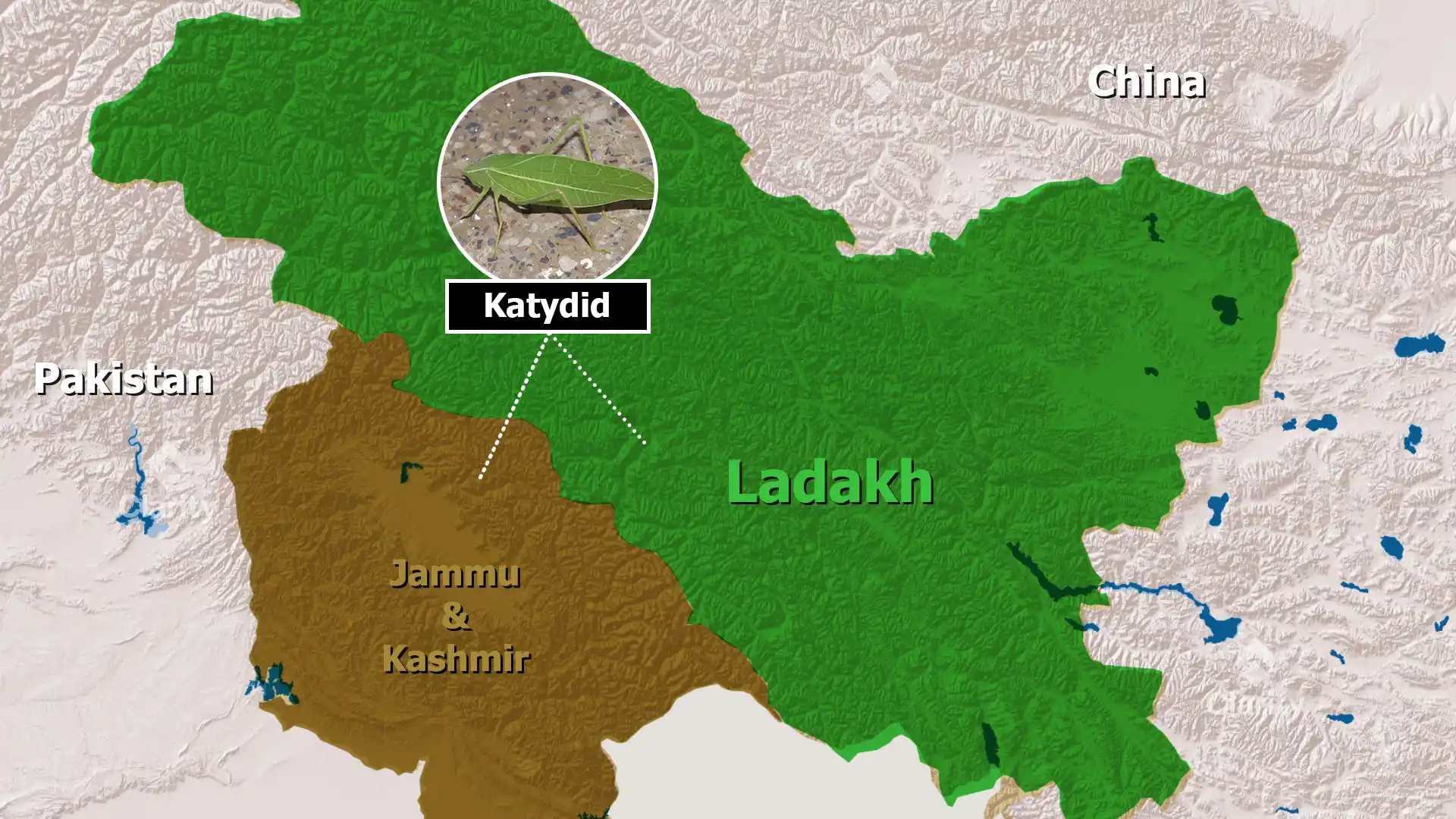
Why in news?
Researchers from Aligarh Muslim University announced in early January 2026 that they had discovered three new species of meadow katydids in Jammu & Kashmir. The species – Conocephalus usmanii, C. nagariensis and C. ganderbali – were described after detailed field surveys and microscopic analysis of their sound‑producing organs. Until now, only one species of the genus Conocephalus had been recorded from the region.
Background
Katydids are members of the insect order Orthoptera, closely related to crickets and grasshoppers. They are known for their leaf‑like wings and the chirping sounds produced by rubbing their forewings together. The genus Conocephalus includes slender, green species commonly called meadow katydids. Studying insect diversity helps scientists understand ecosystem health and informs conservation.
Discovery details
- Field surveys: Researchers conducted surveys across diverse habitats in Jammu & Kashmir, collecting specimens and recording their songs.
- Morphological analysis: The team examined the male stridulatory file – the row of teeth on the wing that produces sound – using scanning electron microscopy. Each species has a distinct number of teeth and unique shape of the male cerci (tail appendages).
- Species characters: C. nagariensis has spindle‑shaped cerci with about 34 teeth on its stridulatory file; C. ganderbali is smaller with a V‑shaped incision and 28 teeth; C. usmanii has a flat, elongated plate and about 36 teeth. Specimens are now preserved at the AMU museum.
Significance
- Biodiversity hotspot: The discoveries suggest that Jammu & Kashmir, already known for its floral diversity, also harbours hidden insect species yet to be documented.
- Conservation importance: Documenting species is the first step toward conserving them. Detailed descriptions enable future researchers to monitor populations and assess threats.
- Stimulus for research: The work highlights the value of taxonomic studies using both field observations and modern microscopy. Similar surveys elsewhere could yield more discoveries.
Sources: ETV Bharat