Why in news?
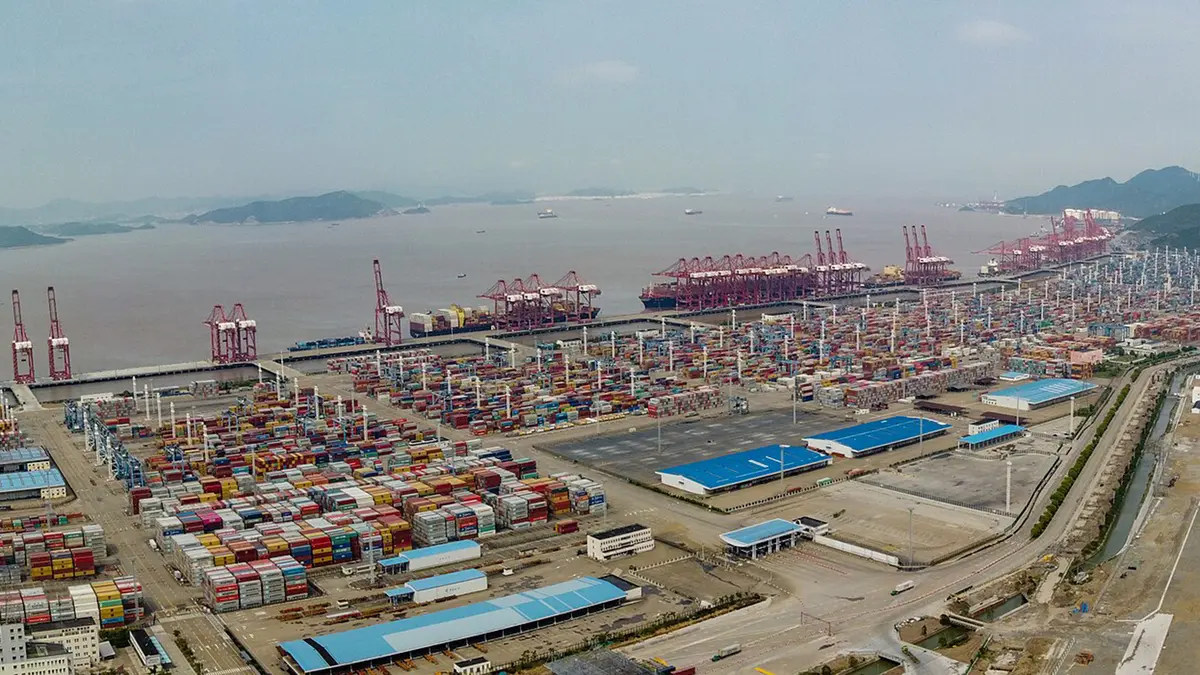
China’s Ningbo Zhoushan port retained its title as the world’s busiest port in early 2026. In 2025 the port handled over 1.4 billion tonnes of cargo and more than 40 million TEUs of containers, far ahead of any competitor. These record volumes and its modern deep‑water channels keep the port in the headlines.
Background
Ningbo Zhoushan port is situated in China’s eastern Zhejiang province, where the Yangtze River system meets the East China Sea. It grew out of centuries‑old harbours at Ningbo and Zhoushan which were merged in 2006 to create a single integrated port cluster. The harbour complex includes facilities on the mainland at Beilun and on island groups like Zhoushan, connected by bridges, causeways and channels.
What makes the port stand out?
- Enormous cargo volumes: The port has been the world’s largest cargo handling facility for more than a decade, moving over 1.4 billion tonnes of goods in 2025. It handles diverse commodities such as containers, crude oil, iron ore, coal and grain.
- Huge container traffic: With throughput exceeding 40 million twenty‑foot equivalent units (TEUs), the port ranks among the top three for container traffic. Its container terminals are designed for ultra‑large vessels.
- Deep‑water infrastructure: Ningbo Zhoushan has more than 200 deep‑water berths and modern channels like the Tiaozhoumen passage that allow 250 000‑tonne ships to call at the port. The water depth and tidal range ensure year‑round navigation.
- Global connectivity: There are over 300 regular container routes linking the port to more than 700 ports worldwide. This network makes it a key node in Asia‑Europe and Asia–North America trade routes.
- Integrated operations: The port authority operates terminals at multiple locations – Beilun, Zhenhai, Daxie, Meishan and Jintang – coordinated through digital platforms. Advanced logistics systems track cargo flows, schedule berths and provide real‑time information to shippers.
- Gateway for Chinese exports: Ningbo Zhoushan serves as one of China’s main gateways for the Yangtze River Delta. It connects manufacturing hubs in Zhejiang and Jiangsu to global markets, facilitating exports of machinery, textiles, electronics and more.
Significance
The port’s efficiency and scale influence global supply chains. Its ability to handle bulk resources and containers supports China’s manufacturing sector and affects freight rates worldwide. For India, the port is an important trans‑shipment point for cargoes moving between Indian ports and North American or European destinations.
Sources: SeatradeMaritime.