Why in news?
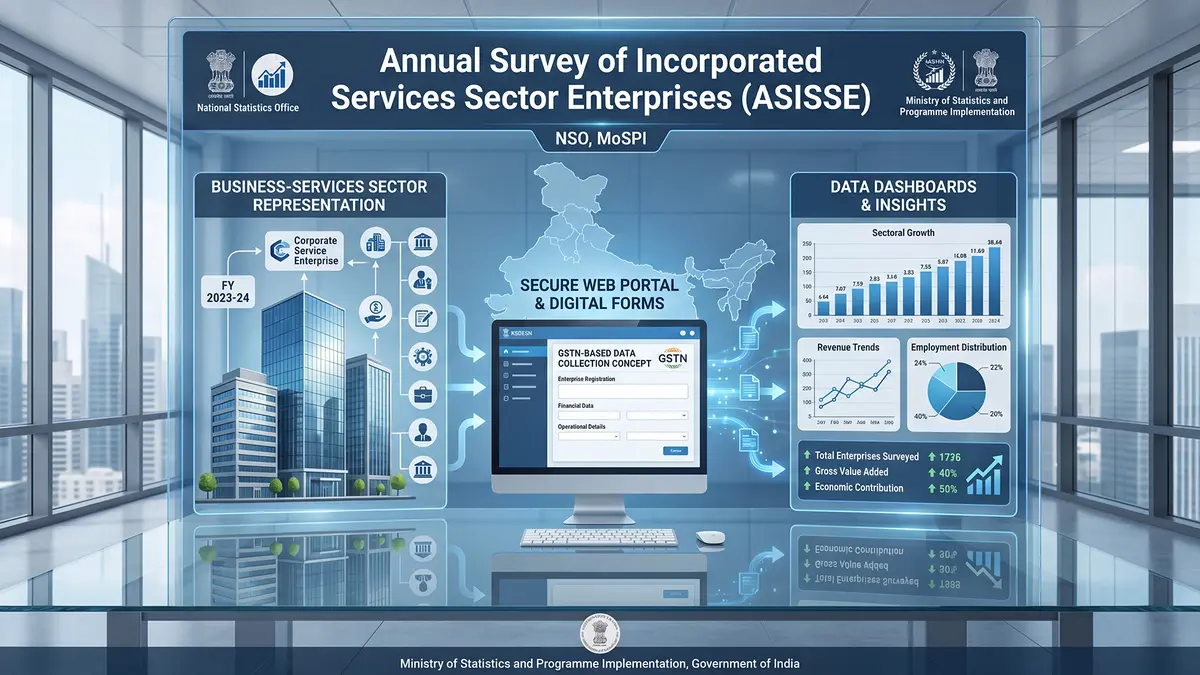
The National Statistics Office (NSO) under the Ministry of Statistics and Programme Implementation commenced the inaugural Annual Survey of Incorporated Services Sector Enterprises (ASISSE) in April 2026. The survey aims to build a comprehensive database of the incorporated services sector, which accounts for more than half of India’s GDP.
Background
India’s services sector includes activities such as information technology, finance, education, healthcare, hospitality and transport. Although these industries contribute significantly to GDP, reliable data on their output, employment and financial performance are scarce. Existing surveys like the Annual Survey of Industries focus on manufacturing and do not cover services‑sector companies registered under the Companies Act or the Limited Liability Partnership Act.
About the ASISSE
- Scope and coverage: The survey uses the Goods and Services Tax Network (GSTN) database as its sampling frame and will cover over 1.21 lakh enterprises across all states and union territories. It targets companies with turnover above specified thresholds and includes those engaged in business services, financial intermediation, professional activities, education and health.
- Data collection: Enumerators will gather information on revenue, expenses, employment, capital expenditure and use of technology. The survey will also examine how enterprises access credit, manage operations and respond to market shocks.
- Statutory basis: The ASISSE is conducted under the Collection of Statistics Act 2008, which mandates cooperation from companies. Confidentiality of individual data will be maintained, and aggregate results will be published for policy use.
- Purpose: The results will feed into national accounts, input–output tables and policy making. They will help identify bottlenecks, guide investment decisions and measure the impact of government initiatives such as Digital India and Skill India.
Expected benefits
By filling critical data gaps, ASISSE will enable evidence‑based planning for a sector that employs millions and drives innovation. Policymakers can design targeted support schemes, investors can gauge market potential and researchers can analyse productivity trends. The survey also signals the government’s commitment to statistical reforms and transparency.
Source: Press Information Bureau