
Why in news?
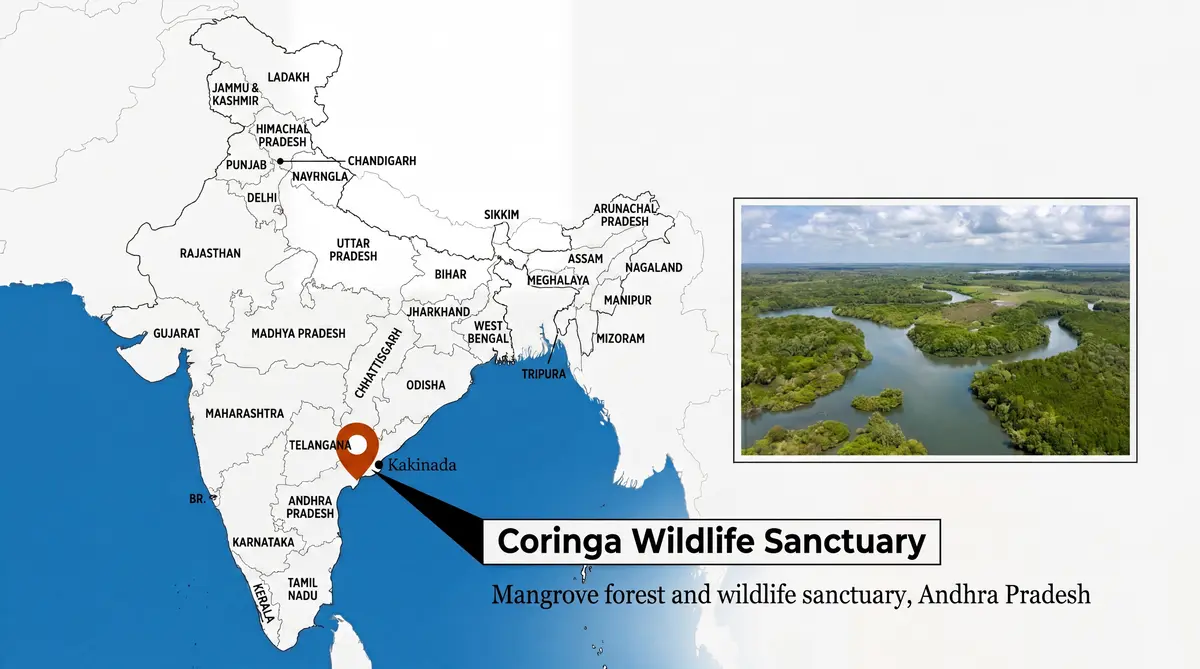
Officials of the Wildlife Management Authority and the Coringa Wildlife Sanctuary in Andhra Pradesh have conserved nearly 20,000 eggs of the Olive Ridley sea turtle on Hope Island in Kakinada Bay. By protecting eggs in situ and monitoring nesting beaches, the sanctuary is ensuring higher hatchling survival during the current nesting season.
Background
The Olive Ridley turtle (Lepidochelys olivacea) is the world’s smallest sea turtle, recognised by its heart‑shaped olive or greyish‑green shell. It inhabits tropical waters of the Pacific, Indian and Atlantic Oceans and is famous for its synchronized mass nesting or arribada, where thousands of females come ashore at once. Key facts include:
- Diet and migration: Olive Ridleys are omnivorous, feeding on jellyfish, snails, crabs and algae. They migrate long distances from the Pacific to the Indian Ocean and arrive on Indian coasts between November and December, staying until April or May.
- Nesting behaviour: Females lay 100–140 eggs in a pit dug on sandy beaches near estuaries and bays. After about 45 days the eggs hatch, and hatchlings scramble to the sea.
- Legal status: All five sea turtle species found in India, including Olive Ridleys, are listed in Schedule I of the Wildlife Protection Act 1972 and Appendix I of CITES. The IUCN classifies the Olive Ridley as Vulnerable.
Hope Island, part of the Coringa Wildlife Sanctuary, is a crucial nesting ground on the Andhra coast. Forest staff employ in‑situ conservation methods: they fence off nesting sites, relocate eggs only when absolutely necessary and keep beaches free of predators and human disturbance.
About Coringa Wildlife Sanctuary
Coringa Wildlife Sanctuary lies in the East Godavari district of Andhra Pradesh, about 20 kilometres south of the port city of Kakinada. Established in 1978, the sanctuary covers around 236 square kilometres and forms part of the Godavari delta. Features include:
- Second‑largest mangrove forest in India: The sanctuary hosts 16 true mangrove species and 19 associate species, including Avicennia, Rhizophora and Sonneratia. These salt‑tolerant trees stabilise the coastline and provide breeding grounds for fish and crustaceans.
- Diverse fauna: More than 245 bird species have been recorded, from pond herons and flamingos to migratory waders. Mammals include the endangered fishing cat (Prionailurus viverrinus), smooth‑coated otter (Lutrogale perspicillata), golden jackal and Indian fox. Reptiles like saltwater crocodiles and various snakes are also present.
- Estuarine ecosystem: The sanctuary is intersected by branches of the Gouthami and Godavari rivers, creating mudflats and brackish lagoons. The mixture of freshwater and seawater supports both marine and terrestrial wildlife.
- Threats and conservation: Deforestation, fuelwood collection, aquaculture and industrial development threaten the mangroves and wildlife. Conservation programmes focus on afforestation, anti‑poaching measures and community education.
Conservation measures for turtles
- Operation Olivia: The Indian Coast Guard conducts patrols during the nesting season to enforce fishing bans and deter trawlers that can accidentally capture turtles.
- Turtle Excluder Devices (TEDs): Fishing nets in some states are fitted with TEDs that allow turtles to escape while retaining fish catch.
- Tagging and monitoring: Researchers tag turtles to track migration routes and study survival rates. Local communities are engaged in protecting nests and guiding hatchlings to the sea.
Significance
- Biodiversity hotspot: Protecting Olive Ridley turtles contributes to the health of marine ecosystems and supports India’s obligations under international conventions.
- Coastal protection: Healthy mangroves and turtle populations help maintain coastal resilience by stabilising shorelines and supporting fisheries.
- Ecotourism potential: Responsible turtle watching can generate income for local communities and raise awareness about conservation.
Conclusion
The conservation of nearly 20,000 Olive Ridley turtle eggs at Hope Island is a testament to the dedication of forest officials and local volunteers. Preserving the mangroves and estuarine ecosystems of Coringa Wildlife Sanctuary not only protects these vulnerable reptiles but also sustains the livelihoods of coastal communities.

