

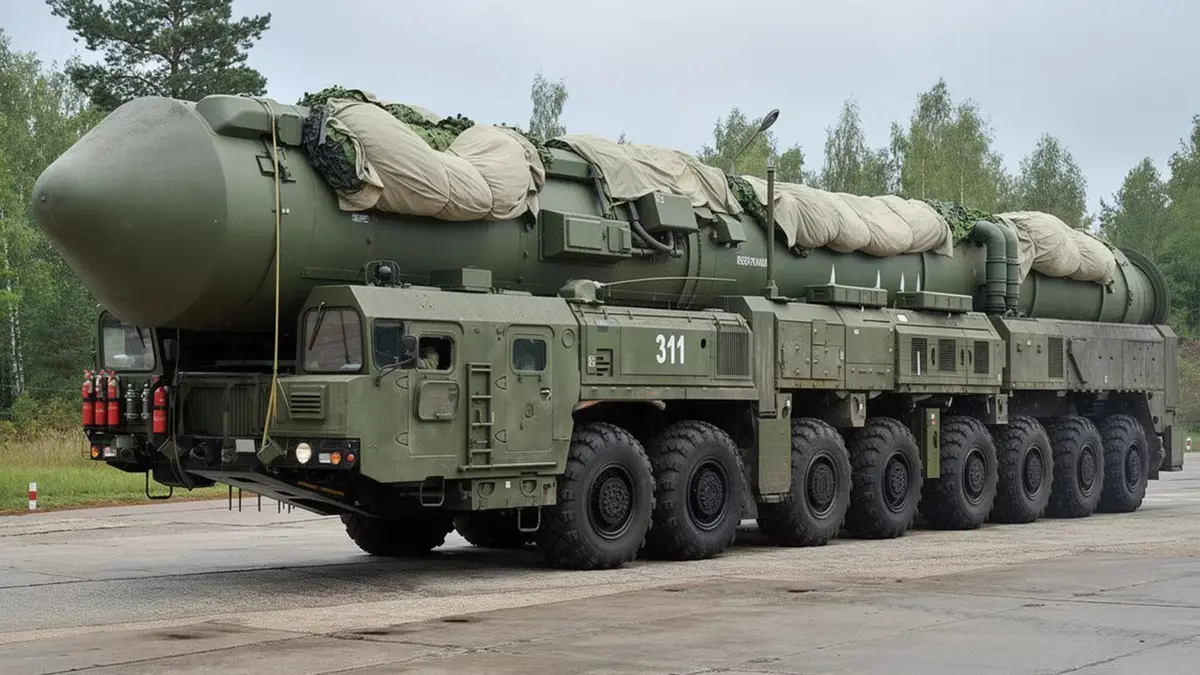
Why in news?
During Russia’s Zapad 2025 military exercises and subsequent announcements, Moscow highlighted a new missile called the Oreshnik. Western analysts believe it is a modified version of the RS‑26 Rubezh intercontinental ballistic missile, repurposed as a medium‑range weapon. Deployment in Belarus would put most European cities within reach.
Background
The Intermediate‑Range Nuclear Forces (INF) Treaty of 1987 banned ground‑launched missiles with ranges between 500 km and 5,500 km. Both the United States and Russia withdrew from the treaty in 2019, and Russia subsequently revived projects for intermediate‑range ballistic missiles. The Oreshnik appears to be one such development. Key details reported by independent analysts include:
- A range of roughly 2,000 – 5,000 km, enabling strikes across Europe from bases in western Russia or Belarus.
- A high terminal speed of around Mach 10, making interception extremely difficult.
- Capability to carry multiple independently targetable re‑entry vehicles (MIRVs) with either conventional kinetic warheads or nuclear payloads.
- Possible use of kinetic‑energy “non‑explosive” warheads designed to destroy targets through sheer impact.
- Development by the Moscow Institute of Thermal Technology as a modified version of the RS‑26 Rubezh ICBM.
Concerns and implications
- Arms control worries: Oreshnik’s range would have violated the now‑defunct INF Treaty. Its deployment may fuel fears of a new arms race and complicate efforts to negotiate future agreements.
- Regional security: Stationing the missile in Belarus extends Russian strike capability deep into Europe and signals an intent to deter NATO. This raises tensions in an already volatile security environment.
- Uncertainty about production: Western intelligence doubts Russia’s ability to mass‑produce the system, but even limited numbers could alter strategic calculations.
Source: Meduza