
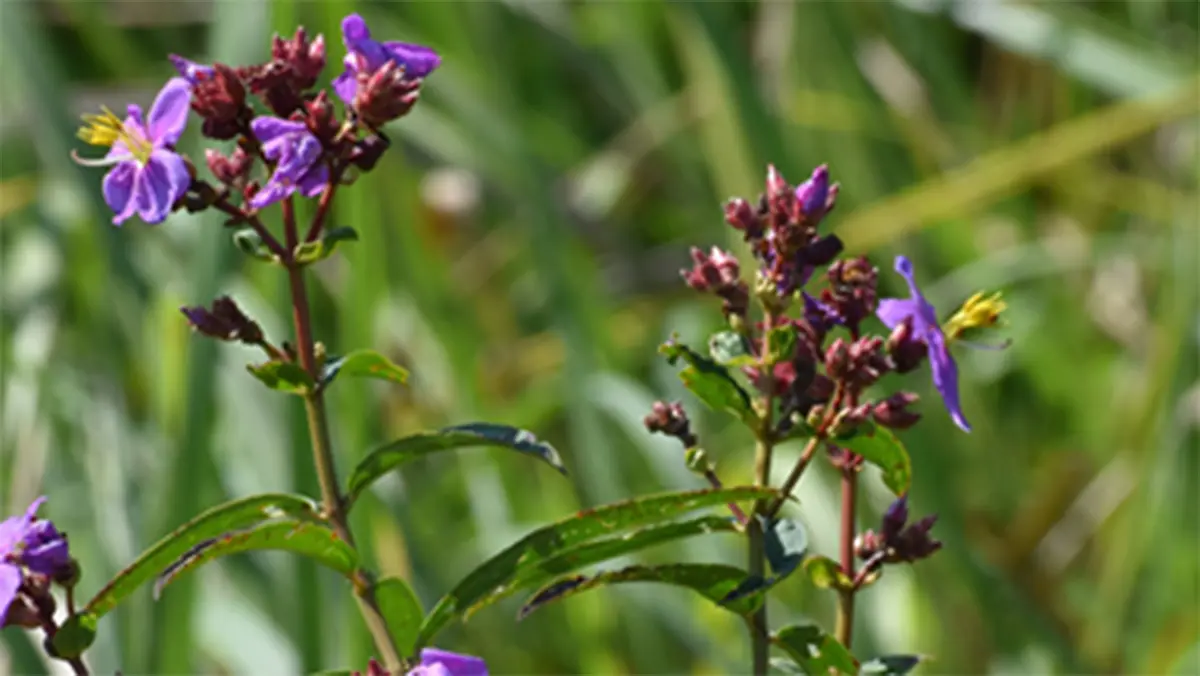
Why in news?
A team from Gauhati University discovered a new shrub species in the grasslands of Assam’s Manas National Park. They named it Osbeckia zubeengargiana to honour the late Assamese singer Zubeen Garg, recognising his cultural and environmental contributions. The finding adds to the botanical diversity of the Eastern Himalaya and brings attention to the need for conservation.
Background
Osbeckia is a genus of flowering shrubs in the Melastomataceae family. The Eastern Himalaya and Western Ghats are its major centres of diversity. Scientists collected specimens of the new plant during field surveys between 2021 and 2025 and confirmed it as a separate species in 2026. The genus includes species such as O. rostrata, but the new species shows several distinctive features.
Key characteristics
- Appearance: A perennial shrub about 3 – 3.5 metres tall with pink, four‑petalled flowers. Leaves are narrow and lance‑shaped with three prominent veins.
- Differences from related species: It has a bell‑shaped (campanulate) floral tube and a ciliated base to the style, whereas related Osbeckia species have tubular or cylindrical flower tubes. Its seeds are larger and its leaves are thicker than those of O. rostrata.
- Habitat: The plant grows in open grasslands near the foothills of the Eastern Himalaya, particularly in Baksa district of Assam. Such habitats are threatened by grazing and human encroachment.
- Why the name: The researchers chose to honour Zubeen Garg for his role in promoting Assamese culture and advocating for environmental protection. Naming new species after cultural icons helps raise public awareness.
Significance
- Biodiversity: The discovery highlights Assam’s rich botanical wealth and the need to document species before habitat loss. Each new species increases our understanding of plant evolution and ecology.
- Conservation message: Naming the plant after a popular figure encourages local communities to take pride in their natural heritage and support conservation efforts.
Source: India Today

