

Why in news?
An exhibition titled “Sut te Saah” opened in Delhi displaying over forty rare phulkari and bagh textiles from pre‑Partition Punjab. The show, which showcased pieces like Chope, Vari‑da‑Bagh, Darshan Dwar and Thirma, renewed public interest in this folk embroidery and highlighted the stories of women who created these heirlooms.
Background
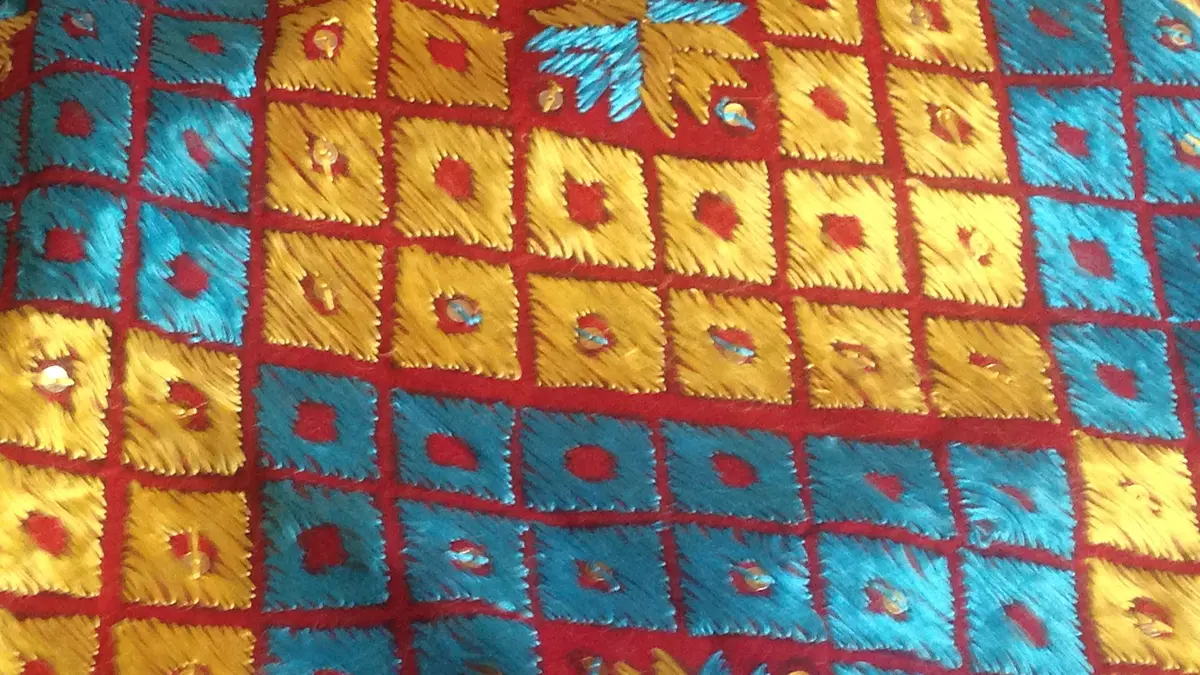
Phulkari, literally meaning “flower work,” is a form of counted‑thread embroidery practised by women in the Punjab region of India and Pakistan. The craft uses brightly coloured silk threads on coarse hand‑woven cotton cloth (khaddar). Traditionally, young women embroidered shawls, veils and garments to mark life events such as weddings and childbirth. The motifs are geometric or inspired by nature and daily life, and many designs were passed down through generations.
Types and motifs
- Bagh: A densely embroidered textile where the background cloth is almost completely covered by silk stitches. These pieces were used for special occasions and often took months to complete.
- Chope: Large dupattas made for brides, typically embroidered on both sides so that no knot or loose thread is visible.
- Darshan Dwar: Phulkaris depicting temple gateways and religious symbols, traditionally presented to temples as offerings.
- Sainchi and Thirma: Regional styles that narrate village scenes, folklore and pastoral life using stylised human and animal forms.
Cultural significance and revival
- A women’s art: Phulkari was created at home by mothers and daughters, providing them a form of expression and a means to mark social milestones. The craft is mentioned in the 17th‑century Sikh scripture Guru Granth Sahib and the epic Heer Ranjha.
- Impact of Partition: The division of Punjab in 1947 separated families and their heirloom textiles. Many phulkari pieces now serve as reminders of lost homes and identities.
- Modern challenges: Cheap machine‑made replicas have flooded markets, pushing handcrafted phulkaris to the margins. However, exhibitions, self‑help groups and government schemes are reviving interest and providing income to rural artisans.
Conclusion
The Delhi exhibition celebrated phulkari not just as decorative cloth but as a record of women’s lives. Preserving and promoting this embroidery supports cultural heritage and offers sustainable livelihoods to artisans.
Source: TH