

Why in news?
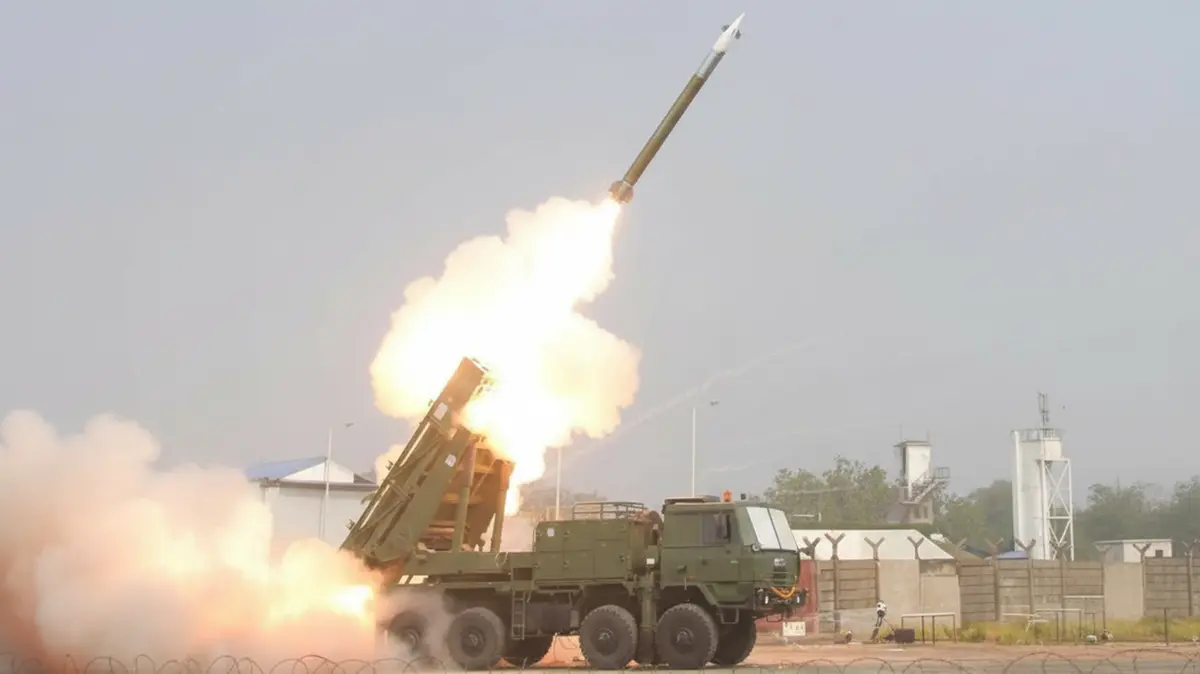
The Defence Research and Development Organisation (DRDO) conducted the maiden flight test of the Pinaka Long Range Guided Rocket (LRGR‑120) on 29 December 2025 at the Integrated Test Range in Chandipur, Odisha. The rocket, launched from an in‑service Pinaka launcher, travelled its maximum 120‑kilometre range and struck its target with precision. Defence Minister Rajnath Singh hailed the test as a game changer for the Indian Army’s artillery capabilities.
Background
The Pinaka multi‑barrel rocket launcher, developed in the 1990s, provides India with rapid‑fire artillery support. Earlier versions – Mark I and Mark II – have ranges of 40 and 75 kilometres. To increase reach and accuracy, DRDO laboratories including the Armament Research and Development Establishment (ARDE) designed the LRGR‑120, keeping the calibre at 214 mm so that existing launchers can fire it. The project received approval from the Defence Acquisition Council in late 2025.
Features of the LRGR‑120
- Extended range: The guided rocket can strike targets up to 120 kilometres away, nearly doubling the reach of the Pinaka Mark II.
- Precision guidance: An inertial navigation system aided by GPS/NavIC provides mid‑course corrections. An on‑board seeker can adjust the trajectory during the terminal phase, enabling a circular error probable of 10–20 metres.
- Backward compatibility: Because the rocket retains the 214 mm calibre, existing Pinaka launchers can fire eight LRGR‑120 rockets without modification. This reduces costs and simplifies logistics.
- Warhead and payload: Each rocket can carry a warhead of up to 250 kilograms. Salvo firing allows 12 rockets to be launched in under a minute, saturating targets such as enemy artillery or infrastructure.
- Development team: The design involved ARDE, the High Energy Materials Research Laboratory (HEMRL), the Defence Research and Development Laboratory (DRDL) and the Research Centre Imarat (RCI).
Conclusion
The Pinaka LRGR‑120 bridges the gap between conventional unguided artillery rockets and expensive tactical missiles. Its successful test demonstrates India’s growing capability to deliver precise, long‑range fire support using indigenous technology.
Source: Press Information Bureau