

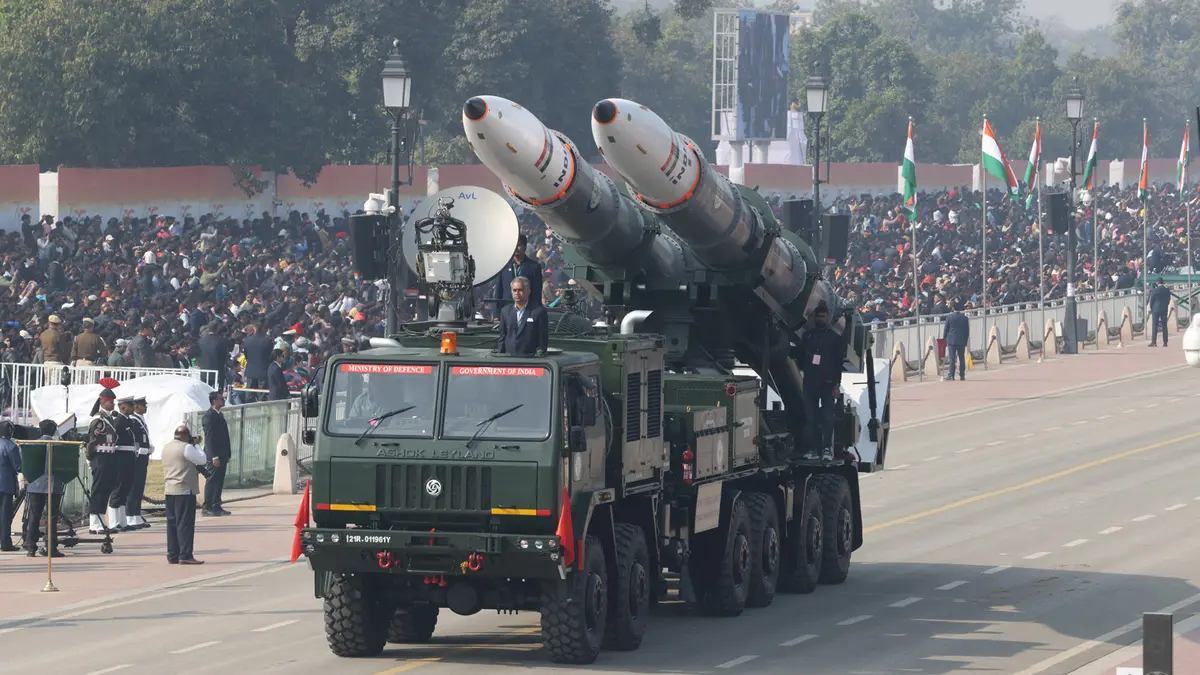
Why in news?
In December 2025 India successfully tested two Pralay short‑range ballistic missiles from a mobile launcher off the Odisha coast. The trials validated the weapon’s accuracy and reliability and preceded plans to induct the missile into the Indian Army’s Rocket Artillery formations.
Background
Pralay (“deluge”) is a surface‑to‑surface missile developed by the Defence Research and Development Organisation (DRDO) as part of a tactical deterrent. Derived from the Prithvi series but with significant upgrades, it is intended to provide the army with a conventionally armed ballistic missile capable of striking high‑value targets deep inside enemy territory. Key features include:
- Range: 150 – 500 km depending on payload. With a 500 kg warhead, the missile can travel up to 500 km; heavier loads reduce the range.
- Payload: Carries 500 – 1,000 kg of high explosive or sub‑munitions and reportedly supports multiple warhead configurations.
- Propulsion: Two‑stage solid‑fuel rocket motor with a composite casing for high thrust and reliability.
- Guidance: Advanced inertial navigation integrated with a micro‑navigation system and redundancy via a satellite guidance unit. Terminal manoeuvring enables a quasi‑ballistic trajectory, making interception difficult.
- Mobility: Mounted on an 8×8 high‑mobility vehicle, allowing launch from dispersed locations and quick redeployment.
Strategic significance
- Gap filler: Pralay bridges the capability gap between multi‑barrel rocket systems like Pinaka and longer‑range cruise missiles such as BrahMos. It gives the army a precision strike option against command centres, radar sites, airfields and supply depots.
- Conventional deterrence: Unlike India’s nuclear‑armed ballistic missiles, Pralay is designed for conventional warfare, thereby lowering the threshold for its use in a regional conflict.
- Indigenous development: Its successful tests showcase DRDO’s ability to develop advanced missile technologies and support the government’s Make‑in‑India initiative.
Source: The Hindu